A steady rain in the morning. Showers continuing in the afternoon. High 59F. Winds SW at 10 to 20 mph. Chance of rain 90%. Rainfall around a quarter of an inch..
Tonight
Showers in the evening with some clearing overnight. Low 49F. Winds W at 5 to 10 mph. Chance of rain 40%.
As a former linguist, I really enjoy listening to folks who come into our shop, especially large families, and trying to figure out what language some of them are speaking when the language is something other than English.
With some really popular restaurants on our block in San Carlos for brunch and lunch I get lots of practice. Among my favorite hints is how someone says “Grandma.” I recognize Halmoni (Korean), Daadi (Hindi), Abuela (Spanish), Bubbe (Yiddish), Nai Nai (Chinese), Nonna (Italian), and Babushka (Russian) just to name a few. An excited grandchild who has discovered something in our shop will often shout out to his or her grandmother to come over and see. My heart swells when I see that grandmother stop whatever she was doing and head straight over, remembering times when I was the focus of my grandparent’s undivided attention. Magic.
My grandmother Estelle was an incredible woman, with a zest for life, the biggest laugh, kindness for miles, and a door always open and a fridge always full. In the later years of her life her primary focus was caring for my grandfather Joseph, who suffered from a form of dementia that left him mostly unable to speak. They lived upstairs from my aunt and uncle, in a tiny attic apartment. That home was a gathering place for other aunts, uncles and cousins, raucous afternoons and evenings of storytelling, some from the “old countries” of Russia and Poland, laughter, and, yes, the occasional very loud arguments. Grandma’s attic apartment was a refuge for me during times when being in my own home a few blocks away was dangerous.
My grandmother Rose was a meticulous and strong woman, mostly blind, who devoted a lot of time to Hadassah, a Jewish women’s volunteer organization supporting Israel. Grandpa Sam worked as a messenger in Manhattan and was an oil painter by hobby. They were originally from Romania and for much of my childhood they lived in the Bronx. On Sundays my father Herbie would drive from Rockaway where we lived, pick them up, drive them to our house, take us all to dinner at the Sherwood Diner, and then drive my grandparents back to the Bronx. I often drove with him both ways. Grandma Rose loved when I sang and would often encourage me to sing her favorite numbers, “Tie A Yellow Ribbon,” or something from Fiddler on the Roof or Hello Dolly. It was never hard to convince me to sing for her.
I was truly blessed to have both sets of grandparents very present in my life during my childhood. They all had a huge influence on how I view the world. I lost Grandma Estelle to leukemia when I was a teenager and for years did volunteer work for the United Leukemia Fund in her memory. Grandpa Joseph was gone shortly after that. Grandpa Sam soon after that and we lost Grandma Rose when I was in my 20s. I miss them.
Recommended for you
They all come to mind right now because my sister, Arlene, just became a grandmother, and I just became a great uncle. Parker Joseph continues the story for Estelle, Joseph, Sam and Rose and so many others. While I won’t have the privilege of living close by I hope to be able to be as memorable to him as all of my uncles and aunts were to me.
What I’m most excited about is my wonderful sister getting a new title, whether it is Bubbe, Grandma, Grannie or to whatever little Parker gravitates. I was kvelling (Yiddish for feeling happy and proud) when I watched a video of Arlene rocking Parker in her arms and cooing to him as his eyes locked on her. So sweet. My brother-in-law Mark will also make a terrific grandfather. I can picture him teaching Parker about his beautiful woodwork or taking him fishing.
The day you’re reading this I’m turning 65, yay Medicare! We’re less than 100 days away from an election that will, whoever wins, have a huge impact on Parker. His parents, grandparents, great grandparents and beyond helped build today’s world, the good and the bad. When I think of the Eastern Europe my grandparents left behind, with rabid antisemitism, pogroms and poverty, I’m grateful that Parker got to be born in the United States.
As you plan on voting, I hope you consider how your vote will impact the children being born today and how future generations will view our choices at this very critical time in America’s story. I’ll have Parker Joseph in mind along with all the souls who came before him. They’re counting on us.
My mother Muriel being quite the planner, I was my sister’s birthday present when she turned 3. Happy Birthday Bubbe!
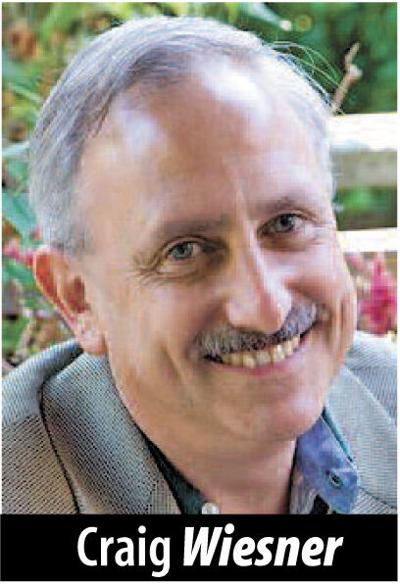
Craig Wiesner is the co-owner of Reach And Teach, a book, toy and cultural gift shop on San Carlos Avenue in San Carlos.
Thank you, Craig, for a heartwarming column that brought back so many wonderful memories.
Both my grandfathers passed away before I was born, leaving my grandmothers alone, caring for 5-6 children each, with my own Dad put to work to help support the family when he was 13! My grandma’s meant the world to me. My Mother’s Mom was a real “Jøssing”, as they called Nazi-hating Norwegians. She had to walk over a bridge to get from her modest apartment in downtown Trondheim to our apartment further south. The sidewalk was so narrow that one had to step into the streetcar tracks in order to pass someone. If a German soldier approached her in the opposite direction, she would stop and mumble: “Jeg rikker meg ikke!”, which means “I’m not moving!”, so the foreign invader had to step into the street to pass the old lady with a cane. If a solder sat down next to her in a streetcar, she would immediately get up and move, and if there was no other seat available, stand and demonstrate her disdain for the foreign guy in uniform. Not until after the war ended, did the family learn that her son, my uncle, a merchant marine officer, had been killed when his ship was torpedoed by a German U-boat while anchored at Brooklynn harbor.
As a kind of reparation, she was granted free travel on the shipping company’s boats for life, bringing a companion with her. So, at the age of 10, 2 years after the war ended, she took me with her on a freighter all the way up north to the Russian border. She trusted me so much that at every stop, I was allowed to run ashore and explore the area, - quite an experience for a 10-year-old, just 2 years after the war ended.
Keep the discussion civilized. Absolutely NO
personal attacks or insults directed toward writers, nor others who
make comments. Keep it clean. Please avoid obscene, vulgar, lewd,
racist or sexually-oriented language. Don't threaten. Threats of harming another
person will not be tolerated. Be truthful. Don't knowingly lie about anyone
or anything. Be proactive. Use the 'Report' link on
each comment to let us know of abusive posts. PLEASE TURN OFF YOUR CAPS LOCK. Anyone violating these rules will be issued a
warning. After the warning, comment privileges can be
revoked.
Please purchase a Premium Subscription to continue reading.
To continue, please log in, or sign up for a new account.
We offer one free story view per month. If you register for an account, you will get two additional story views. After those three total views, we ask that you support us with a subscription.
A subscription to our digital content is so much more than just access to our valuable content. It means you’re helping to support a local community institution that has, from its very start, supported the betterment of our society. Thank you very much!





(1) comment
Thank you, Craig, for a heartwarming column that brought back so many wonderful memories.
Both my grandfathers passed away before I was born, leaving my grandmothers alone, caring for 5-6 children each, with my own Dad put to work to help support the family when he was 13! My grandma’s meant the world to me. My Mother’s Mom was a real “Jøssing”, as they called Nazi-hating Norwegians. She had to walk over a bridge to get from her modest apartment in downtown Trondheim to our apartment further south. The sidewalk was so narrow that one had to step into the streetcar tracks in order to pass someone. If a German soldier approached her in the opposite direction, she would stop and mumble: “Jeg rikker meg ikke!”, which means “I’m not moving!”, so the foreign invader had to step into the street to pass the old lady with a cane. If a solder sat down next to her in a streetcar, she would immediately get up and move, and if there was no other seat available, stand and demonstrate her disdain for the foreign guy in uniform. Not until after the war ended, did the family learn that her son, my uncle, a merchant marine officer, had been killed when his ship was torpedoed by a German U-boat while anchored at Brooklynn harbor.
As a kind of reparation, she was granted free travel on the shipping company’s boats for life, bringing a companion with her. So, at the age of 10, 2 years after the war ended, she took me with her on a freighter all the way up north to the Russian border. She trusted me so much that at every stop, I was allowed to run ashore and explore the area, - quite an experience for a 10-year-old, just 2 years after the war ended.
Welcome to the discussion.
Log In
Keep the discussion civilized. Absolutely NO personal attacks or insults directed toward writers, nor others who make comments.
Keep it clean. Please avoid obscene, vulgar, lewd, racist or sexually-oriented language.
Don't threaten. Threats of harming another person will not be tolerated.
Be truthful. Don't knowingly lie about anyone or anything.
Be proactive. Use the 'Report' link on each comment to let us know of abusive posts.
PLEASE TURN OFF YOUR CAPS LOCK.
Anyone violating these rules will be issued a warning. After the warning, comment privileges can be revoked.