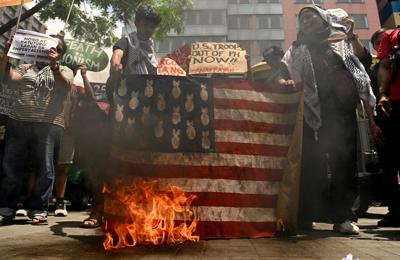
Filipino activists burn a mock American flag while participating in a protest in front of the U.S. Embassy during Defense Secretary Pete Hegseth's visit to Manila, Philippines.
Defense Secretary Pete Hegseth and Philippine Army Chief of Staff Romeo Brawner Jr. shake hands at Camp Aguinaldo, in Quezon City, Metro Manila, Philippines.
MANILA, Philippines (AP) — U.S. Defense Secretary Pete Hegseth said Friday that the Trump administration would work with allies to ramp up deterrence against threats across the world, including China's aggression in the South China Sea.
Hegseth, who was visiting the Philippines, blamed the previous Biden administration for insufficient actions that emboldened aggressors like China over the years. He said the U.S. military was being rebuilt under President Donald Trump and was reestablishing its "warrior ethos" in the region, but did not elaborate.
"What we're dealing with right now is many years of deferred maintenance, of weakness, that we need to reestablish strength and deterrence in multiple places around the globe," Hegseth told a news conference with his Philippine counterpart, Gilberto Teodoro, after meeting President Ferdinand Marcos Jr. in Manila.
U.S. Defense Secretary Pete Hegseth visited the Manila American Cemetery and took part in a wreath laying ceremony on Friday. Hegseth’s decision to make the Philippines his first stop in Asia, followed by Japan — both U.S. treaty allies facing territorial disputes with China — was the strongest assurance yet by the U.S. under President Donald Trump to maintain a security presence in the region.
"There's a long line of countries in the past who have attempted to test U.S. resolve," Hegseth added. "We are resolved at this time … to work with our partners."
Earlier, he told Marcos that deterrence was particularly needed in the Indo-Pacific region "considering the threats from the communist Chinese."
"Friends need to stand shoulder to shoulder to deter conflict, to ensure that there is free navigation whether you call it the South China Sea or the West Philippine Sea," he told Marcos.
The U.S. was not gearing up for war, Hegseth said — while underscoring that peace would be won "through strength."
The Philippines was the first stop in Hegseth's first trip to Asia. He is due to travel next to Japan, another staunch U.S. ally.
Ahead of his visit to the region, China called the United States a "predator" and an unreliable ally.
Hegseth said the Trump administration would commit more security assistance to the Philippines in addition to a $500 million fund to help the Philippine military modernize. The U.S. funding was first announced by the previous Biden administration.
Filipino activists burn a mock American flag while participating in a protest in front of the U.S. Embassy during Defense Secretary Pete Hegseth's visit to Manila, Philippines.
Reuters
US-Philippine joint war games
The U.S. would also deploy an anti-ship missile system called the Navy Marine Expeditionary Ship Interdiction System as well as unmanned sea vessels for largescale military exercises involving thousands of American and Filipino forces next month in the Philippines, Hegseth said.
That would enable the allied forces to train together to defend Philippine sovereignty, he said.
Additionally, the allied forces agreed to stage special operations forces training in Batanes province, a cluster of islands in the northernmost tip of the Philippine archipelago across a sea border from Taiwan, he said.
Recommended for you
Taiwan is the self-ruled island that China regards as a province and has threatened to annex, by force if necessary.
China claims virtually the entire South China Sea, a major security and global trade route. The Philippines, Vietnam, Malaysia, Brunei and Taiwan also have overlapping claims to the resource-rich and busy waters, but confrontations have spiked between Chinese and Philippine coast guard and naval forces in the last two years.
Hegseth said that U.S. Indo-Pacific Command chief Adm. Samuel Paparo, who heads the largest number of American combat forces outside the U.S. mainland, has "real war plans" and was ready to work with allied forces to create "strategic dilemmas for the communist Chinese that (will) help them reconsider whether or not violence or action is something they want to undertake."
Aside from the U.S., Teodoro said the Philippines has been building security alliances with other friendly countries for added deterrence.
"God forbid. We must be prepared … to deter any possibility in the future for our mutual defense and the defense of freedom and international law," Teodoro said.
Trump's "America First" foreign policy thrust has triggered concerns in Asia about the scale and depth of U.S. commitment to the region.
Under the previous Biden administration, the U.S. has repeatedly warned that it is obligated to help defend the Philippines if Filipino forces, ships and aircraft come under an armed attack, including in the South China Sea. Hegseth renewed that Biden commitment in his talks with Marcos and Teodoro.
China warns of 'opening the door to a predator'
Ahead of Hegseth's visit, Chinese Defense Ministry spokesperson Wu Qian said China opposes "interference from outside countries" in the South China Sea.
"U.S.-Philippines military cooperation must not harm the security interests of other countries or undermine regional peace and stability," he said Thursday in a news conference.
He added without elaborating that the United States has "an astonishing record of breaking its promises and abandoning its allies" throughout its history.
Chinese Foreign Ministry spokesperson Guo Jiakun separately warned the Philippines earlier this week "that nothing good could come out of opening the door to a predator. Those who willingly serve as chess pieces will be deserted in the end."
Hegseth, who has come under strong criticism for texting attack plans t o a Signal group that included top-level U.S. security officials and the editor-in-chief of The Atlantic magazine, projected composure and camaraderie while in Manila.
Clad in a sweatshirt and shorts, he joined American and Filipino forces in physical training, including push-ups, in a gym after arriving Thursday in Manila.
The U.S. defense chief shook hands and posed smiling with military personnel while they flashed the thumbs-up in pictures posted by the U.S. Embassy on X.
Keep the discussion civilized. Absolutely NO
personal attacks or insults directed toward writers, nor others who
make comments. Keep it clean. Please avoid obscene, vulgar, lewd,
racist or sexually-oriented language. Don't threaten. Threats of harming another
person will not be tolerated. Be truthful. Don't knowingly lie about anyone
or anything. Be proactive. Use the 'Report' link on
each comment to let us know of abusive posts. PLEASE TURN OFF YOUR CAPS LOCK. Anyone violating these rules will be issued a
warning. After the warning, comment privileges can be
revoked.
Please purchase a Premium Subscription to continue reading.
To continue, please log in, or sign up for a new account.
We offer one free story view per month. If you register for an account, you will get two additional story views. After those three total views, we ask that you support us with a subscription.
A subscription to our digital content is so much more than just access to our valuable content. It means you’re helping to support a local community institution that has, from its very start, supported the betterment of our society. Thank you very much!



(0) comments
Welcome to the discussion.
Log In
Keep the discussion civilized. Absolutely NO personal attacks or insults directed toward writers, nor others who make comments.
Keep it clean. Please avoid obscene, vulgar, lewd, racist or sexually-oriented language.
Don't threaten. Threats of harming another person will not be tolerated.
Be truthful. Don't knowingly lie about anyone or anything.
Be proactive. Use the 'Report' link on each comment to let us know of abusive posts.
PLEASE TURN OFF YOUR CAPS LOCK.
Anyone violating these rules will be issued a warning. After the warning, comment privileges can be revoked.