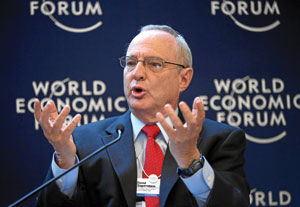
A longtime social justice leader, lawyer, professor and described by the Washington Post as “the quintessential religious lobbyist on Capitol Hill,” Rabbi David Saperstein will be spending two weeks in San Mateo lecturing about various social justice issues.
Saperstein’s free 13 lectures are part of the North Peninsula Jewish Community Center’s scholar-in-residence program, which was inaugurated in 2011. Saperstein, 66, has headed the Religious Action Center of Reform Judaism for 40 years and also represents the national Reform Jewish Movement to Congress and the president’s administration.
“I’ve stayed because I believe deeply we are called by God to be partners in shaping the world with social justice for all of God’s children,” said Saperstein, who was selected by Newsweek magazine in 2009 as the most influential rabbi in the country. “It has been a great blessing in my life.”
Saperstein is part of a large rabbinic family. Two great uncles were Reform rabbis, and two great-grandfathers were Orthodox rabbis. His father Harold and uncle Sanford were well-known Reform rabbis and his brother Marc is a leading Jewish scholar.
His upcoming lecture topics include “Being the Hands of God: Jewish Justice at a Time of Crisis and Opportunity,” “Israel in Crisis: Is There Still Hope for Peace?” and “The Environment, Global Warming and American Jews.” He says, for now, he is focusing on gun control, economic justice, the Middle East peace process, employment discrimination and comprehensive immigration reform. In total, it deals with 60-65 issues.
Saperstein, who lives in Washington, D.C., and teaches law at Georgetown University Law School, is originally from New York. He first started at his role at the center after writing about the future of Reform Judaism when the denomination celebrated its 100th anniversary and helped mobilize rabbis to protest the bombing of Cambodia in the early 1970s. Now, he has two sons, aged 20 and 23, and is married to award-winning journalist Ellen Weiss.
“Like many of us, it was circumstantial,” he said. “Three heads had left the office within four years and they wanted someone younger who would be around for a while.”
His job consists of three parts, the first is working on advocacy for various issues, preparing materials for synagogues around the country to study social justice issues and bringing 3,000 people in for policy and skills training programs. He also travels a lot, spending about three months a year outside of Washington, D.C., He attends conferences, does keynote addresses and travels to Israel regularly.
There are boundless opportunities for young people to get involved in social justice issues, he said.
Recommended for you
“I’m very proud of the fact Jews are disproportionately involved in calls for social justice,” he said. “They’re leaders, donors, on boards, are elected officials, on the Supreme Court and use their legitimate democratic rights efficiently and effectively.”
Saperstein says that people can really make a difference today and that they need to since the world is at a crossroads with issues like global warming and international economic injustice.
“Decisions now affect the entire lives of young people and we’re trying to get them involved now,” he said. “Will they be the audience watching or the authors? We encourage them to be the authors and be shapers of a more hopeful future.”
The rabbi would like to see more denominations work together more closely on local, state and national issues.
“When we work together, we can really make an impact on issues,” he said.
Saperstein has also served as co-chair for the Coalition to Preserve Religious Liberty and is on the boards of the NAACP and People for the American Way. In 2009, he served on President Barack Obama’s Council for Faith-Based and Neighborhood Partnerships, a volunteer advisory council made up of 25 religious and secular leaders and scholars.
The rabbi says he probably does close to 100 speeches and lectures a year. This most recent lecture series features 35-minute speeches, followed by 45-minute discussions and run through Feb. 11. The Reform Judaism movement is a liberal branch of Judaism and focuses on ideas such as autonomy, modernity, universalism and the historical-philosophical critique of religion.
Keep the discussion civilized. Absolutely NO
personal attacks or insults directed toward writers, nor others who
make comments. Keep it clean. Please avoid obscene, vulgar, lewd,
racist or sexually-oriented language. Don't threaten. Threats of harming another
person will not be tolerated. Be truthful. Don't knowingly lie about anyone
or anything. Be proactive. Use the 'Report' link on
each comment to let us know of abusive posts. PLEASE TURN OFF YOUR CAPS LOCK. Anyone violating these rules will be issued a
warning. After the warning, comment privileges can be
revoked.
Please purchase a Premium Subscription to continue reading.
To continue, please log in, or sign up for a new account.
We offer one free story view per month. If you register for an account, you will get two additional story views. After those three total views, we ask that you support us with a subscription.
A subscription to our digital content is so much more than just access to our valuable content. It means you’re helping to support a local community institution that has, from its very start, supported the betterment of our society. Thank you very much!



(0) comments
Welcome to the discussion.
Log In
Keep the discussion civilized. Absolutely NO personal attacks or insults directed toward writers, nor others who make comments.
Keep it clean. Please avoid obscene, vulgar, lewd, racist or sexually-oriented language.
Don't threaten. Threats of harming another person will not be tolerated.
Be truthful. Don't knowingly lie about anyone or anything.
Be proactive. Use the 'Report' link on each comment to let us know of abusive posts.
PLEASE TURN OFF YOUR CAPS LOCK.
Anyone violating these rules will be issued a warning. After the warning, comment privileges can be revoked.