
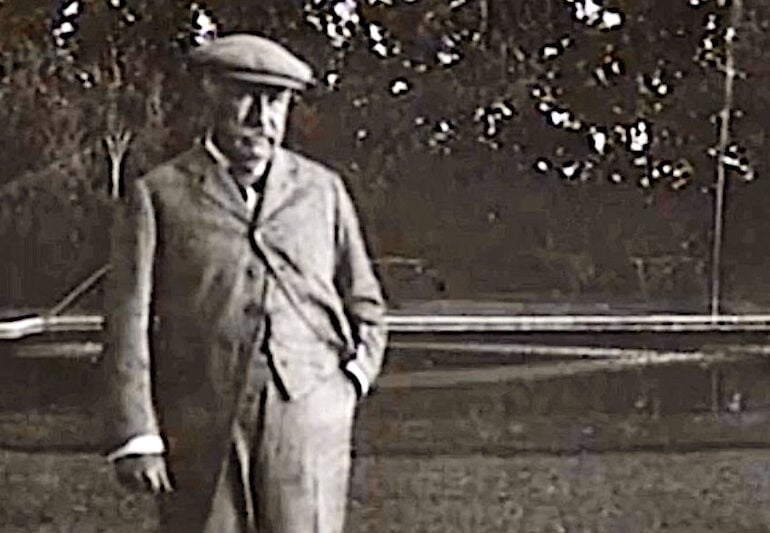
Henry Pike Bowie’s local story on the San Francisco Peninsula began with his marriage to Agnes Poett Howard on June 23, 1879.
Henry was 31 at the time and Agnes was 46. The age difference no doubt raised some eyebrows, but by this time in her life Agnes was probably hardened to gossip. She had already been the talk of the town in 1857, when as a 24-year-old widow she married her first husband’s brother. Now, some two decades later she was set to be married a third time, this time to a San Francisco attorney 15 years her junior. Who was this third husband Henry? How did Agnes meet him? What was the nature of their relationship?
The families of Agnes and Henry were friendly and moved in the same social circles. Both were part of a small, elite group of San Franciscans who arrived here early in 1849 before the Gold Rush took hold (In 1848, San Francisco’s population was estimated to be about 1,000 people; by the end of 1849, it was estimated to be 25,000). Both Henry and Agnes’ fathers were physicians. Some may have suspected that Henry was a “gold digger” when he married the widow of two of the wealthiest and most influential Gold Rush San Franciscans, William Davis Merry Howard and his brother George H. Howard. However, the Bowies had money of their own.
By all accounts, the marriage appears to have been a happy one. Agnes and Henry left almost immediately after their 1879 wedding for a lengthy European honeymoon with her children from husband No. 2 in tow. They left the Howards’ San Mateo estate, El Cerrito, in the hands of Agnes’ oldest son William H. Howard and John McLaren, the landscape gardener she had hired and brought to San Mateo from Scotland some 5+ years before. When the couple returned from Europe, they began work on a new home, Severn Lodge. This home would also have beautiful gardens — formal French gardens at first, and later Japanese gardens as well.
Although several San Franciscans had begun to build summer cottages on the mid-Peninsula in the 1880s, most maintained primary residences in San Francisco. The Bowies were an exception, spending a good deal of their time in San Mateo County. They seemed to prefer the quiet, country life to the social whirl of San Francisco. They spent their time designing their new home and gardens, reading, and playing music together — Henry on the violin and Agnes on the piano.
On Feb. 1, 1893, Agnes died at the age of 60. As a 45-year-old man who ran in all the socially prominent circles, Henry had any number of activities that could have kept him very busy after Agnes died. Instead, he decided to set sail and leave for Japan. He went alone.
Why Japan? Why not Europe or the Eastern Seaboard of the United States? We simply do not know. In his unpublished memoirs, he wrote that “Japan had long been to me a land of wonder.” Henry’s father, a former naval surgeon, had traveled to Japan in 1845 with the U.S. Navy and may have told young Henry tales that aroused his interest in the country. Or, he may have become caught up in the trend toward Japanese art and gardens that were becoming very au courant at the end of the 19th century. What we do know, is that once his ship sailed into Yokohama harbor, it was love at first sight. Henry described his thoughts at seeing Japan for the first time this way:
My first view of Japan was a revelation of loveliness. Fuji San seen from the ocean suspended in space, the horizon all mist, the heavens an azure canopy … the happiness of gazing on that mountain in the sky lingers in the memory as an approach to pure joy.
After a relatively short trip in 1893, Henry went back to Japan in 1894 and followed that trip with numerous other visits. While in Japan he threw himself into learning the language and learning the technique of Japanese painting. Henry’s efforts were not that of a dilettante. He pursued both language and painting with a scholarly, methodical approach, working with experts in both areas.
Recommended for you
In the next two decades, until his death in 1920, whenever he returned to the United States he took the opportunity to advance the cause of mutual understanding and respect between Japan and the United States — founding the Japan Society in 1905; helping to create Japanese gardens at private homes on the Peninsula; hosting Japanese artists; giving lectures on Japanese painting; and in 1909 hosting a large contingent of Japanese businessmen. His efforts to promote understanding and respect came at a particularly ugly time for relations between Japan and the United States. Due in part to Hawaii becoming a U.S. territory in 1898, the Japanese population in the United States increased from 2,000 in 1890, to 24,000 by 1900, to 72,000 by 1910. San Francisco laborers and farmers were particularly threatened by Japanese immigration. Laws were soon passed in San Francisco preventing Japanese from holding jobs and requiring children to go to segregated schools. The tensions rose so high that even the U.S. President Teddy Roosevelt tried to mediate, reaching a “Gentleman’s Agreement” in 1907 with the Japanese government, which promised to voluntarily restrict immigration of Japanese laborers. During this time, Bowie resisted the anti-Japanese hysteria. Instead, he was one of the few willing to sell property to Japanese (In 1903, the Bowie Estate sold property at 112 Fremont St. in San Mateo to Tomisuke Ito, who became the first Japanese man to buy land in San Mateo County). Despite the attempts to defuse the tensions, the anti-Japanese fervor continued, ultimately resulting in the Alien Land Act of 1913 which prevented Japanese from buying agricultural land in California. The Japanese were so infuriated they almost pulled out of the Panama-Pacific International Exhibition planned for 1915.
Unbeknownst to many, Bowie had a more personal reason to advance the cause of better relations between the two countries. In 1898, on one of his visits to Japan, he married Komako (“Koma”) Hirano, who gave birth to their first son in 1900, making Henry a first-time father at the age of 52. Imao Hirano was followed by a second son, Takeo Hirano, born in 1908 when Henry was 60. For the 22 years of his marriage to Koma, Henry would travel back and forth between the Bay Area and Japan, tending to his business here while also tending, perhaps as best he could, to his family in Japan.
In the summer of 1899 Henry returned to the United States after being diagnosed with typhoid fever. He made observations upon his return to the United States that affirm the opinion that has often been expressed that Henry was a “lawyer by training, but an artist by temperament.” Henry observed, perhaps for the first time, that the contrast between the life he had been following and the strictly business character of all American pursuits was marked. The calm of the East and the rush of the West are far apart. One never hears an artist in Japan discuss financial affairs or the cost of living or allude to money, but in America these are absorbing topics of general conversation.
He reflected that: In California the plum and almond tree blossoms of early spring produce gorgeous effects, but the suggestion of an excursion to witness such display of buds and flowers would provoke in the average citizen, a queer smile . . . In Japan, parties for flower gazing called Hanami Kwai will joyously trudge miles at night to distant places to view there the morning glory opening its blossom at daybreak.
It is clear Henry yearned to return to Japan.
The fascination which Japan exercises over every visitor is irresistible. Travelers to other countries are seldom heard to express themselves with that enthusiasm which those who have once visited the Orient indulge in . . . It is hard to say why this is so; it is hard to say why people who have once been to Japan invariably declare their intention of returning.
Indeed, Henry did return to Japan, making at least four more trips for various lengths of stay. At the age of 72, it looked like he might be making his last move to Japan a permanent one. On a trip to the Bay Area in the fall of 1920, Henry appeared to be saying goodbye to the Bay Area for good. The purpose of his trip was apparently to wrap up some remaining business issues. However, he became ill while staying at the Burlingame Country Club and died a few days before Christmas at San Mateo’s Mills Hospital. His body was buried with Agnes’ in the large mausoleum built for her at St. John’s Cemetery.
Henry’s will, signed in 1918, left over half of his property to Koma and their two sons. The remaining portions went to Henry’s siblings. Agnes’s adult children (Henry’s stepchildren) sued, claiming they were the rightful heirs of the property Henry inherited from their mother some 20 years earlier. They claimed they had no knowledge of his Japanese family. This seems doubtful, since many family members had visited Bowie when he was in Japan. It is more likely that his family and friends knew of his Japanese family but chose to pretend they did not, since California still had miscegenation laws that prevented white people from marrying anyone other than another. In the will contest, San Mateo Superior Court Judge George H. Buck ultimately ruled in favor of Koma and the couple’s sons.
Despite writing extensively on his life in Japan and his scholarly pursuits to learn the language and painting techniques (which he collected into a book and published in 1911 under the title “On the Laws of Japanese Painting”) Henry was elusive about his private life with Koma and his sons. We can find no mention of them in his published writings. Regardless of what Henry said or wrote when he was living, in death he declared his affection for Koma and the boys by providing for them in his will. Upon his deathbed, Henry is rumored to have declared that “although my body will remain in San Mateo, my soul will be forever in Japan.” Based upon his own words and deeds, we have every reason to believe this is true.





(0) comments
Welcome to the discussion.
Log In
Keep the discussion civilized. Absolutely NO personal attacks or insults directed toward writers, nor others who make comments.
Keep it clean. Please avoid obscene, vulgar, lewd, racist or sexually-oriented language.
Don't threaten. Threats of harming another person will not be tolerated.
Be truthful. Don't knowingly lie about anyone or anything.
Be proactive. Use the 'Report' link on each comment to let us know of abusive posts.
PLEASE TURN OFF YOUR CAPS LOCK.
Anyone violating these rules will be issued a warning. After the warning, comment privileges can be revoked.