

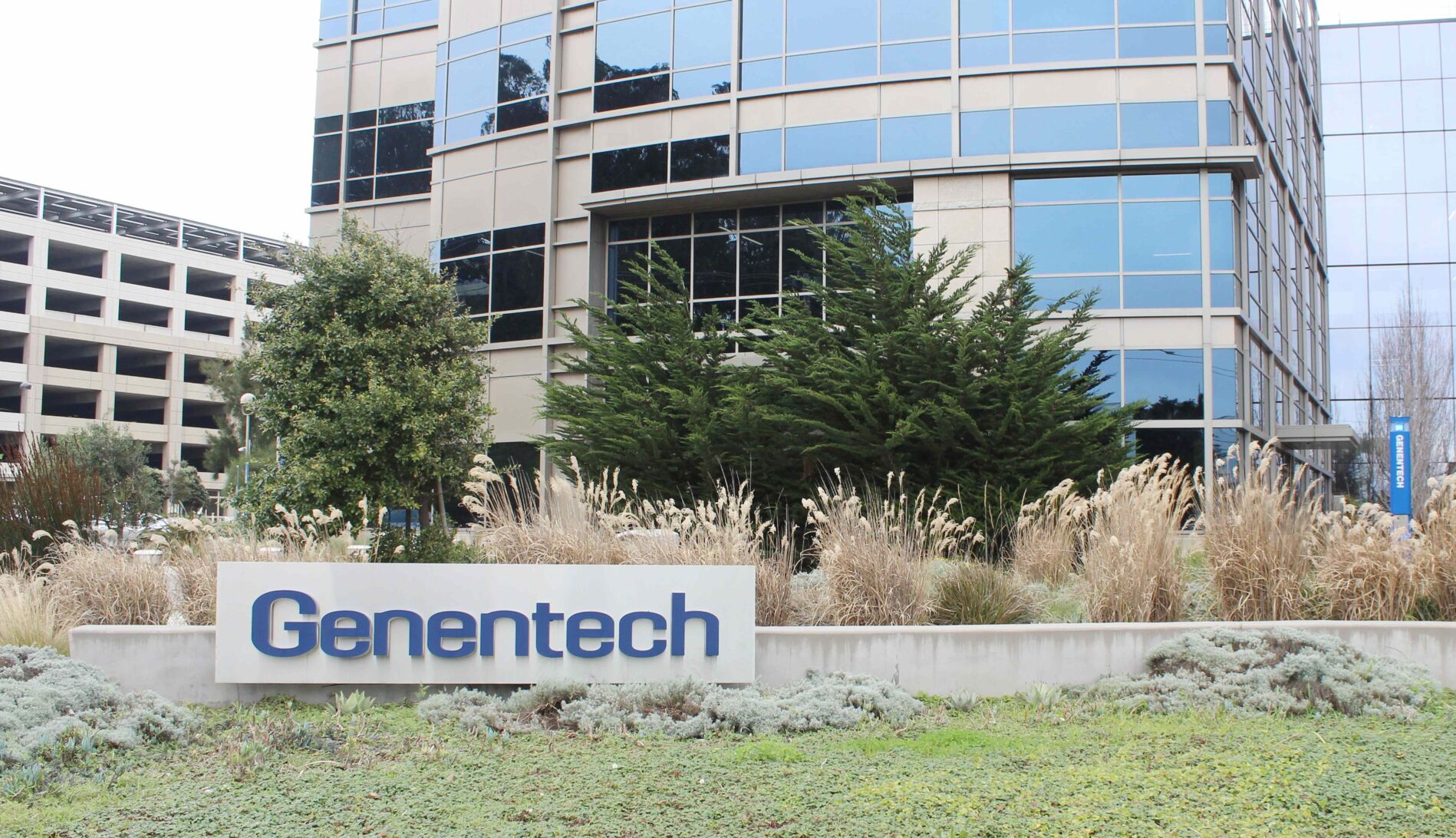
After two years of layoffs and funding pullbacks, South San Francisco’s life science industry is showing stronger signs of a comeback— though more mega-rounds and less early-stage funding could concentrate investment in just a few conditions and diseases.
A recent report from HSBC shows that venture funding within health care — much of which consists of biotechnology — is getting back to healthy, pre-pandemic levels, with 2025 showing $60 billion invested in 2025, up from $44 billion in 2023 and $54 billion in 2024.
The uptick indicates some positive movement for biotech-heavy places like San Mateo County, where the industry has shown mixed indicators. On one hand, in 2025, three out of the top 20 largest biopharmaceutical deals in the world came from San Mateo County-based companies, and while some firms like Genentech and Gilead still announced layoffs last year, it was a fraction of the workforce reductions in 2023. However, life science real estate vacancy rates remain stubbornly high. Just over the past year, two major life science developments requested 10-year extensions to build out their projects given tough financing conditions. In Belmont, several life science projects have either withdrawn, paused or requested similar 10-year extensions to their projects.
Life science deals have become more concentrated in larger “mega-rounds,” said Jonathan Ross, managing director at HSBC Innovation Banking. While biopharma funding increased by $5 billion between 2023 and 2024, the number of deals slightly decreased, the report showed.
South San Francisco-based Xaira took first place in the largest biopharma venture deal last year, raising $800 million, and Belmont-based SOLVE made the top 10 list, raising $321 million.
The high number of mega-rounds reflects a low to moderate appetite risk, given multiple investors could share potential downside. Such financing has also gone toward companies in Phases 2 or 3 — which comes after the initial discovery phase and focuses on building up research— where they already have robust data and higher chances of success.
“Mega-rounds became dominant because drug development costs are high and timelines are long,” he said. “Raising $200 million or $300 million up front gives companies time to hit meaningful clinical milestones without constantly worrying about the next raise.”
It’s also beneficial for certain types of diseases, or indications, that require more robust clinical data and trials, and thus stronger financing.
“In cardiovascular and metabolic [indications], safety is everything,” Ross said. “You need large patient populations, long trials and very clean data. That drives bigger trials and, by extension, much larger financing rounds.”
South City-based Kardigan, for instance, is a cardiovascular-focused biotech firm which raised $300 million, making it one of the top deals in the world last year.
Beyond cardiovascular and metabolic diseases, Ross said autoimmune and oncology remain core areas of investor interest.
“Autoimmune has been very exciting over the last few years,” he said. “We saw a bit of a step down in investment this year, but that’s more about timing than loss of interest. A lot of those companies have already raised large rounds.”
Recommended for you
Though it remains a highly competitive area, oncology has proved particularly strong for mergers and acquisitions, Ross said.
Many of the companies and divisions focused on such conditions and diseases have benefited from these mega-rounds, but the concentration of capital has other consequences. Despite being able to fund extensive trials for certain types of diseases, it also means fewer early-stage companies receive funding, which means less initial discovery and development across a wider range of conditions.
“The downside is that fewer companies get funded overall, particularly at the early stage,” Ross said.
Biocom California Executive Director Michelle Nemits said the last two years have been especially difficult for smaller firms.
“There’s still capital in the system,” Nemits said. “But instead of giving $10 million to 10 companies, investors are giving $100 million to one company that’s further along and more de-risked.”
The shift has been compounded by uncertainty around National Institutes of Health funding and Small Business Innovation Research grants, key sources of capital for early innovation. Nemits said groups like Biocom are advocating for sufficient federal funding to ensure the United States doesn’t lose its increasingly narrow edge to China, which has become a major global player and competitor.
“These grants fund the basic research that eventually becomes venture-backable,” Nemits said. “When that pipeline slows, it affects the entire ecosystem. It’s the lifeblood of the early innovative research, and it’s essential to U.S. competitiveness.”
And while record-high artificial intelligence investment continues throughout the San Francisco Bay Area, the technology's tangible impacts are still in the early stages within the life science industry. Unlike the tech sector, life science companies can’t avoid the costly clinical trials, regulatory approvals and years of research, Ross said.
Applying AI to processes like drug discovery is nearly ubiquitous at this point, though it will still take time to see favorable returns on investment, especially given the current preference for funding companies that have already undergone the development phase.
“Traditional biopharma investors don’t want to underwrite an algorithm alone,” Ross said. “They want to see the first drug.”
In addition to renewed investment compared to the recent past, Ross added that there is more confidence around initial public offerings and M&A activity, reflecting general optimism for the industry.
“We’re not going back to 2021,” Ross said. “But this is a more sustainable environment — and that’s probably a good thing for the industry long term.”


(0) comments
Welcome to the discussion.
Log In
Keep the discussion civilized. Absolutely NO personal attacks or insults directed toward writers, nor others who make comments.
Keep it clean. Please avoid obscene, vulgar, lewd, racist or sexually-oriented language.
Don't threaten. Threats of harming another person will not be tolerated.
Be truthful. Don't knowingly lie about anyone or anything.
Be proactive. Use the 'Report' link on each comment to let us know of abusive posts.
PLEASE TURN OFF YOUR CAPS LOCK.
Anyone violating these rules will be issued a warning. After the warning, comment privileges can be revoked.