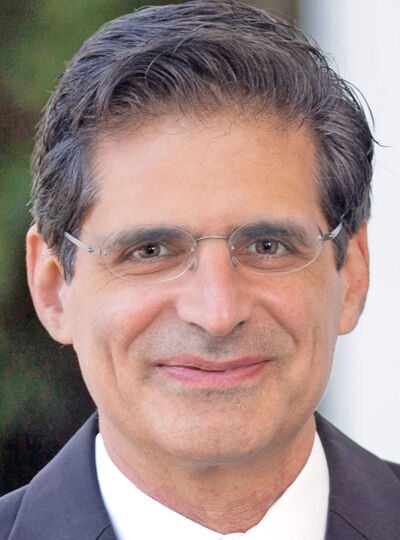
State Sen. Josh Becker, D-Menlo Park, believes California has an opportunity to lead the way in regulating the impact of artificial intelligence and use of personal information.
Josh Becker
On a federal level, passing meaningful AI legislation has proved challenging, leaving states to fill in the gaps with a patchwork approach. That’s further complicated by a December 2025 executive order from the Trump administration attempting to limit state regulation of the technology.
But as a large state known for being a hub of technological prowess, California has an opportunity to set standards other states could follow, Becker said.
“We have to lead. We’ve got the heft with our economy, we've got many of the companies here,” he said. “There’s good evidence that when California leads, other states follow.”
He cited two pieces of legislation that he’s authored — the DELETE Act, which allows consumers to request the deletion of their data from over 500 third-party data brokers at once, and an AI transparency act, which requires disclosure of AI-generated material, as two examples. Other states have begun to work on their own versions of these bills, he said.
“We’ve stepped forward with legislation that is strong and effective and well thought through,” Becker said. “It’s something that is not unrealistic, it’s something companies can and should do, then other states will follow.”
One arena where California could be taking more strident steps toward protecting internet users against the potential harms of artificial intelligence is the prevalence of fake, digitally generated replicas of individuals — known as deepfakes. That’s exemplified by recent legislation, Senate Bill 1142, that Becker has introduced.
If passed, Senate Bill 1142 would require large online platforms with California users to offer clear mechanisms for individuals to report unauthorized deepfakes of themselves and processes for the platforms to take them down, Becker said.
The legislation would also up the penalties for individuals creating unauthorized deepfakes, fining them $5,000 per incident if victims win a defamation lawsuit. That’s particularly notable because deepfake creators are often prolific, creating multiple videos, Becker said.
Recommended for you
Although the legislation — which would not regulate free-speech protected works like satire — is designed to protect California users, it can target companies outside of the state if enough Californians are using the technology.
Some internet platforms already have relatively robust processes in place for deepfake reporting and removal, Becker said. If it passes, the legislation would standardize that.
“We're codifying that into law, what some people are already doing, and then we're going to force others to do it,” he said.
The effort is particularly important given the fact that companies remain unconvinced a federal regulatory framework is soon to materialize, Becker said. Given that the current state-by-state patchwork approach can be unwieldy for internet platforms and leave enforcement gaps, setting up a strong example in one of the largest, most technologically-forward states can help mitigate those challenges.
“They know that generally, with this Congress, it's hard to get them to do anything in this space. So some have said publicly, ‘hey, regulate us,’ in D.C., but I think they know it's really not going to happen,” Becker said. “I think that's why we're sort of stepping in in California.”
Beyond the absence of a federal regulatory framework, active pushback from the Trump administration on California’s regulations remains an abject concern, he acknowledged.
“I do expect a fight from the Trump administration, from D.C., and we need to be ready for that,” Becker said.
Given the lessons learned from the last major technological jump — the advent of the internet — now is the time for lawmakers to attempt to keep pace with the speed of innovation and involve themselves in creating regulation that will stand the test of time, he said.
“I think there's a general sense that policymakers were too hands off in the development of the internet, and that's spurring some folks’ interest in trying to get this right,” Becker said.
Keep the discussion civilized. Absolutely NO
personal attacks or insults directed toward writers, nor others who
make comments. Keep it clean. Please avoid obscene, vulgar, lewd,
racist or sexually-oriented language. Don't threaten. Threats of harming another
person will not be tolerated. Be truthful. Don't knowingly lie about anyone
or anything. Be proactive. Use the 'Report' link on
each comment to let us know of abusive posts. PLEASE TURN OFF YOUR CAPS LOCK. Anyone violating these rules will be issued a
warning. After the warning, comment privileges can be
revoked.
Please purchase a Premium Subscription to continue reading.
To continue, please log in, or sign up for a new account.
We offer one free story view per month. If you register for an account, you will get two additional story views. After those three total views, we ask that you support us with a subscription.
A subscription to our digital content is so much more than just access to our valuable content. It means you’re helping to support a local community institution that has, from its very start, supported the betterment of our society. Thank you very much!







(0) comments
Welcome to the discussion.
Log In
Keep the discussion civilized. Absolutely NO personal attacks or insults directed toward writers, nor others who make comments.
Keep it clean. Please avoid obscene, vulgar, lewd, racist or sexually-oriented language.
Don't threaten. Threats of harming another person will not be tolerated.
Be truthful. Don't knowingly lie about anyone or anything.
Be proactive. Use the 'Report' link on each comment to let us know of abusive posts.
PLEASE TURN OFF YOUR CAPS LOCK.
Anyone violating these rules will be issued a warning. After the warning, comment privileges can be revoked.