
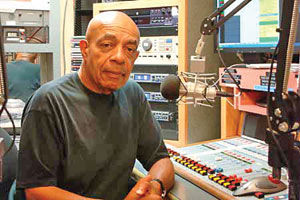
KCSM radio’s own Sonny Buxton has been selected by the Jazz Journalists Association to receive the 2013 Jazz Hero Award for his contributions and dedication to broadcasting. Buxton, along with 25 other musicians and educators from the United States and Canada will be honored May 5 at the Jazz Heritage Center in San Francisco.
Initially, Buxton never considered a future in radio or television as a career. In the early 1950s, he landed an internship in Los Angeles at a small radio station.
Soon after, as a member of the U.S. Air Force, he became a disc jockey for the Armed Forces Radio while stationed in Tokyo in 1958. His first official broadcast show, House of Bamboo, played jazz from midnight until 1 a.m. Fascinated, Buxton sought employment at several different stations but was shunned by the racial discrimination that plagued the ’50s and ’60s.
Radio stations were segregated which made it almost impossible to find a job. These challenges simply motivated him to push through the racial red tape. In 1962, he attained his FCC broadcasting license and tried to get a job at a radio station in Berkeley. Buxton recalls the station manager throwing his audition tape and bio in the trash after the interview.
“He called me in based upon the way that the tape sounded, but when he saw me things changed,” Buxton said.
Undeterred by discrimination, he remained steadfast in his ambition. During his quest, he noticed that many stations were turning him down because he didn’t have an engineer’s license, which was necessary to work in the studio after midnight. He eventually went back to school and received his engineer’s license. This was just another obstacle that Buxton fought through which lit a fire under him and boosted his confidence.
“I simply wanted to eliminate any excuses,” Buxton said.
At 18, a wide-eyed and enthusiastic Buxton found himself at a party in Los Angeles for Lena Horne. Here he was introduced to Joe Adams, the stylistic, midday voice of KOWL. Buxton expressed to Adams his ambition to get into radio while dealing with a slight stuttering problem. Adams helped him overcome that issue by giving Buxton some speaking exercises. One of the exercises was for Buxton to go to the beach and project his voice over the waves with a mouthful of pebbles while enunciating each word. Although Buxton seemed to be already immersed in the culture, he still wasn’t sure broadcasting was for him.
Along with Adams, there were several other radio personalities he admired. Bob Summerrise, who had a smooth, laid-back style, was the first African-American in radio in Seattle and a favorite of Buxton’s. When Buxton was stationed in Amarillo, Texas, he was able to pick up the 50,000 watt signal from KSL and Russ Bowen in Salt Lake City. Fast-talking Daddy “O” Dailey from Chicago was also a favorite of Buxton’s. Buxton took notes on how each of them carried themselves on air, while figuring out his own style.
Buxton has met and worked with some of the greatest entertainers in history over the years, from Duke Ellington to Sarah Vaughn, Eartha Kitt, Ray Charles, Percey Sledge and Smokey Robinson. Buxton credits Leonard Russell in Seattle and Charles Sullivan for exposing him to the business side of radio and music by booking shows, clubs and concerts at the Fillmore and the Richmond Auditorium. Buxton proved his business worth again by co-owning several clubs in Seattle years later like The District, Checkmate and Anxious Asp. In San Francisco, Buxton also opened Milestones in 1984, and co-owned Jazz at Pearl’s with Pearl Wong, which closed in 2003. A few of Buxton’s favorite artists include Ella Fitzgerald, Sammy Davis Jr., Ben Webster, Dexter Gordon, Carlos Jobim and anyone with a warm sound or considered American Standard, like Irving Berlin and Frank Sinatra.
Today’s music and radio has taken a turn for the worse, Buxton said. Radio has become pre-packaged and ultra-commercial and most stations lack an individual with personality. He misses that particular quality that connects listeners to the station. The music business is suffering as well, he said. Not only because of the digital technology and music downloading which damaged album sales, but there aren’t any major American record companies anymore. Foreign entities now own these companies which have created a conglomerate. Buxton predicts that one day there will probably be only two to three record companies in the world.
“Record companies can’t figure out what the next move is,” Buxton said. “They used to be ahead of the public, now the public is ahead of them.”
Seattle roots, and professional football
Buxton was born in Seattle and raised mostly by his mother. She emphasized education and enrolled him in a strict private school even though they were not well-off. Buxton recalled a time when other students antagonized him because of his tattered school uniform.
Recommended for you
He attended Seattle Catholic Preparatory where he excelled in athletics, mainly football as a running back and defensive back. While there, he received a football scholarship from the University of Washington, and later transferred to Long Beach State University. Buxton gained early recognition in college, but was later drafted into the Air Force. While spending three years in the service, he continued to play football and was a standout.
Once out of the military, he completed his undergraduate education and received letters of recommendation to play professionally. He played in the Continental Football League in Harrisburg, Penn. for one season and eventually played in the AFL with the Oakland Raiders. Five successful seasons with the Raiders was just another challenge that Buxton finessed into a career. Buxton has always considered himself to be a late bloomer, and felt like this was just part of the blooming process.
“Almost invariably throughout my life, when people said that I couldn’t do it, then I felt like I was going to do it,” Buxton said.
Unlike the majority of professional athletes today, Buxton worked during the offseason selling cars and playing the congas and trap drums. His musical talent later gave him an opportunity to play with Billy Strayhorn. Buxton also continued to work at a variety of radio stations, so the transition from football to broadcasting was easy.
Early radio days
He worked at KZAM in Seattle, which was the first commercial FM station. He purposely stayed away from stations that played primarily jazz because he didn’t want to be labeled. Instead, he flexed his versatility and worked at a country western station in Seattle and had a weekend show at KING, the flagship station that played classical music as well as pop.
At KYAC, Buxton was trained to be a station manager. This station’s frequency position on the dial had never been filled before, so he had to work from the ground up. KYAC wanted to implement new programming that was aimed at African-Americans. This rubbed him the wrong way until he was promised by the radio troubleshooters that it would be a first-class operation. Buxton agreed, but was more motivated by the opportunity to learn the inside workings and every aspect of engineering. Buxton’s voice, skill and persistence eventually gave him the opportunity to become a reporter and talk show host for KGO-TV and Radio, and garnered success with eight years of voice-over work for commercials that include Cadillac and Kleenex.
KCSM and teaching
At 75, Buxton possesses the same determination, wit and raspy, welcoming voice. You can tune into his radio show every Saturday morning on KCSM Radio at the College of San Mateo. At KCSM, he enjoys having full creative control for his program allowing him to freelance. Radio is almost a lost art with scarce individuality, Buxton said.
“It’s almost the end of the road for this kind of radio,” he said.
He’s content with doing one show a week. He treasures the four hours that he has on Saturdays.
“I’m sort of entertaining myself when I’m over there, but I’m hoping the audience comes along with it,” he said.
His passion for broadcasting definitely comes through the speakers. His passion extends beyond the booth by lecturing and teaching at the Stanford University Jazz Workshop, once a week at the University of San Francisco Fromm Institute and elsewhere. He lectures on jazz-related topics like Big Band and other genres.
Buxton feels responsible for enlightening individuals based upon his experiences. He sees a need, and proudly takes on the role to advocate and inform about jazz, a true American classic. Buxton is one of the last of a fading breed of true pioneers, both culturally and historically, in broadcasting.





(0) comments
Welcome to the discussion.
Log In
Keep the discussion civilized. Absolutely NO personal attacks or insults directed toward writers, nor others who make comments.
Keep it clean. Please avoid obscene, vulgar, lewd, racist or sexually-oriented language.
Don't threaten. Threats of harming another person will not be tolerated.
Be truthful. Don't knowingly lie about anyone or anything.
Be proactive. Use the 'Report' link on each comment to let us know of abusive posts.
PLEASE TURN OFF YOUR CAPS LOCK.
Anyone violating these rules will be issued a warning. After the warning, comment privileges can be revoked.