
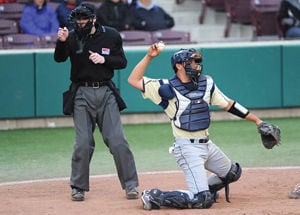
Scott Kalush was never a marquee name during his playing days at Aragon. But those inside baseball recognized his hard work and dedication to the art of catching would further his playing days.
Coming out of Aragon, U.C. Davis was the only Division I school to offer Kalush a scholarship, but the Aggies coaching staff must have liked what they saw. Kalush became a part-time starter midway through his freshman year and has been the full-time starter the last two seasons. Kalush capped his college career this year in grand style — his final collegiate hit was a home run and last week he was named to the All Big West second team list.
"Honestly, I didn’t know what to expect (when I got to Davis). I didn’t have super high expectations,” Kalush said. "When I first got here, I didn’t think I would be All Big West second team.”
There were few better behind the plate in the Big West this season than Kalush. He started all 52 games and he led the conference by picking off six base runners and threw out 17 trying to steal — third-best in the Big West.
"I felt like, throughout the conference, they gave me pretty good respect as a catcher, just the way I controlled my pitching staff,” Kalush said.
Offensively, Kalush batted just .240, but his five homers tied for the team lead, his 24 RBIs were good for third-best and with 42 hits, he ranked sixth on the Aggies’ squad.
"I tried to make the hits count the most,” Kalush said. "I think this year I felt a lot more comfortable. Just being older, being more experienced, I felt I knew what was coming.”
Kalush realized from an early age he would have to excel on defense to carve out a place for himself in the game. He benefited greatly from working with his older brother, Steve — who also starred at Aragon and went on to pitch for four years at Santa Clara University — and dad Ed. Considering Steve Kalush was a few years older, young Scott was exposed to a lot of older players and experienced coaches who helped with his development.
"I was never the best hitter on any of my teams. I knew defense was where I was going to have to do my best,” Kalush said. "One of the things that helped me most was catching my brother. I learned to catch better, older guys.”
He also spent a lot of time around Steve’s summer league team, the San Mateo Post 82 American Legion program. Even though he wasn’t quite old enough to play, he was soaking up the lessons taught by the Post 82 coaching staff, especially former coach Mike Chanteloup.
"Even when I wasn’t on the (Post 82) team, I was watching (them) and they always helped me out,” Kalush said. "I learned a lot from Chanty just talking to him and watching those (teams) play.”
Chanteloup is a longtime baseball coach on the Peninsula and ran the Post 82 program for about a decade. He saw a lot of talented players come through the system and even though he coached Kalush for only a couple summer seasons, he saw he had the tools to excel at catcher.
Recommended for you
"I knew he would be a better college guy than high school guy. Most guys go the other way,” Chanteloup said. "He was like a 4.0 student behind the plate. The highest compliment I heard at Davis was how every one of their pitchers loved throwing to him.
"I think he was born to be a catcher. The term ‘tools of ignorance’ (a common baseball term for those who strap on the catcher’s equipment) don’t apply. I think Scotty was the maestro of an orchestra back there.”
One thing Kalush learned sooner than a lot of catchers was how to work with a pitching staff and how to call games. It takes a lot of hard work for a coaching staff to feel comfortable turning over the pitch calling to the catcher, who has to know the general tendencies of every opposing batter — not only what reputation they bring into game, but how their at-bats have gone for that particular game. Kalush said he started calling his own pitches a few times during his sophomore year but called a majority of the pitches his junior and senior seasons. That puts Kalush ahead of the curve over a lot of other college catchers, who are rarely given the freedom to call their own games, but is an integral part of the pro game.
Those kinds of skills are rare in college players and Kalush is hoping that will generate enough interest from professional scouts to take a chance on him in the first-year amateur baseball draft this week.
"I’ve gotten a little bit (of interest from pro scouts). Nothing for certain,” Kalush said. "I’m hopeful someone will take a chance on me.”
Kalush is confident there is still a place in the pro game for a defense-first catcher. Especially when one considers teams are taking offense-first catchers and moving them to other, safer, positions. The San Francisco Giants are going through it right now with Buster Posey and the Washington Nationals wasted no time in moving phenom Bryce Harper — who was a catcher — to the outfield as soon as he was drafted.
"I think (being a defensive catcher) is even more important (now),” Kalush said. "You really have to make the pitchers the best. Having a defensive catcher really helps there.”
Even if his name isn’t called by a professional organization, Kalush can be satisfied he became a legitimate Division I college player during a time when emphasis and the spotlight are placed on offense.
"Overall, the four years were pretty successful. I didn’t expect to be starting all four years,” Kalush said. "All the hard work paid off.”
Count Chanteloup among those who believe Kalush can play at the next level.
"I don’t think he’s done (playing),” Chanteloup said.




(0) comments
Welcome to the discussion.
Log In
Keep the discussion civilized. Absolutely NO personal attacks or insults directed toward writers, nor others who make comments.
Keep it clean. Please avoid obscene, vulgar, lewd, racist or sexually-oriented language.
Don't threaten. Threats of harming another person will not be tolerated.
Be truthful. Don't knowingly lie about anyone or anything.
Be proactive. Use the 'Report' link on each comment to let us know of abusive posts.
PLEASE TURN OFF YOUR CAPS LOCK.
Anyone violating these rules will be issued a warning. After the warning, comment privileges can be revoked.