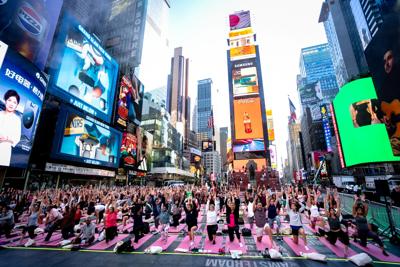
People participate in a yoga class during the 23rd annual 'Solstice in Times Square: Mind Over Madness Yoga' event to celebrate the summer solstice in New York City.
Peak sunshine has arrived in the Northern Hemisphere — the summer solstice.
Friday is the longest day of the year north of the equator, where the solstice marks the start of astronomical summer. It's the opposite in the Southern Hemisphere, where it is the shortest day of the year and winter will start.
The word "solstice" comes from the Latin words "sol" for sun and "stitium" which can mean "pause" or "stop." The solstice is the end of the sun's annual march higher in the sky, when it makes its longest, highest arc. The bad news for sun lovers: It then starts retreating and days will get a little shorter every day until late December.
Thousands of people from across the world are expected to gather at Stonehenge in southern England to mark the summer solstice. The ancient monument is a focal point for spiritual rituals on the longest day of the year and the first day of astronomical summer.
People have marked solstices for eons with celebrations and monuments, including Stonehenge, which was designed to align with the sun's paths at the solstices. But what is happening in the heavens? Here's what to know about the Earth's orbit.
Solstices are when days and nights are at their most extreme
As the Earth travels around the sun, it does so at an angle relative to the sun. For most of the year, the Earth's axis is tilted either toward or away from the sun. That means the sun's warmth and light fall unequally on the northern and southern halves of the planet.
The solstices mark the times during the year when this tilt is at its most extreme, and days and nights are at their most unequal.
During the Northern Hemisphere's summer solstice, the upper half of the earth is tilted toward the sun, creating the longest day and shortest night of the year. This solstice falls between June 20 and 22.
Meanwhile, at the winter solstice, the Northern Hemisphere is leaning away from the sun — leading to the shortest day and longest night of the year. The winter solstice falls between December 20 and 23.
Recommended for you
People participate in a yoga class during the 23rd annual 'Solstice in Times Square: Mind Over Madness Yoga' event to celebrate the summer solstice in New York City.
Reuters
The equinox is when there is an equal amount of day and night
During the equinox, the Earth's axis and its orbit line up so that both hemispheres get an equal amount of sunlight.
The word equinox comes from two Latin words meaning equal and night. That's because on the equinox, day and night last almost the same amount of time — though one may get a few extra minutes, depending on where you are on the planet.
The Northern Hemisphere's spring — or vernal — equinox can land between March 19 and 21, depending on the year. Its fall – or autumnal — equinox can land between Sept. 21 and 24.
On the equator, the sun will be directly overhead at noon. Equinoxes are the only time when both the north and south poles are lit by sunshine at the same time.
What's the difference between meteorological and astronomical seasons?
These are just two different ways to carve up the year.
While astronomical seasons depend on how the Earth moves around the sun, meteorological seasons are defined by the weather. They break down the year into three-month seasons based on annual temperature cycles. By that calendar, spring starts on March 1, summer on June 1, fall on Sept. 1 and winter on Dec. 1.
Keep the discussion civilized. Absolutely NO
personal attacks or insults directed toward writers, nor others who
make comments. Keep it clean. Please avoid obscene, vulgar, lewd,
racist or sexually-oriented language. Don't threaten. Threats of harming another
person will not be tolerated. Be truthful. Don't knowingly lie about anyone
or anything. Be proactive. Use the 'Report' link on
each comment to let us know of abusive posts. PLEASE TURN OFF YOUR CAPS LOCK. Anyone violating these rules will be issued a
warning. After the warning, comment privileges can be
revoked.
Please purchase a Premium Subscription to continue reading.
To continue, please log in, or sign up for a new account.
We offer one free story view per month. If you register for an account, you will get two additional story views. After those three total views, we ask that you support us with a subscription.
A subscription to our digital content is so much more than just access to our valuable content. It means you’re helping to support a local community institution that has, from its very start, supported the betterment of our society. Thank you very much!



(0) comments
Welcome to the discussion.
Log In
Keep the discussion civilized. Absolutely NO personal attacks or insults directed toward writers, nor others who make comments.
Keep it clean. Please avoid obscene, vulgar, lewd, racist or sexually-oriented language.
Don't threaten. Threats of harming another person will not be tolerated.
Be truthful. Don't knowingly lie about anyone or anything.
Be proactive. Use the 'Report' link on each comment to let us know of abusive posts.
PLEASE TURN OFF YOUR CAPS LOCK.
Anyone violating these rules will be issued a warning. After the warning, comment privileges can be revoked.