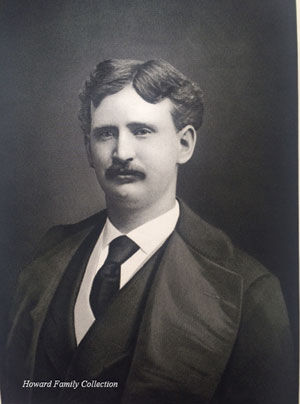
The first-born heir of a wealthy Gold Rush merchant, William Henry Howard shaped much of modern Burlingame. Despite his privileged beginnings, however, his life was marked by tragedy. Born on June 3, 1850, at his parents’ home on San Francisco’s Mission Street in what was then called “Happy Valley,” William H. Howard was not destined to live a happy life. When William was just 4, while the family was visiting the Boston area, young Willie witnessed a nanny beat his younger brother to death by swinging the child around by his nightshirt. Before he turned 6, Willie’s father died. The next year, he was sent off to a boarding school in England. William would remain outside of California attending schools in Europe or the East Coast for the next 15 years. In 1873, at the age of 23, William married Anna Dwight Whiting in Massachusetts. She was from a prominent New England family. They soon moved to Paris.
Even though most of his childhood was spent outside California, family responsibilities brought him back. When his father died in 1856, young William inherited a large portion of Rancho San Mateo (most of his property was east of El Camino Real between Burlingame Avenue and downtown San Mateo). In 1879, when William was 29, he and his young family moved back to California — in part to watch his mother’s large El Cerrito estate for her while she and her third husband took an extended honeymoon in Europe and in part to manage his own property here. During this time, he requested the family gardener John McLaren to help improve William’s property at Coyote Point by planting thousands of eucalyptus trees there. William and Anna also commissioned a huge brownstone home, designed by New York architect Bruce Price (Emily Post’s father), to be built near the property that William inherited from his father, William Davis Merry Howard. The home, called Uplands, was located at the current site of Crystal Springs Uplands School.
Among other business interests, Howard operated a dairy and a cattle ranch on the Peninsula. By 1889, however, he began to view his Peninsula property as having greater potential for residential real estate use rather than agricultural use. In that year, he made his first real estate subdivision on a small sliver of land, north of downtown San Mateo and east of the railroad tracks. However, one wonders if sales were slow or if expenditures were simply too high, as by 1894 he sold his large home Uplands to Charles Frederick Crocker. The year before, William had been an enthusiastic founding member of the Burlingame Country Club — a club designed to spur real estate sales on the Peninsula to wealthy San Franciscans. Howard donated land at the northern edge of his property for an attractive Burlingame train station that was built to welcome guests to the club who arrived by train. The train station was designed by his half-brother, George Howard.
Three years later, after the Burlingame Country Club was formed, Howard would make Burlingame’s first subdivision (in 1896). He called it “the Town of Burlingame” and it included small lots between Burlingame Avenue on the north and Peninsula on the south and between El Camino Real on the west and Dwight Road on the east. However, any sales from these lots apparently did not occur fast enough or were not sufficient to ward off a foreclosure action on Howard property in San Francisco. In August of 1896, the Hibernia Savings and Loan Society sued Howard for $150,000. The loan had been in default for 17 months. By 1900, the Howards had separated: Anna Dwight Whiting Howard moved back to Boston. William H. Howard died on Oct. 20, 1901 of “Bright’s disease” — a term that is no longer in use, but used to refer to various kidney-related diseases. The boy who was born in Happy Valley had died alone at the age of 51. When sales in his subdivision of Lyon-Hoag finally took off after the 1906 earthquake, it was his widow who would benefit.
Joanne Garrison is the author of “Burlingame Centennial: 1908-2008” and a board member of the Burlingame Historical Society. The society operates a museum in the Burlingame train station; it is open on the first Sunday of months from 1 p.m.-4 p.m. For more information about Burlingame and Hillsborough see burlingamehistory.org or burlingamefoundingfamilies.wordpress.com
Keep the discussion civilized. Absolutely NO
personal attacks or insults directed toward writers, nor others who
make comments. Keep it clean. Please avoid obscene, vulgar, lewd,
racist or sexually-oriented language. Don't threaten. Threats of harming another
person will not be tolerated. Be truthful. Don't knowingly lie about anyone
or anything. Be proactive. Use the 'Report' link on
each comment to let us know of abusive posts. PLEASE TURN OFF YOUR CAPS LOCK. Anyone violating these rules will be issued a
warning. After the warning, comment privileges can be
revoked.
Please purchase a Premium Subscription to continue reading.
To continue, please log in, or sign up for a new account.
We offer one free story view per month. If you register for an account, you will get two additional story views. After those three total views, we ask that you support us with a subscription.
A subscription to our digital content is so much more than just access to our valuable content. It means you’re helping to support a local community institution that has, from its very start, supported the betterment of our society. Thank you very much!






(0) comments
Welcome to the discussion.
Log In
Keep the discussion civilized. Absolutely NO personal attacks or insults directed toward writers, nor others who make comments.
Keep it clean. Please avoid obscene, vulgar, lewd, racist or sexually-oriented language.
Don't threaten. Threats of harming another person will not be tolerated.
Be truthful. Don't knowingly lie about anyone or anything.
Be proactive. Use the 'Report' link on each comment to let us know of abusive posts.
PLEASE TURN OFF YOUR CAPS LOCK.
Anyone violating these rules will be issued a warning. After the warning, comment privileges can be revoked.