
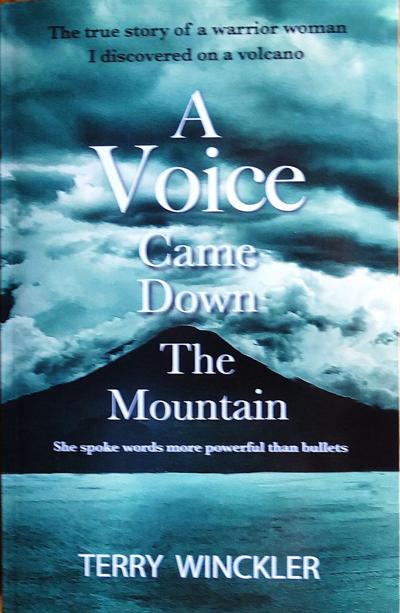

We live in a period when it seems any voice to the left of Donald Trump’s can encounter some attempt to stifle it. However, Terry Winckler doesn’t plan to shut up. So, he’s been making appearances at Bay Area bookstores, with one more coming on April 24.
A longtime California journalist and a former editor of the San Mateo County Times, Winckler recently published his memoir, featuring a young female revolutionary, Ana — a guerrilla leader during a decade when indigenous Maya fought to shrug off a yoke of centuries of political and economic oppression in Guatemala.
Her leadership took place in a period of violent military assaults on Mayan villages, resulting in many thousands of Mayan deaths. During Guatemala’s entire civil war, 1960-96, some 200,000 deaths or disappearances were reported by the BBC, primarily among the indigenous. (Amnesty International provides a similar estimate.)
“A Voice Came Down the Mountain” tells of Winckler’s encounter with “Capitána Ana” at a hideout on a volcano named Atitlán, near a lake of legendary beauty, high in the Sierre Madre de Chiapas range of southwestern Guatemala. He came away from that camp in the verdant jungle impressed, inspired, and not a little in love.
“I felt infatuated by every aspect of Ana,” Winckler said. “She had presence, she was physically beautiful, and she radiated conviction, a political charisma. She actually led a guerrilla force and was famously brave in combat. Men and women in her band adored her.”
Winckler’s south-of-the-border saga began in 1972, after he trekked to a town called Cunen to launch an anti-tuberculosis campaign. When that effort sputtered, he turned to helping build a rural school. It gave him a chance to educate himself on the political plight of the indigenous poor.
“I loved watching the soft-voiced Mayan women work as they made beautiful things,” he said. “Their hands could play weaving looms like musical instruments. But the Maya lost more and more ground, no matter how hard they labored. Their lives seemed to hold a lot of futility.”
In his book, he sketches some of Guatemala’s modern history. The country’s two democratically elected presidents in the 1950s sought to loosen the firm grip of the United Fruit Company via labor and land reforms. The corporation fought back by lobbying the Eisenhower administration for a coup. And one was promptly engineered by the CIA. Guatemala’s second elected president, Jacobo Árbenz, was supplanted by a military dictator. A parade of more dictators followed. Denied expression through politics, the opposition turned revolutionary. Retribution for government massacres took the form of guerrilla ambushes. Students agitating for liberal advances were arrested and sometimes “disappeared.”
Recommended for you
Amid this situation, Winckler returned to Guatemala in 1985. The murderous policies of the dictators Rios Montt and Oscar Mejía, as well as the revolutionary counter-measures, were in full uproar then. He observed the military invasion of the University of San Carlos campus, went into the countryside, arriving back in Cunen shortly after a teenage Mayan boy — Juan Botón — was shot on the steps of the village church by a soldier who wielded an American M-1 rifle. Winckler then leapt at a chance to research and report on the guerrillas high up in their mountain refuges.
Whereupon he met Ana and her lover and co-comandante, Pancho, and grew to understand the patience and fortitude and idealism required to deal with all the rigors and dangers of their struggle. After he came down off the mountain, he realized that he’d become a target of the regime, too. He filed his stories by pressing them upon travelers flying to the United States, then fled northward himself.
No matter what else he did in journalism or writing, Winckler kept an eye on events in Guatemala. He learned of the peace pact that ended the revolution in 1996, and he yearned to find out what it meant for Ana. But he didn’t learn that till he traveled there again in 2017. He discovered that she had laid down her gun, yet continued to preach with revolutionary fervor, meeting up with Mayan women in the shade of a particular tree, to tell them, “Somos equales.” The essence of her message to them was: “Skin is just the outside. True power is on the inside, where we are all equal, if you believe it.”
Although Ana did inspire generations of Maya women to rise up, take pride in themselves and take charge of their lives, she could not save herself. In 1992, just two years after she came down from the volcano to give birth to a son, she was stabbed to death in Mexico City during a dispute over a secret bank account held by her group.
However, Winckler said, her message endures and remains relevant. “The equality of all people is at the core of Christianity. It’s also the essence of our Declaration of Independence,” he said. “If we do all we can to promote fairness, equality and economic justice in places like Central America, then the people there will be far less inclined to try to migrate into our country, since they can stay happy exactly where they are.”
Terry Winckler will appear at Books Inc in Palo Alto (855 El Camino Real, No. 74 in the Town & Country Village Plaza) 7 p.m. Thursday, April 24. He’ll be in conversation with Tamoa Calzadilla — editor-in-chief of Factchequeado, a Miami-based outlet founded to vet and improve reporting on Latino and Spanish language communities. Calzadilla currently is a John S. Knight Journalism Fellow at Stanford.
Paul McHugh is a Bay Area journalist and novelist, paulmchughbooks.com.












(0) comments
Welcome to the discussion.
Log In
Keep the discussion civilized. Absolutely NO personal attacks or insults directed toward writers, nor others who make comments.
Keep it clean. Please avoid obscene, vulgar, lewd, racist or sexually-oriented language.
Don't threaten. Threats of harming another person will not be tolerated.
Be truthful. Don't knowingly lie about anyone or anything.
Be proactive. Use the 'Report' link on each comment to let us know of abusive posts.
PLEASE TURN OFF YOUR CAPS LOCK.
Anyone violating these rules will be issued a warning. After the warning, comment privileges can be revoked.