
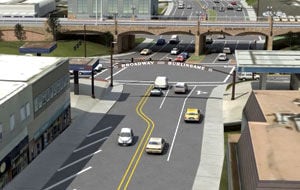
To clear congestion at one of the most clogged intersections along the Peninsula, Burlingame officials identified a preferred rail and road grade separation alignment at the Broadway intersection.
Engineering consultants hired to address the problematic train and car crossing suggested raising the rail tracks through the area to a peak height of roughly 13 feet, and dropping Broadway by roughly the same distance to give clearance for traffic traveling east and west to pass more freely.
The alignment, similar to other grade separation projects in Belmont and San Carlos, is expected to be the least disruptive and most manageable to construct, according to a presentation given to the City Council during a meeting Tuesday, Jan. 19.
No final decision was made at the meeting but, of six options presented, officials believe the raised tracks and sunken road is likely the preferred alternative, according to an email from City Manager Lisa Goldman.
The identified solution “minimizes impacts to properties in the project vicinity, provides opportunities to improve gateway aesthetics and maintains the character of the Broadway commercial district while providing a balanced approach to address community needs,” said Goldman.
Much more work needs to be done to address the issue though, said Goldman, as officials are interested in collecting more community feedback on the project before ultimately moving toward making a decision.
A larger concern, according to Goldman, is that the funding source for the project remains yet to be identified.
Officials have selected a variety of potential substantial capital improvement projects, such as constructing a new recreation center, building a new part on the city’s stretch of the Bayfront as well as the Broadway grade separation, which have no funding source.
Caltrain spokeswoman Tasha Bartholomew said though cities typically are responsible for taking the lead on financing similar grade separation projects, there are often local, state and federal funding sources available to tap into as well.
She identified the San Mateo County Transportation Authority as an agency which Burlingame could look to for financial assistance on the project, but the regional authority has a relatively small pool of dollars to pull from and many other cities in the county are vying for the money as well.
The county authority solicited interest from local cities in 2013 for assistance on grade separation projects, and ultimately granted $1 million to Burlingame for study of solutions to the Broadway issue.
Beyond looking to other agencies for assistance, the Burlingame City Council received a presentation last year regarding the variety of public financing methods, such as a bond measure, officials could pursue to provide revenue streams to address the list of capital improvement projects.
The Broadway intersection, which connects the nearby commercial district to Highway 101 over the Caltrain tracks, has been rated one of the most congested crossings in the state and the worst on the Peninsula, according to a city report.
Recommended for you
Officials have hosted a variety of community meetings over the past year to receive feedback from residents, business owners and other community members on the project.
Aecom, the company hired by the city to help design the project, anticipates going back to the community in the coming month to gather more input on the preferred alignment, according to video of the Jan. 19 meeting.
Councilman Michael Brownrigg said it is becoming clear which is the preferred alignment for the grade separation project.
“I think we can all see where you get pushed to in terms of choices,” he said.
The other most viable option is to drop the tracks and raise the road, according to the report, but there are more challenges associated with putting a railway below the street level due to the overhead infrastructure required to operate the trains.
Mayor Ann Keighran said though she understands the challenges associated with alternative alignments, she would like to know more about what would have been required to raise the street and drop the tracks.
Murtuza added the amount of excavation allowed in the project is limited because the water table is so high through the area, which essentially precludes digging deep enough to burrow the rail tracks.
Officials are expected to go back to collect more community input on the project in March, with the anticipation of coming back to the council for additional recommendation on how to proceed in April.
Murtuza emphasized more work needs to be done on the project before a final solution is identified.
“This is a concept, this is not a design,” he said. “This can be further improved.”
(650) 344-5200 ext. 105





(0) comments
Welcome to the discussion.
Log In
Keep the discussion civilized. Absolutely NO personal attacks or insults directed toward writers, nor others who make comments.
Keep it clean. Please avoid obscene, vulgar, lewd, racist or sexually-oriented language.
Don't threaten. Threats of harming another person will not be tolerated.
Be truthful. Don't knowingly lie about anyone or anything.
Be proactive. Use the 'Report' link on each comment to let us know of abusive posts.
PLEASE TURN OFF YOUR CAPS LOCK.
Anyone violating these rules will be issued a warning. After the warning, comment privileges can be revoked.