

In an effort to put jail inmates with mental health conditions on a path toward self-sufficiency, the San Mateo County Sheriff’s Office is aiming to bolster support for programs providing inmates with specialized mental health treatment and education while they are in custody.
Whether it entails stabilizing inmates with medication, working with small groups to write in journals and learn about their mental health conditions or connecting inmates with pet-assisted therapy, county law enforcement and health officials have been strengthening what Lt. William Fogarty of the Sheriff’s Office calls a continuum of mental health resources for those in custody.
By providing a series of programs treating inmates with a range of conditions, jail staff are hoping they can meet the wide array of needs of those whose mental health conditions may have landed them in jail or present a threat to themselves or other inmates and staff, said Fogarty.
“It’s giving them life skills as well as the medication as well as treatment options,” he said.
Opened in October, the Acute Stabilization Unit, or ASU, in the Maguire Correctional Facility is one of the newest additions to the resources the Sheriff’s Office and the San Mateo County Health’s Correctional Health Services Division have focused on ramping up in recent years.
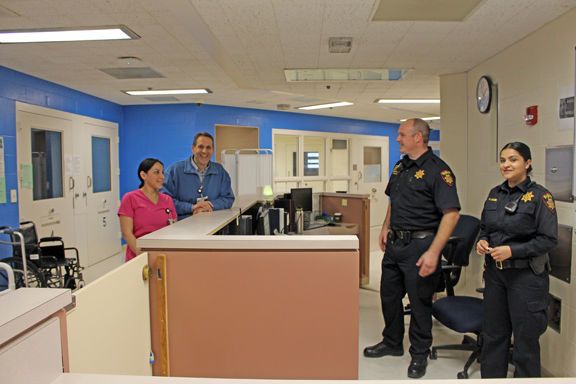
With blue-colored walls aimed at calming those who are admitted to the unit, the ASU serves as a psychiatric ward for the county jail population, providing treatment for male and female inmates who a team of mental health clinicians and sheriff’s deputies believe could be a danger to themselves, said Mark DeLucchi, director of the ASU.
Staffed with a psychologist, psychiatrist and a nurse who are available 24 hours a day, a mental health worker who checks on those admitted to the unit every 15 minutes and two sheriff’s deputies, the ASU is equipped to treat inmates with a range of conditions, including depression, bipolar disorder, mania and schizophrenia. As of mid-February, DeLucchi said all of the inmates who had been admitted at the ASU came from the jail’s administrative segregation population, comprised of inmates with a history of behavioral issues and are kept in individual cells for much of the day to prevent them from hurting themselves or others.
Before the unit admitted its first patient in October, inmates experiencing psychiatric emergencies were transported by at least two deputies to an emergency room in Santa Clara County, where they would wait with the general public for care, said DeLucchi. By transitioning psychiatric emergency services to another unit within the San Mateo County jail, health officials and deputies are able to ensure inmates receive more immediate and consistent treatment within the same facility, where they can also extend the average length of stay to more than 30 days if needed, he said.
“We can work with them here, it’s much more immediate treatment,” he said. “We can really … make sure that we’re transporting someone from this unit to a different unit in the jail when they’re safe [and] when they’re psychiatrically stable.”
Developing strategies
Once inmates with more severe mental health conditions or episodes are stabilized through the treatment DeLucchi’s team offers, many of them move to the jail’s Behavioral Health Program instead of back into administrative segregation, explained DeLucchi.
As a clinician for the Behavioral Health Program at Maguire Correctional Facility, Andrew Tardiff is currently working with some eight inmates to develop strategies for managing their mental health conditions, whether it’s better understanding their medication, learning about how their conditions affect them specifically or participating in substance abuse classes. By participating in art therapy sessions and journaling classes as well as living together in the same pod of cells, inmates can also develop social skills they might not have learned before, noted Fogarty.
Having helped develop the jail’s Behavioral Health Program and worked with inmates who have transitioned out of the ASU, Tardiff has seen the benefits of working closely with inmates to stabilize them, which allows them to start taking steps toward managing their conditions and learning about resources available to help them once they are released from jail.
Recommended for you
“The patients that we were unable to touch because they were so decompensated, we’re now able to reach,” he said. “[It] allows us to reach them at a point where we can encourage them to take care of themselves and look at other options that would be beneficial to them.”
Fogarty said those who progress through the Behavioral Health Program can join the jail’s general population and also may participate in CHOICES, a voluntary alcohol and drug treatment program available to all inmates in the Maguire and Maple Street correctional facilities.
He noted the growing continuum of resources aimed at addressing mental health conditions at county jails can also help curb costs, which range from eliminating the Sheriff’s Office’s need to contract with Santa Clara County Corrections for psychiatric emergencies services or reducing the damage on jail facilities when those with untreated mental health conditions have destructive episodes.
High amount of mental health need
Staffed on the ASU, Deputy Kevin Holley said he’s worked with an inmate who was previously held in administrative segregation and combative toward correctional officers get to the point where he can have a conversation with others without displaying aggressive behavior. He also noted the strain of psychiatric emergencies on deputies’ abilities to carry out duties such as overseeing recreation time, adding the additional mental resources have helped reduce those incidents.
Having seen inmates transition from the Acute Stabilization Unit to the Behavioral Health Program and later access other resources that can help them manage their mental health conditions, Holley noted the additional programs mark a shift in the options available to inmates while they are in custody and after they are released.
“It seems like now there’s a plan for the inmates,” he said.
Carlos Morales, director of County Health’s Correctional Health Services Division, said some 300 inmates are currently seen by Correctional Health staff. Though he acknowledged the number of inmates receiving mental health services fluctuates daily, he estimated some 30 percent to 40 percent of county inmates have needs that are addressed by Correctional Health staff.
Fogarty said state legislation passed in the last 10 years and diverting inmates convicted of certain specific crimes from state prison to county jails has in part driven a need for more mental health services in the county jail. With the administrative segregation pod of the jail at capacity much of the time, Fogarty was hopeful the series of programs taking shape could help reduce the need to keep some inmates in maximum security and eventually open more opportunities to inmates when they are released from jail than they had when they were taken into custody.
“I really think that’s the value of having a program in jail and really providing people with a treatment program,” he said.
(650) 344-5200 ext. 106





(0) comments
Welcome to the discussion.
Log In
Keep the discussion civilized. Absolutely NO personal attacks or insults directed toward writers, nor others who make comments.
Keep it clean. Please avoid obscene, vulgar, lewd, racist or sexually-oriented language.
Don't threaten. Threats of harming another person will not be tolerated.
Be truthful. Don't knowingly lie about anyone or anything.
Be proactive. Use the 'Report' link on each comment to let us know of abusive posts.
PLEASE TURN OFF YOUR CAPS LOCK.
Anyone violating these rules will be issued a warning. After the warning, comment privileges can be revoked.