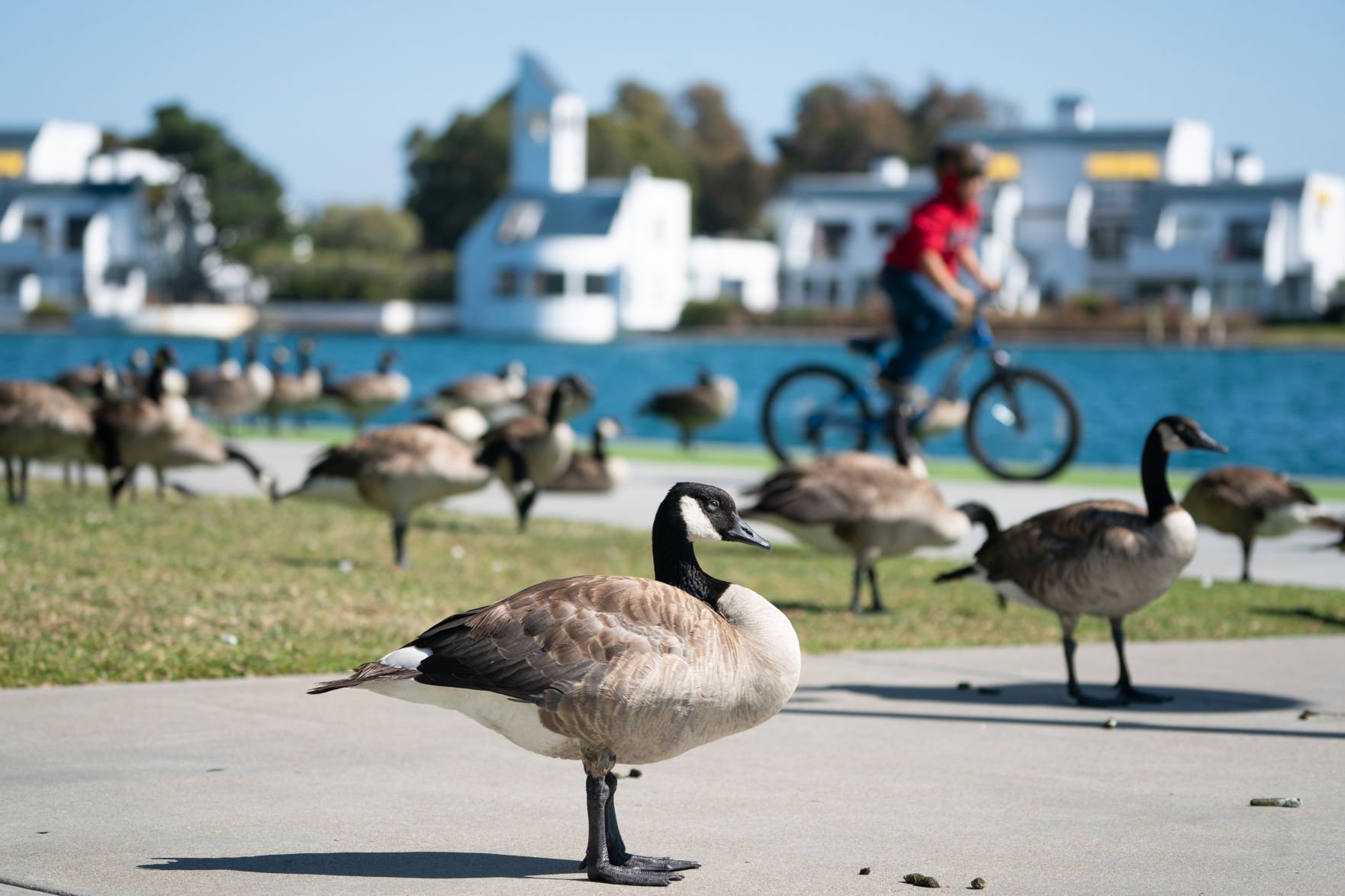
The Foster City Council is moving forward with a handful of approaches to curb its excessive goose population and solidified its decision not to employ lethal tactics to do so.
A new plan recommends a variety of techniques, including using remote control devices, strobe lights, lasers and chemical repellents. It could also include “propane cannons, pyrotechnics and electronic devices,” the report said, though such methods may trigger noise restrictions.
Dan Biteman, senior biologist at Wildlife Innovations, said during the Dec. 2 meeting that the city should focus on mitigation efforts at several strategically situated parks.
“Parks were prioritized that are on the lagoon,” Biteman said. “They really like to have food sources next to water sources. Water provides an escape from predators.”
The geese have been more than just a nuisance for city residents. Staff say the increase has reduced water quality within the lagoon, as the high amount of fecal matter introduces health risks, such as the spread of pathogens like E. coli. Feces also fuel algae blooms and degrade lagoon water quality, Biteman said.
Despite the high-profile nature of Foster City’s geese mitigation efforts, the issue is not unique to the area. Canada geese have increased almost 11% annually between the early 1990s and 2015 in North America, Biteman said.
Wildlife Innovation’s proposed plan for the city includes habitat modification, which could replace well-manicured grass areas with tall, thick vegetation, or rocks and shrubs. According to a staff report, hazing, or deterrence methods, could include a mix of chemical repellents, sound making devices — like pyrotechnics or propane cannons — and remote controlled devices that resemble predators.
Recommended for you
Councilmember Sam Hindi added that he is in strong favor of reproductive control methods.
“I think it is really critical to have an egg addling plan and to make sure that you have enough professionals doing that,” Hindi said. “You have to have a meaningful addling part of this plan.”
Egg addling is used to prevent eggs from hatching, such as moving the eggs from the nest or coating them with oil.
Over the last couple of years, the city has deployed some mitigation tactics but has had to work on a report to assess the environmental impacts per the California Environmental Quality Act before pursuing a more robust plan.
Vice Mayor Stacy Jimenez said she wants to pursue as many nonlethal strategies as possible.
“Let’s be as aggressive as we can,” Jimenez said. “They are becoming an absolute nuisance, they’re eroding the quality of life in Foster City, they’re eroding our landscape, they’re dangerous to our pets, they’re dangerous to our kids, and at this point it feels like it’s gotten completely out of hand.”
The city has budgeted about $70,000 for the goose mitigation efforts, according to the staff report.
This Foster City geese soap opera has been going on for what, several years now? What’s the score, geese 8, Foster City 0? Maybe we can place a monetary tariff on them to add to FC’s coffers. Unfortunately, FC has been receiving a type of tariff and I hear it can be used as fertilizer. BTW, it’d be interesting to see details regarding expenses to date in continually losing to the geese. I’m estimating the money wasted is closer to $500,000 than $100,000.
Keep the discussion civilized. Absolutely NO
personal attacks or insults directed toward writers, nor others who
make comments. Keep it clean. Please avoid obscene, vulgar, lewd,
racist or sexually-oriented language. Don't threaten. Threats of harming another
person will not be tolerated. Be truthful. Don't knowingly lie about anyone
or anything. Be proactive. Use the 'Report' link on
each comment to let us know of abusive posts. PLEASE TURN OFF YOUR CAPS LOCK. Anyone violating these rules will be issued a
warning. After the warning, comment privileges can be
revoked.
Please purchase a Premium Subscription to continue reading.
To continue, please log in, or sign up for a new account.
We offer one free story view per month. If you register for an account, you will get two additional story views. After those three total views, we ask that you support us with a subscription.
A subscription to our digital content is so much more than just access to our valuable content. It means you’re helping to support a local community institution that has, from its very start, supported the betterment of our society. Thank you very much!







(1) comment
This Foster City geese soap opera has been going on for what, several years now? What’s the score, geese 8, Foster City 0? Maybe we can place a monetary tariff on them to add to FC’s coffers. Unfortunately, FC has been receiving a type of tariff and I hear it can be used as fertilizer. BTW, it’d be interesting to see details regarding expenses to date in continually losing to the geese. I’m estimating the money wasted is closer to $500,000 than $100,000.
Welcome to the discussion.
Log In
Keep the discussion civilized. Absolutely NO personal attacks or insults directed toward writers, nor others who make comments.
Keep it clean. Please avoid obscene, vulgar, lewd, racist or sexually-oriented language.
Don't threaten. Threats of harming another person will not be tolerated.
Be truthful. Don't knowingly lie about anyone or anything.
Be proactive. Use the 'Report' link on each comment to let us know of abusive posts.
PLEASE TURN OFF YOUR CAPS LOCK.
Anyone violating these rules will be issued a warning. After the warning, comment privileges can be revoked.