

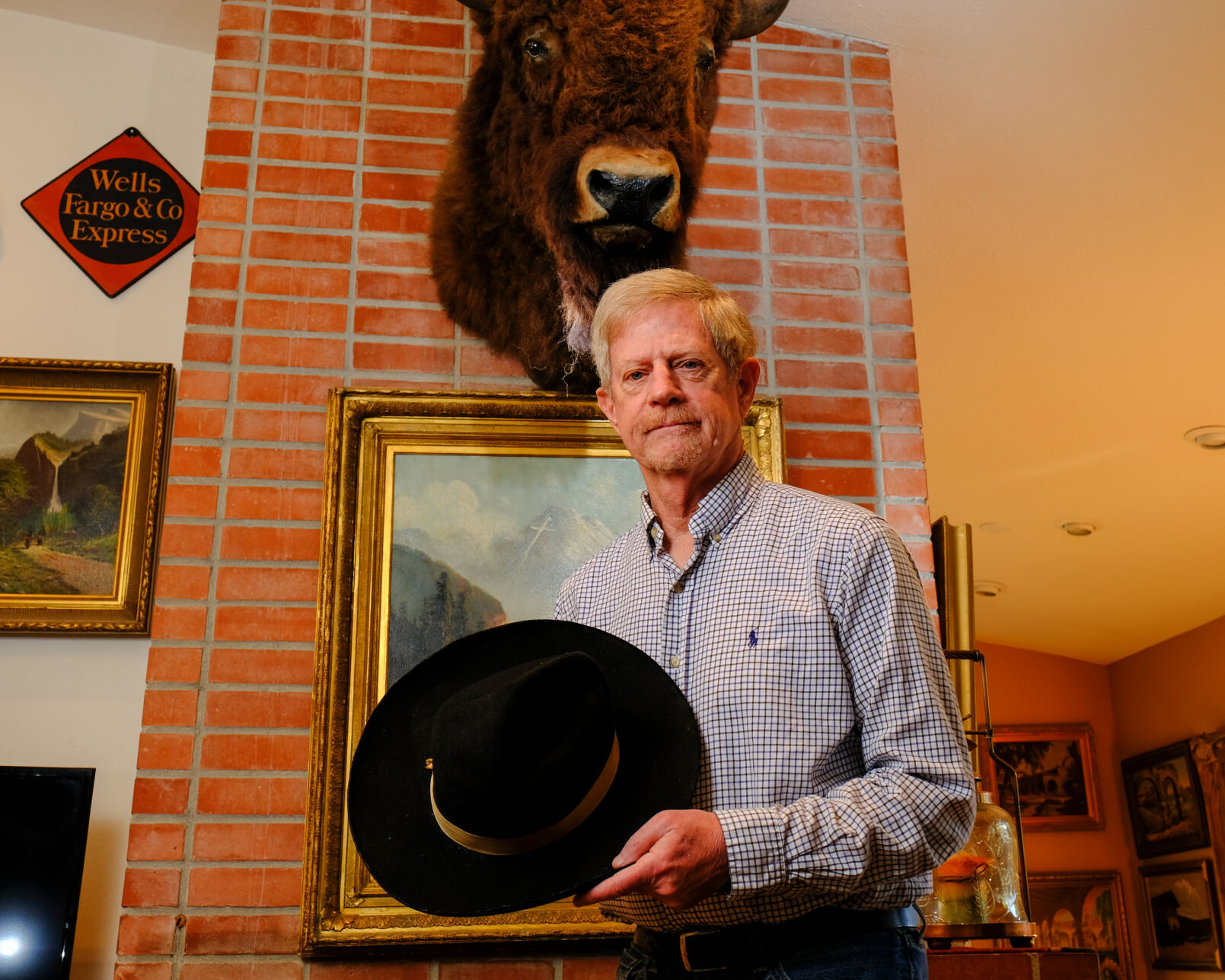
Former San Mateo police officer and western historian John Boessenecker uses his skills as an attorney to tell the stories of notorious outlaws and the lawmen who hunted them.
DJ: Please, tell a bit about yourself.
JB: I was born in San Francisco and grew up in Mill Valley. I graduated with a degree in history from San Francisco State and worked as a police officer, first in Mill Valley and then in San Mateo. Here I met my wife, Marta Diaz, now retired as a San Mateo County Superior Court judge. We raised our two sons in Foster City.
DJ: You’ve written extensively about lawmen and outlaws. What drew you to these subjects?
JB: As a boy, growing up in the late 1950s and 1960s, I was exposed to the countless westerns that were so popular on television. They were all set in places like Texas, New Mexico, Arizona, Wyoming, etc. I began to wonder if there was ever a Wild West in California. When I was a freshman in high school I began reading every book in my local library on the topic, then in the county library and, when those were all read, the San Francisco public library. There were numerous western history “pulp” magazines back then, and when I was 15 I sold my first article to one of them and I have been writing about the Old West ever since.
DJ: How does your professional background influence the way you approach historical topics?
JB: My experiences as a police officer and trial attorney have been a huge influence in my research and writing. When I was a young policeman, I realized early on that the personalities, actions and motivations of the criminals I encountered in the 1970s were little different from the outlaws I read about who rode in the 1870s. As anyone who has read a Jane Austen novel from the 1810s knows, there is little difference between people then and now. My work as a lawyer has given me insight into both historical research and analyzing the accounts from witnesses to events that took place on the American frontier.
DJ: What sources do you use for your research?
JB: I try to rely mainly on primary sources from the period — newspapers, diaries, letters and court records. I wish there were police records or police reports but those were unknown in that era. I strenuously avoid legends and folklore, especially “my grandma told me” stories recounted a hundred years after the fact. I also avoid many of the books about the Wild West that were published from the 1920s to the 1950s, because so many of them are filled with exciting narratives but are sorely lacking in facts and historical accuracy.
DJ: Are there mentors you would like to acknowledge?
Recommended for you
JB: My good friend, the late William B. Secrest, was, like me, an avocational historian, and the author of many books on California history. I learned more from Bill than I could ever describe. As a young man I was mentored by many others, and I try to do the same for younger writers and historians.
DJ: What prompted you to write your book “Texas Ranger: The Epic Life of Frank Hamer, the Man Who Killed Bonnie and Clyde”?
JB: When I was 14 in 1967, I saw the classic film “Bonnie and Clyde,” starring Faye Dunaway and Warren Beatty. I was fascinated and wanted to know the real story, so I read everything I could get my hands on about them. The film portrayed Frank Hamer as the villain, which I soon learned was wildly false. During the ensuing decades I read every book written about the Texas Rangers, and I found that Frank Hamer had one of the most extraordinary careers of any Ranger since they were founded in the 1820s. Many of the authors of Texas history were my friends, and when I learned that none of them planned on writing a book about Hamer, I decided to do so. I concluded that his career was so remarkable that tracking down Bonnie and Clyde was one of the least important of his exploits. He was a man who, as a young Ranger, saved 15 African Americans from lynch mobs and later, in the 1920s, led the fight against the Ku Klux Klan in Texas. He took part in 52 gun battles with desperadoes and killed 22 men in the line of duty, not including Bonnie and Clyde.
DJ: Frank Hamer has been depicted in a number of movies, most recently by Kevin Costner in “The Highwaymen.” What did those movies get right and what did they get wrong?
JB: In the 1967 film, Bonnie and Clyde capture Frank Hamer and humiliate him and he then sets up an ambush and kills them in revenge. In fact, although it is true that Bonnie and Clyde held one law officer hostage briefly, the only time Bonnie and Clyde came within 50 feet of Frank Hamer, they were dead in less than a minute. Despite their romantic depiction in the film, the real Bonnie and Clyde were very dangerous and murdered more than a dozen people, many of them law officers. The Highwaymen is a very entertaining film and gave a much more accurate depiction of Frank Hamer. It is also heavily fictionalized, of course, but it focuses on Hamer and his friend Maney Gault and their efforts — finally successful — to track down Bonnie and Clyde.
DJ: Frank Hamer’s search for Bonnie and Clyde in 1934 took about three months. Would modern technology have shortened that period?
JB: In 1934 modern policing was in its infancy. The use of automobiles, telephones, fingerprints and photography was rapidly developing. Frank Hamer used all of this in his manhunt for Bonnie and Clyde, including close cooperation with the FBI and local sheriffs in Texas and Louisiana. Because communications were so poor in the early 1930s, Bonnie and Clyde were able to escape their pursuers and travel all over the Midwest, almost unmolested. In the end, it was old-style police work that brought them to justice. Frank Hamer simply cut a deal with the family of one of the gang members to give them up.
DJ: What is your most recent project?
JB: My new book is “Bring Me the Head of Joaquin Murrieta: The Bandit Chief Who Terrorized California and Launched the Legend of Zorro.” Murrieta was, and is, America’s most notorious Latino outlaw. He and his gang robbed and killed throughout the California gold rush of the early 1850s, even including raids in the East Bay and South Bay. In 1853 the state government organized the California Rangers, modeled after the Texas Rangers, to break up the gang. They finally tracked down Joaquin and killed him in a wild gun battle on the west side of the San Joaquin Valley. Because there was no photographer in more than a hundred miles, they cut off his head and displayed it throughout the mining region to prove that they got the right man. The head ended up in a freak museum in San Francisco and was destroyed in the great earthquake and fire of 1906. Over the years Murrieta’s story was overtaken by myth and he became known as the Robin Hood of El Dorado, a social revolutionary, and even as the basis for Zorro. As I explain in my book, the truth is much more complicated.





(0) comments
Welcome to the discussion.
Log In
Keep the discussion civilized. Absolutely NO personal attacks or insults directed toward writers, nor others who make comments.
Keep it clean. Please avoid obscene, vulgar, lewd, racist or sexually-oriented language.
Don't threaten. Threats of harming another person will not be tolerated.
Be truthful. Don't knowingly lie about anyone or anything.
Be proactive. Use the 'Report' link on each comment to let us know of abusive posts.
PLEASE TURN OFF YOUR CAPS LOCK.
Anyone violating these rules will be issued a warning. After the warning, comment privileges can be revoked.