Napa Valley is the state’s epicenter of world-class wines but one vineyard manager believes Bay Area residents are also an integral part of the food chain from their compost contributions.
Johnnie White, Pina Vineyard Management operations supervisor, said compost is used in about every step of the process. The lifespan of a grape vine is about 20 to 30 years. As new vines are planted, compost is used to amend the soil. It is also used during the planting process to nurture the young vines.
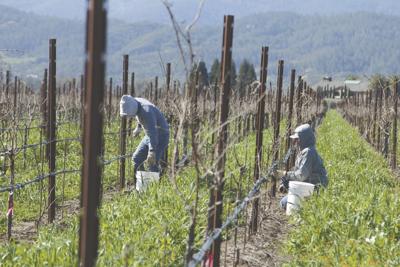
“Every year we spread compost, we do about 5 tons an acre and we broadcast it and its spreading organic material out for both the cover crop and the vines to grow,” White said.
The rolling hills of Napa Valley use cover crops like mustard, buckwheat and daikon radish to stop erosion and nutrient runoff, he added.
“These hillside vineyards need a good cover crop and the roots to go down and hold that soil down because our top soil is so important to us,” White said. “Compost plays a huge part in maintaining that effort.”
Every vineyard is unique and they all have different issues the farmers are trying to correct, White added. The balanced pH of nutrient and organic material is a long-term benefit farmers need to work on for years before they see results. But not all composts are equal and White argues one thing residents can do to help him grow better grapes is continuing to compost their food waste.
“The food waste is essential. I have had compost that doesn’t have food waste and it’s not as good of a quality or dense in nutrients,” White said. “You are eating it for nutrition right? And that same nutrition, the plants need to grow.”
Soil affects the flavor of the grapes and it drives the plant growth. Compost is a huge component, White added.
However, the vineyard is the last stop for compost. After a resident places their green bin on the curb for pickup it travels on a truck to a compost management site, like the Recology Hay Road compost facility in Vacaville. General Manager Kirk Steed said turning organic waste into compost is important for agricultural purposes but it’s also good for the environment to keep it out of landfills.
“Composting is likely the truest and the most local way that people can recycle,” Steed said.
Recommended for you
The compost facility has an 11-step process and the first step is weeding out any non-organic materials that shouldn’t be in the pile. Steed has seen lots of plastic, shoes, wine bottles, plastic bags and even an engine block, he said.
“Those things really degrade the quality of the compost … but it’s difficult to deal with,” Steed said.
The rest of the process deals with aerating, watering, turning and letting worms feed on the burning mounds of muck. Steed and White aren’t the only compost advocates. The push to reduce emissions and climate pollutants have nudged lawmakers in Sacramento. Senate Bill 1383, which went into effect in 2022, means food service providers like grocery stores, supermarkets and wholesalers are responsible for reducing organic material disposal. The two tiered law will roll out its second ordinance by 2024, including large restaurants, hotels, large venues and events, health facilities, schools and state agencies with cafeterias will be required to participate.
Vineyard farmers like White argues there’s more to it than greenhouse gases but water conservation is in play. The density and moisture of the compost acts like a sponge. That is beneficial during droughts, which plagued the state until recently.
When organic material breaks down, Steed said it generates methane and carbon dioxide released back into the atmosphere. He said it’s more beneficial for those gases to be cycled back into the soil where there are more benefits for the plants.
Farms that use compost can grow up to 40% more food during a drought compared to conventional farming techniques, according to the Rodale Institute.
However, compost isn’t just available for world-class vineyards, they are available to residents to put into their gardens. The Shoreway Environmental Center located at 333 Shoreway Road in San Carlos allows residents to take two 50 pound bags of compost each week, for free. Only proof of residency is required.
School gardens are allowed to use up to five 50-pound bags of compost each week and Recology offers delivery options as well.
Keep the discussion civilized. Absolutely NO
personal attacks or insults directed toward writers, nor others who
make comments. Keep it clean. Please avoid obscene, vulgar, lewd,
racist or sexually-oriented language. Don't threaten. Threats of harming another
person will not be tolerated. Be truthful. Don't knowingly lie about anyone
or anything. Be proactive. Use the 'Report' link on
each comment to let us know of abusive posts. PLEASE TURN OFF YOUR CAPS LOCK. Anyone violating these rules will be issued a
warning. After the warning, comment privileges can be
revoked.
Please purchase a Premium Subscription to continue reading.
To continue, please log in, or sign up for a new account.
We offer one free story view per month. If you register for an account, you will get two additional story views. After those three total views, we ask that you support us with a subscription.
A subscription to our digital content is so much more than just access to our valuable content. It means you’re helping to support a local community institution that has, from its very start, supported the betterment of our society. Thank you very much!














(0) comments
Welcome to the discussion.
Log In
Keep the discussion civilized. Absolutely NO personal attacks or insults directed toward writers, nor others who make comments.
Keep it clean. Please avoid obscene, vulgar, lewd, racist or sexually-oriented language.
Don't threaten. Threats of harming another person will not be tolerated.
Be truthful. Don't knowingly lie about anyone or anything.
Be proactive. Use the 'Report' link on each comment to let us know of abusive posts.
PLEASE TURN OFF YOUR CAPS LOCK.
Anyone violating these rules will be issued a warning. After the warning, comment privileges can be revoked.