One of the greatest contributors to the development and understanding of light, electricity and movies was Thomas Edison.
Edison’s lifetime of inventions produced an extension of the life a light-bulb, use of it for homes and cities plus as we know today, almost everything imaginable. The common misconception that he had invented the light-bulb is wrong, just like the misconception that Henry Ford invented mass production. These men improved on ideas and theories that other inventors had started but had not perfected it to the degree that Edison and Ford did. Edison, after of hundreds of experiments finally found a material that could withstand the heat produced by electricity in a light-bulb, carbon filaments.
After he had achieved this breakthrough and patented it, he became curious about how he could make it useful and turn a profit using this information. The light bulb by itself is limited in use. Edison had to develop a system of electric-power distribution to homes, cities and factories plus a safe way to handle it (with insulation that he invented), and keep the cost down to make a profit. It would take millions of dollars to set up this system so he had to form a company that could deal with these problems.
The light being produced in his era was the result of burning kerosene and John Rockefeller supplied this material. To get the money to go into business, he took Rockefeller in as a partner. The biggest opportunity any person could want to happen did when Edison decided to go into business and produce electricity. The Niagara Falls area was to be used so generators could produce electricity for the entire eastern United States and bids were going out for a company to do it.
Edison had a rival in this bidding process – Nikola Tesla. Tesla had invented the alternating current (AC) process to distribute electricity whereas Edison and Rockefeller designed the direct current (DC) process. After a big public relations fight, Tesla’s method of AC distribution won and Edison and Rockefeller became a part of the General Electric conglomerate after Edison changed his mind and began using the AC method. Tesla, although a great inventor, lost out in money and glory with this move and Edison got most of the credit for the biggest distribution system in the U.S. at that time.
Recommended for you
In the 1850s, it was discovered that the human eye could be deceived by a process called “persistence of vision.” A person can view one picture by itself and the eye perceives no movement but of a number of single pictures are strung together and the film moved rapidly, the pictures appear to be in movement because the past picture image remains for a second in the brain (persists), this is enough time to move the frame, and movement of images seem connected and moving.
The projection of the film on a screen became dependent upon a strong, bright light of some sort and his light bulb fit the bill to produce this light. At first the cameras were crude and the “movies” were very short and unrefined but time and many small discoveries changed this problem.
Edison was also interested in sound being recorded and transferred to over long distances. This interest may have come from Edison losing his hearing at a very young age. Many attribute this loss to a bout of scarlet fever during childhood.
Here his experience as a telegraph operator gave him the insight that produced improved telegraphic devices that he patented and eventually resulted in the production of the phonograph in 1877. His discoveries associated with sound also became necessary to incorporate sound onto the film although this didn’t happen for many years. Eventually these “still shots or pictures” were incorporated on a thin sheet of celluloid that could be projected on a screen and a short movie was born. The public went crazy after seeing the first ‘movies” and a whole new industry was born and produced the “roaring 20s.” The first movies were in black and white due to the difficult road to understanding how color could be added to the non-talking film. The explosion for building of movie houses began in the late 1920s and lasted until the new medium of television was unveiled.
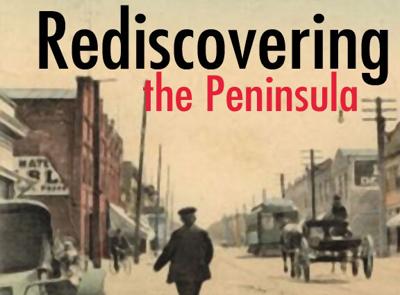
Rediscovering the Peninsula runs every weekend. It is compiled through our archives created by Jim Clifford and the late Darold Fredricks.
Keep the discussion civilized. Absolutely NO
personal attacks or insults directed toward writers, nor others who
make comments. Keep it clean. Please avoid obscene, vulgar, lewd,
racist or sexually-oriented language. Don't threaten. Threats of harming another
person will not be tolerated. Be truthful. Don't knowingly lie about anyone
or anything. Be proactive. Use the 'Report' link on
each comment to let us know of abusive posts. PLEASE TURN OFF YOUR CAPS LOCK. Anyone violating these rules will be issued a
warning. After the warning, comment privileges can be
revoked.
Please purchase a Premium Subscription to continue reading.
To continue, please log in, or sign up for a new account.
We offer one free story view per month. If you register for an account, you will get two additional story views. After those three total views, we ask that you support us with a subscription.
A subscription to our digital content is so much more than just access to our valuable content. It means you’re helping to support a local community institution that has, from its very start, supported the betterment of our society. Thank you very much!






(0) comments
Welcome to the discussion.
Log In
Keep the discussion civilized. Absolutely NO personal attacks or insults directed toward writers, nor others who make comments.
Keep it clean. Please avoid obscene, vulgar, lewd, racist or sexually-oriented language.
Don't threaten. Threats of harming another person will not be tolerated.
Be truthful. Don't knowingly lie about anyone or anything.
Be proactive. Use the 'Report' link on each comment to let us know of abusive posts.
PLEASE TURN OFF YOUR CAPS LOCK.
Anyone violating these rules will be issued a warning. After the warning, comment privileges can be revoked.