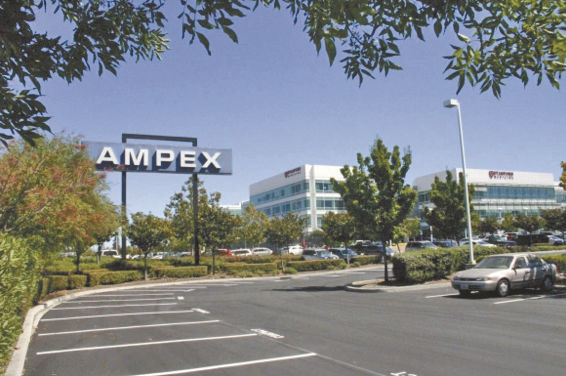
The Ampex sign that for decades was a literal landmark off Highway 101 in Redwood City has been torn down and efforts are being made to find it a new home. So far, no takers, but has anyone tried Germany?
Yes, Germany. Ampex, the pioneering Peninsula company that gave the world so many advances in audio technology, owes a great deal to German enterprise. Our story goes back to World War II when an American army officer listened to the radio in England, tuned in a German station and heard music so clear of scratches and skips that he thought it was a live broadcast.
The officer, Signal Corps Lt. John Mullin, was an electrical engineer in civilian life. He was so impressed with what he heard that he later tracked down German recording equipment. One report said the gear was found in Paris while others say the discovery was in Germany. Wherever it was, Mullin, who died in 1999 at the age of 85, brought the German recording device — called a Magnetophon — and 50 reels of tape back home with him to San Francisco where he demonstrated his modified version of the device to a radio engineering club in 1946. The audience included Ampex engineer Harold Lindsay.
At that time, Ampex was a small San Carlos company that made electric motors for Navy radar systems. Ampex founder Alexander M. Poniatoff was so impressed with the German Magnetophon that he went to work developing an improved tape recorder that could be used for master recording (Ampex takes its name from Poniatoff’s initials plus “ex” for excellence). Ampex moved to Redwood City in the 1950s and became one of the first American companies to make magnetic tape recorders. It is now based in Hayward.
In addition to German scientists, Ampex owes a tip of the hat to singer Bing Crosby, whose voice sounded tinny when recorded on discs. The Crosby show on Oct. 1, 1947, was recorded on Ampex tape and broadcast with Ampex equipment. The show that featured Crosby’s crystal-clear rendition of “My Heart is a Hobo” was so well received some stations were overwhelmed with calls from people who thought the broadcast was live. Shortly afterward, Crosby advanced Ampex $50,000. Elvis Presley added to the company history in 1954 when he recorded his first single, “That’s All Right,” on an Ampex device.
Recording on discs was standard for the broadcast industry in the United States before Ampex changed the game. Discs were easily subject to shock, vibration and temperature changes. The other option was wire recording which was mainly used as a dictation device.
Recommended for you
The Germans were way ahead. In 1938, magnetic tape was standard in Germany and by 1941 all German radio stations were using high-fidelity Magnetophons. A typical radio day in Germany would include live and taped speeches by Nazi officials, interspersed with taped music and commentary. Such flexibility would not come to American radio for nearly 10 more years.
In an article in “High Fidelity” magazine in 1976, Mullin recalled his days in the Army when he worked late into the night troubleshooting radio receiver problems in England. He said he was shocked to discover by flipping the dial that large symphony orchestras were broadcasting late into the night in Germany. He knew by the length of the programs and the high quality of the sound that they were not disc recordings.
“In Germany at that stage, of course, Hitler could have anything he wanted,” Mullin concluded.
Mullin’s determination led to Ampex becoming one of Silicon Valley’s first tech giants with a list of successes that includes the first videotape recorder.
Recently, the Ampex sign was taken down to make way for construction of Stanford’s new satellite campus. A suggestion: Why not put the sign back in its original location and add a marker that tells of the Ampex legacy? As Stanford University was “sensitive” enough to drop its Indian mascot, how about being “sensitive” to Redwood City’s history?
The Rear View Mirror by history columnist Jim Clifford appears in the Daily Journal every other Monday. Objects in The Mirror are closer than they appear.
It would be nice if these paeans to Ampex included some of the contributions the company made to the local neighborhood in Redwood City. Things like the elimination of open space, the security guards running off non employees from the fountain areas, the use of Proposition 13 to stop paying virtually any property tax, for not making any contribution to the community at all, for their shortsighted management of marketing and finance that caused the layoffs for hundreds of workers, the traffic impact on the community from out of town employees, increasing the flooding of south Redwood City by forcing runoff into the Friendly Acres and the mobile home parks. Yess, they were a great neighbor.... and good riddance to that sign.
Incorporated in 1944, Ampex occupied the top floor of the 4-story Dalmo Victor building where Walgreens and Trader Joe's now stand. From 1946 through 1951 the company address was a block north at 1155 Howard Avenue. The move to 934 Charter Street, Redwood City, was in 1952.
Keep the discussion civilized. Absolutely NO
personal attacks or insults directed toward writers, nor others who
make comments. Keep it clean. Please avoid obscene, vulgar, lewd,
racist or sexually-oriented language. Don't threaten. Threats of harming another
person will not be tolerated. Be truthful. Don't knowingly lie about anyone
or anything. Be proactive. Use the 'Report' link on
each comment to let us know of abusive posts. PLEASE TURN OFF YOUR CAPS LOCK. Anyone violating these rules will be issued a
warning. After the warning, comment privileges can be
revoked.
Please purchase a Premium Subscription to continue reading.
To continue, please log in, or sign up for a new account.
We offer one free story view per month. If you register for an account, you will get two additional story views. After those three total views, we ask that you support us with a subscription.
A subscription to our digital content is so much more than just access to our valuable content. It means you’re helping to support a local community institution that has, from its very start, supported the betterment of our society. Thank you very much!







(2) comments
It would be nice if these paeans to Ampex included some of the contributions the company made to the local neighborhood in Redwood City. Things like the elimination of open space, the security guards running off non employees from the fountain areas, the use of Proposition 13 to stop paying virtually any property tax, for not making any contribution to the community at all, for their shortsighted management of marketing and finance that caused the layoffs for hundreds of workers, the traffic impact on the community from out of town employees, increasing the flooding of south Redwood City by forcing runoff into the Friendly Acres and the mobile home parks. Yess, they were a great neighbor.... and good riddance to that sign.
Incorporated in 1944, Ampex occupied the top floor of the 4-story Dalmo Victor building where Walgreens and Trader Joe's now stand. From 1946 through 1951 the company address was a block north at 1155 Howard Avenue. The move to 934 Charter Street, Redwood City, was in 1952.
Welcome to the discussion.
Log In
Keep the discussion civilized. Absolutely NO personal attacks or insults directed toward writers, nor others who make comments.
Keep it clean. Please avoid obscene, vulgar, lewd, racist or sexually-oriented language.
Don't threaten. Threats of harming another person will not be tolerated.
Be truthful. Don't knowingly lie about anyone or anything.
Be proactive. Use the 'Report' link on each comment to let us know of abusive posts.
PLEASE TURN OFF YOUR CAPS LOCK.
Anyone violating these rules will be issued a warning. After the warning, comment privileges can be revoked.