Early geology history: Twenty-thousand years ago, the area was affected by ice age — ocean dropped 300 feet; it was dry to Farallon Islands to west; small San Jose River in middle of Bay. There was a land bridge from Asia to Alaska; migration was on land and sea. Glaciers melt about 20,000 years and, from 4,000 to 5,000 years ago, man (Indians) began migrating into the Bay as water from glacial melt filled the valley to east of San Bruno and forms the Bay. Indians found climate mild with plenty of food and a bountiful Pacific Coast flyway for migrating birds.
Biodiversity and overview of early times: Bears, coyotes, ducks, steelhead trout, mussels, clams and seeds were abundant so the Indians became gathers and migrated from the Bay side to the hills to the west as the season afforded food. They developed no written language. They lived in tule (reeds) huts that lasted one year before they rotted and became unlivable. The huts were rebuilt the next year. They did not build any adobes, etc.
It has been calculated that approximately 10,000 Indians lived from the head of the Peninsula and Monterey in small groups called tribelets. There no overall organized society outside of small groups of about 50 to 100 Indians.
In 1769, Gaspar de Portola expedition discovers San Francisco Bay; Monterey becomes capital of Alta, Calif. In 1774 Juan Bautista de Anza blazes land trail to California from Mexico (Arizona).
In 1776, Juan Bautista de Anza and 240 colonists arrive in the Bay Area to settle and established the San Francisco Mission Dolores to control the area in Palo Alto (San Francisquito Creek).
Early Mission Days: In 1776, the Presidio and Mission were established. Mission Dolores and Santa Clara became social/religious centers; Indians grouped at missions to join Catholic church and learn farming skills; harsh treatment due to lack of communication by Padres; disease begins killing natives.
In the 1780s, San Pedro Valley (in Pacifica) was used to grow food. By the 1790s, disaster (measles, etc.) wiped out Indians on coast.
In the 1780, use of San Mateo area to grow food was suited best and extensive use of it for grains began. Cattle and horses graze on Peninsula and thrive.
Conflict with military over Rancho Buri Buri use by the church. South San Francisco Rancho del Rey was established by the military.
California left to survive by own devices by Spanish government and the people began selling hides and tallow to Yankee skippers although it was illegal. A few English and Americans “jump ship” and began developing logging areas (Woodside) and ranches (San Bruno Mountain).
In 1821, Mexico acquires Spanish territory in North America and the missions lose power and land. Huge parcels of land are granted to hundreds of Mexican subjects.
Recommended for you
1836, Rancho Buri Buri granted to Jose Antonio Sanchez (Anza soldier) with 15,000 acres; located South of San Bruno Mountain; south to Burlingame; east of El Camino Real to crest of mountains). Sanchez died in 1843 and 10 children get 1,500 acres each; Rancho breaks up; time of turmoil as Texas gains independence from Mexico and California gains statehood in 1850. In 1835, there was approximately 35 people in Yerba Buena (San Francisco).
Gold Rush to California: By 1850, approximately 50,000 people in San Francisco and numbers increase in 1850s.
In 1849, the 14-Mile House (Uncle Tom Cabin) was built (lasted 100 years).
In 1861, San Bruno House was built; In 1859, San Bruno Toll Road (San Mateo Avenue) built.
San Francisco and San Jose Railroad train built in the 1860s; became SP in the late 1860s.
Jenevein’s Junction House (San Mateo Avenue and El Camino Real) built in 1889
In 1856, San Mateo County formed; Redwood City becomes county seat
1870s, Sneath and Tanforan build farms and dairy north of area; Custodio Silva ranch on El Camino Real (across from Tanforan race track). Repetto/Pastorino grew vegetable gardens and farmers used the land.
In 1899, Tanforan race track was built north of city; population approximately 100; land platted for houses; early 1900s, population approximately 150; in 1914, 1,400 residents; in 1950, 12,409; in 1954, 15,623; April 1960, 27,850; December 1960, 29,063; April 1962, 31,850; 1964, 35,200; 1998, 40,000.
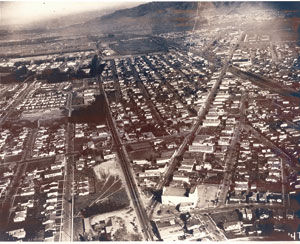
Between 1950 and 1965, the two square miles of San Bruno became six square miles of houses and the city experienced the greatest building boom it has ever had.
Rediscovering the Peninsula by Darold Fredricks appears in the Monday edition of the Daily Journal.
Keep the discussion civilized. Absolutely NO
personal attacks or insults directed toward writers, nor others who
make comments. Keep it clean. Please avoid obscene, vulgar, lewd,
racist or sexually-oriented language. Don't threaten. Threats of harming another
person will not be tolerated. Be truthful. Don't knowingly lie about anyone
or anything. Be proactive. Use the 'Report' link on
each comment to let us know of abusive posts. PLEASE TURN OFF YOUR CAPS LOCK. Anyone violating these rules will be issued a
warning. After the warning, comment privileges can be
revoked.
Please purchase a Premium Subscription to continue reading.
To continue, please log in, or sign up for a new account.
We offer one free story view per month. If you register for an account, you will get two additional story views. After those three total views, we ask that you support us with a subscription.
A subscription to our digital content is so much more than just access to our valuable content. It means you’re helping to support a local community institution that has, from its very start, supported the betterment of our society. Thank you very much!






(0) comments
Welcome to the discussion.
Log In
Keep the discussion civilized. Absolutely NO personal attacks or insults directed toward writers, nor others who make comments.
Keep it clean. Please avoid obscene, vulgar, lewd, racist or sexually-oriented language.
Don't threaten. Threats of harming another person will not be tolerated.
Be truthful. Don't knowingly lie about anyone or anything.
Be proactive. Use the 'Report' link on each comment to let us know of abusive posts.
PLEASE TURN OFF YOUR CAPS LOCK.
Anyone violating these rules will be issued a warning. After the warning, comment privileges can be revoked.