
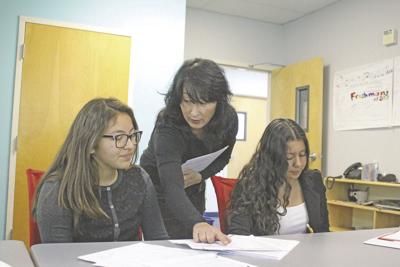
San Mateo County’s newest charter high school is focused on building independently-driven students bonded closely with their community, but some are finding sizable hurdles come with the ambitious vision.
Oxford Day Academy opened in East Palo Alto to a class of roughly 50 freshmen who comprise the inaugural class of the most recent addition to the Sequoia Union High School District.
The school founded by educator Mallory Dwinal aims to enhance a student’s self-determination by offering them more authority in managing their learning, both in and out of the classroom.
But after nearly two months since the first class started, officials are beginning to wonder whether refinements of their vision are in order to more appropriately implement the innovative model.
“There are challenges. The question is whether these are challenges that are insurmountable,” said Dwinal, who last year received charter approval from the county Office of Education to launch the school following the district Board of Trustees initially rejecting it due to feasibility concerns.
Beyond the baseline difficulties of getting a new school up and running with all the technology and requisite infrastructure in place, Dwinal said there are also kinks to be worked out in the academic program promoting critical thinking through real world scenarios, with a special emphasis on social service.
Students are expected to spend half their school time working with community service organizations such as churches, nonprofits and public safety agencies, which Dwinal said requires administrators of those programs to raise their expectations of the teens.
She added more coordination is required with the surrounding community as well to train residents that it is OK for students to be off campus during school hours.
Clear communication is essential to reach the school’s academic mission too, said Dwinal, as students are assigned work emphasizing analytical processes and problem solving.
When struggles occur, teachers are encouraged to collaborate alongside their subjects rather than hand down answers. The unconventional approach can be both challenging and rewarding for some students who are more familiar with a traditional school model.
“When I ask for help, the teacher gives me guidance on how to get the answer and doesn’t just give me the answer,” said Sofia Sandoval, a 14-year-old East Palo Alto native.
She said the constructive interaction not only builds her confidence in working through obstacles, but it also fosters a trust with educators expanding beyond the classroom.
Sandoval claims the dynamic encourages her to share with her teachers details of her personal life and home issues which otherwise may have made her feel uncomfortable discussing.
But the focus on individual learning can be difficult as well, said Fernando Chavez, especially for students who are not accustomed to a learning environment more akin to college than middle school.
Essential to the model is teachers and administrators trusting lessons are being understood and retained but, when students fall behind, they may not feel comfortable asking for help, said Chavez, 14.
Recommended for you
Such a scenario can lead to conflicting emotions, according to Jahkim Hendrix, of East Palo Alto, who said he appreciated the intent of the curriculum but suggested improvements are in order for best implementation.
Top of mind for Hendrix, 14, is a need for more dialogue between students and educators as the academy community works together in getting the school off the ground.
He said the agency afforded to students can help build their character, as they gain a greater sense of responsibility for taking charge of their education. But with that comes a desire to be more participatory in suggesting improvements, he said.
A primary example offered by Hendrix is a wish that administrators would grant more opportunities for students to work with community organizations in building the partnerships central to their education.
Students can repair bikes for local churches, help the local police department with its website or social media outlets, work with performing art organizations on music or other productions and a variety of other initiatives.
The educational model promotes the programs as a means of connecting students to their community and establishing a value to working alongside service-oriented organizations, said Dwinal.
While the work should better prepare students for college and careers, she said the higher emphasis is promoting a philosophy encouraging students to be active and engaged in their surroundings.
Hendrix though said students should be more integral in building those opportunities and expanding them to local businesses like Facebook, which is headquartered a short distance away.
“Why not have better alliances that allow us to put [Oxford Day Academy] on the map?” questioned Hendrix.
To hear students sufficiently empowered to start expressing such sentiments so early into their time at a new school is equal parts encouraging and disconcerting for Dwinal.
“It’s starting to click for students. It’s heartening to see them begin to take that up, but it’s also a challenge,” she said.
With such issues raising plenty of tough questions, the search for answers regarding whether the innovative academy endures will be revealed through the test of time.
(650) 344-5200 ext. 105





(2) comments
Wow! This sounds like the kind of school that will graduate winners!
Define what a winner is ?
Welcome to the discussion.
Log In
Keep the discussion civilized. Absolutely NO personal attacks or insults directed toward writers, nor others who make comments.
Keep it clean. Please avoid obscene, vulgar, lewd, racist or sexually-oriented language.
Don't threaten. Threats of harming another person will not be tolerated.
Be truthful. Don't knowingly lie about anyone or anything.
Be proactive. Use the 'Report' link on each comment to let us know of abusive posts.
PLEASE TURN OFF YOUR CAPS LOCK.
Anyone violating these rules will be issued a warning. After the warning, comment privileges can be revoked.