
The 1910s were a decade of discontent. German forces were doing their best to expand the holdings of their country and they completely shook up Europe in the process. The French and English were battling it out mainly on French soil but the war was not going well. It became a stalemate with lives being lost on all sides every day.
Strong opinions in America were keeping our country of out of the conflict, however the stalemate of armies was something that many felt could be changed if we sent troops into the conflict. Eventually, our leadership felt it was time to help straighten things out in Europe and the United States formed the American Expeditionary Force. General John J. Pershing was put in charge of the AEF in May 1917. Realizing the U.S. Army was not trained and equipped to enter the battle, a hurried agenda of recruiting, training and transportation was begun but this resulted in a slow deployment of troops until 1918. By June 1917, 14,000 U.S. soldiers were in France and, by May 1918, more than one million were in the trenches fighting.
At the same time Germany was at war, Italy was involved in hostilities and the Bolshevik Revolution was being fought in Russia that would eventually change the world for many years. Russia is a vast country with very diverse geology and weather. The fighting in Russia was different than what was occurring in France. It was spread out and the antagonists were grouped in "pockets” of power over the entire country — there was no central nucleus of resistance to fight and sporadic action occurred that resembled guerilla warfare. Fearful of losing materials and supplies that we had sent to western Russia, around the port city of Vladivostok, President Woodrow Wilson decided that we must send troops to Russia to counteract the forces of Japan, China and Czechoslovakia we thought were in danger of grabbing power and upsetting the entire region’s political situation.
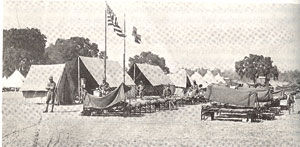
On July 18, 1917, a training center of troops to be sent into battle was opened in Menlo Park, Calif. Recruits from Washington, Oregon, Idaho, Wyoming, etc. began arriving in the little hamlet of 2,300. Construction began to house the expected 40,000 men on July 27, 1917 on 7,203 acres of land the government acquired west of El Camino Real. In addition to men, thousands of horses were stabled to the east of El Camino Real in the vicinity of the future hospital facilities. Soon after the more than 1,124 structures were built, cannon and rifle fire began being heard from the hills to the west. Training had begun.
Menlo Park had become a boomtown. Every structure for miles around was being used to either house wives, children or merchants who heard of the fortunes that could be made off of the army and soldiers. The area was in complete turmoil and the government immediately tried to avoid some problems by declaring five miles around Menlo Park a "dry” zone. This was later extended to 10 miles.
Recommended for you
Finally, in August 1918, plans were made to deploy the 27,000 troops to France. This destination was changed almost immediately and it was decided to send these men to Russia to gain a presence in the Vladivostok area and protect the supplies we had sent to Russia even though we didn’t know who was in charge. It appeared that everybody and nobody was in charge and the men of Camp Fremont were sent to this frigid climate unprepared and ill-clothed. It was a living hell for the soldiers. The soldiers lived in boxcars while there and patrolled the recently completed Trans-Siberian Railroad to keep it from falling into enemy hands. The commanders didn’t know what their mission was and the soldier’s morale was very low.
The World War I Armistice of Nov. 18, 1918 didn’t have an effect on the revolution in Russia. Our soldiers continued to serve in Siberia until April 1920. The Red Army capture on Oct. 22, 1922 marked the end of the Russian Civil war and began many decades of strife, mistrust and the "cold war” of the ’50s through the early ’90s.
Rediscovering the Peninsula by Darold Fredricks appears in the Monday edition of the Daily Journal.





(0) comments
Welcome to the discussion.
Log In
Keep the discussion civilized. Absolutely NO personal attacks or insults directed toward writers, nor others who make comments.
Keep it clean. Please avoid obscene, vulgar, lewd, racist or sexually-oriented language.
Don't threaten. Threats of harming another person will not be tolerated.
Be truthful. Don't knowingly lie about anyone or anything.
Be proactive. Use the 'Report' link on each comment to let us know of abusive posts.
PLEASE TURN OFF YOUR CAPS LOCK.
Anyone violating these rules will be issued a warning. After the warning, comment privileges can be revoked.