Earlier this year, a columnist for a San Francisco newspaper urged the Bay Area to “be bold” and run trains across the Golden Gate Bridge. Surprisingly, the writer never noted that decades ago trains carried commuters over the Bay Bridge.
The electric-powered trains that ran on tracks on the lower section of the bridge were part of the Key System, which operated an extensive street car and bus network in the East Bay as well as a fleet of ferry boats. The trains started carrying passengers across the span on Jan. 15, 1939, the day after the opening of the Transbay Terminal in downtown San Francisco, located just a few blocks from the Ferry Building. The terminal site is now being converted to a regional transit center for the Bay Area. Supporters of the approximately $8 billion project hope it will become the “Grand Central Station of the West” by connecting eight Bay Area counties through 11 transit systems.
The original terminal at First and Mission streets was designed to handle as many as 35 million passengers a year. According to the Transbay Center website, the system’s heyday was at the end of World War II when the rail system transported 26 million people annually. After wartime gas rationing ended, the passenger load gradually decreased, declining to around 5 million people traveling by rail per year. In 1958, the lower deck of the bridge was converted to auto traffic only and, in 1959, the terminal was a strictly bus-only facility.
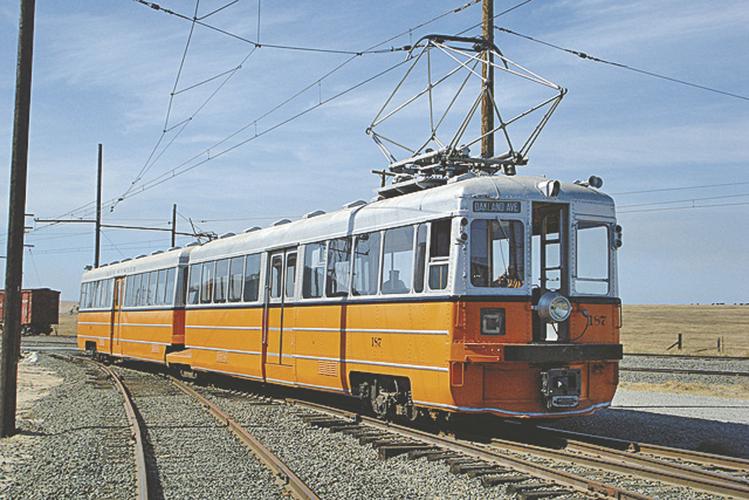
The Key System name disappeared in 1960 when the Alameda-Contra Costa Transit District took over Key System bus lines. According to the Western Railway Museum in Suisun City, which has the largest collection of surviving Key System equipment, many AC Transit buses follow the same routes used by Key System trains and streetcars. The museum’s collection includes articulated all-steel cars designed and built specifically to run across the bridge. The museum’s Key System cars are in working order and operate on weekends. They are especially popular this time of year when the destination is a pumpkin patch. The official name of the system was “San Francisco, Oakland and San Jose Consolidated Railway,” which was not very catchy. The “Key” came when someone noticed that a route map resembled an old-fashioned key.
The last run across the bridge came on April 20, 1958, with 500 passengers jammed in to the train for a farewell ride. The Key System traced its birth back to 1893 when Francis “Borax” Smith of “Twenty Mule Team” fame started buying railroads, street car lines and real estate in the East Bay. His company holdings included the Claremont Hotel in the Berkeley hills, a landmark once described by famed architect Frank Lloyd Wright as “one of the few hotels in the world with warmth, character and charm.”
The realty company Smith formed with San Francisco lawyer Frank Haven and East Bay developer John Spring also owned the Key System. Plans called for running trains directly into the lobby of the Claremont. The “E” line never made it that far. It stopped between the hotel tennis courts. The tracks were removed when the line ended service in 1958. The tennis courts are still there, with a path between them where the track used to be. Now that is an unusual “rail to trail” story.
The Rear View Mirror by history columnist Jim Clifford appears in the Daily Journal every other Monday. Objects in The Mirror are closer than they appear.
Keep the discussion civilized. Absolutely NO
personal attacks or insults directed toward writers, nor others who
make comments. Keep it clean. Please avoid obscene, vulgar, lewd,
racist or sexually-oriented language. Don't threaten. Threats of harming another
person will not be tolerated. Be truthful. Don't knowingly lie about anyone
or anything. Be proactive. Use the 'Report' link on
each comment to let us know of abusive posts. PLEASE TURN OFF YOUR CAPS LOCK. Anyone violating these rules will be issued a
warning. After the warning, comment privileges can be
revoked.
Please purchase a Premium Subscription to continue reading.
To continue, please log in, or sign up for a new account.
We offer one free story view per month. If you register for an account, you will get two additional story views. After those three total views, we ask that you support us with a subscription.
A subscription to our digital content is so much more than just access to our valuable content. It means you’re helping to support a local community institution that has, from its very start, supported the betterment of our society. Thank you very much!



(0) comments
Welcome to the discussion.
Log In
Keep the discussion civilized. Absolutely NO personal attacks or insults directed toward writers, nor others who make comments.
Keep it clean. Please avoid obscene, vulgar, lewd, racist or sexually-oriented language.
Don't threaten. Threats of harming another person will not be tolerated.
Be truthful. Don't knowingly lie about anyone or anything.
Be proactive. Use the 'Report' link on each comment to let us know of abusive posts.
PLEASE TURN OFF YOUR CAPS LOCK.
Anyone violating these rules will be issued a warning. After the warning, comment privileges can be revoked.