
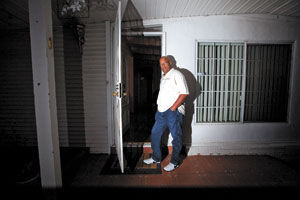
At any given moment you could walk to the refrigerator, open the door and glance inside.
Seeing nothing appetizing, the door is closed. It’s a simple, nearly everyday occurrence for most people. But is it a freedom?
For East Palo Alto resident Rick Walker it is.
Walker spent 12 years locked up for a murder he didn’t commit longing for the smallest freedom or sense of privacy. In 2003, he was released after being found factually innocent.
"I knew in my heart that I would get out. It was just a matter of when and how,” he said.
While it would be easy to understand how such an experience could make someone bitter or angry, Walker is an optimistic man always looking for the positive in any situation.
When released he had no money, no career and no place to call home. During his 12-year prison term, Walker had missed his son growing up, his father’s passing and the deaths of numerous other family members.
He rejoined a population in which children had cell phones and the Internet was commonplace — two wildly popular technologies which were not mainstream when Walker was locked up in 1991 at the age of 35.
Even after his release, Walker’s battle wasn’t over.
State Sen. Joe Simitian, D-Palo Alto, gutted a bill and re-wrote it to compensate Walker $100 for each day he spent wrongly locked up. Passing the bill, which provided just over $400,000 for Walker, wasn’t an easy task during a difficult budget year that required multiple votes.
It’s this effort that is chronicled in "$100 a Day,” a documentary to be shown in Foster City Monday. Walker will be on hand to talk with those in attendance after the film.
A murder charge was not the path Walker’s life seemed to be headed.
He grew up with a loving family in a good home in San Francisco. His parents later moved to East Palo Alto to fulfill his father’s dream to own property with land. Walker used the space on the property to run his own mechanic business, a job he admitted allowed him the opportunity to fund his recreational drug habit.
Walker also had a son, William, named after Walker’s father.
Walker had previously dated Lisa Hopewell but the two had split before she was found wrapped in duct tape and mutilated in her Cupertino apartment in 1991. A man whose fingerprints were found at the crime scene made a deal with prosecutors and named Walker as the killer.
"I was that person from East Palo Alto,” Walker said.
The city’s homicide rate was high at the time. Walker was a black man from a violent city who did not have an emotional reaction to the news of his former girlfriend’s murder.
"All they had to do was paint me in a negative light,” he said.
And they did.
Recommended for you
Walker was sentenced to 26 years to life for the murder of Hopewell. He spent years in prisons like San Quentin and Pelican Bay, known for housing the toughest of the state’s criminals.
Inside, Walker was met with other problems. A clerical error diminished his academic aptitude tests meaning Walker was required to take courses. He was also restricted from certain jobs since his crime was listed as having a sexual nature — a fact Walker successfully fought to change while in prison.
During his tenure behind bars, Palo Alto native Alison Tucher, an attorney who had been a third-year law student when Walker went into prison, worked to prove his innocence. She was able to convince the Santa Clara County District Attorney’s office of his innocence in 2003 after finding multiple witnesses and other evidence to prove Walker wasn’t at the murder scene. In a matter of days, Walker was freed.
Since then, two men were charged with Hopewell’s murder — a drug dealer named Rahsson Bowers, who had originally turned on Walker, and Mark Swanson. Both are now in prison.
Walker left his cell at 9 a.m. on a June morning in 2003. By 1 p.m., he and his mom were driving through East Palo Alto again on his way home.
Getting home followed with a flurry of media coverage before the real work of rebuilding his life began.
Walker started to look for a job, which he found at Precision Automotive in Palo Alto, where he’s been ever since. Three months after his release, Simitian’s bill passed and Walker received the $400,000 payment. Even with the money in the bank, Walker couldn’t purchase a home. He had no credit. Eventually he bought his mother’s home. She moved to a new place in Clear Lake. She sold him the house on one condition — his nieces who were living there while attending school could stay.
Walker obliged. Today one of his nieces is about to enter her junior year at Columbia University. The other is starting her senior year at Eastside College Preparatory School. Some may say he’s tough on the girls, but he sees it as preparing them to be self-sufficient. He’d do anything to help them, or any young family member, to be successful and tears up talking about his love and support for his family.
"It’s their time,” he said.
Stories about his granddaughter, a little girl named Ava Monroe who will soon be 2, also causes his eyes to water. Being able to take her shopping — even if it means buying more than he had hoped — is a privilege he wasn’t sure he’d have.
Walker is truly a thankful man. He tells stories about how much he learned in prison from classes, but also the people. He forgives those who turned on him noting they were simply doing what they needed to do to survive.
"Mad only affects you,” he said.
It’s that positive outlook that colored every story Walker told over lunch this week.
People always talk about the negativity of a situation, that’s what they want to know from Walker as well. But that’s not his focus. It’s not about being angry or bitter. It’s about looking forward.
"How strong did it make you?” he said.
That’s Walker’s focus when looking back. It made him stronger, more appreciative, and thankful for what he has now.
The documentary "$100 a Day” will be shown 2 p.m. Monday, Aug. 9 at the Peninsula Jewish Community Center, 800 Foster City Blvd., Foster City. The cost is $4. Walker will be on hand to take questions after the screening. For more information call 212-PJCC or visit pjcc.org.
Heather Murtagh can be reached by e-mail: heather@smdailyjournal.com or by phone: (650) 344-5200 ext. 105.





(0) comments
Welcome to the discussion.
Log In
Keep the discussion civilized. Absolutely NO personal attacks or insults directed toward writers, nor others who make comments.
Keep it clean. Please avoid obscene, vulgar, lewd, racist or sexually-oriented language.
Don't threaten. Threats of harming another person will not be tolerated.
Be truthful. Don't knowingly lie about anyone or anything.
Be proactive. Use the 'Report' link on each comment to let us know of abusive posts.
PLEASE TURN OFF YOUR CAPS LOCK.
Anyone violating these rules will be issued a warning. After the warning, comment privileges can be revoked.