
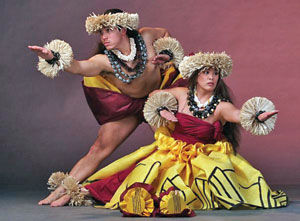
The soothing vibrations of Hawaiian music, rich in sentiment, bring a sense of calm and aloha to listeners across the world. References to the sounds of wind blowing through the trees or the pour of rain on the earth are themes often represented in the customary pacific-islander dance, the hula.
This Saturday, the public is invited to celebrate Hawaiian culture with a commemorative hula performance.
The ancient narration of the islands and its people was traditionally passed down by oral accounts. Hula embodies these transcendental legends, timeless to the Hawaiian people. Each hula song and dance is a story within itself, full of one’s mana, loosely translated as sacred spiritual energy. A method of imparting the history and beliefs of the culture to future generations, hula continues to engage and educate viewers of all ethnicities.
Kawika Keikiali’i Alfiche, 39, has established the Kaululehua Hawaiian Cultural Center to foster the continuance of his culture on a local level.
The center, also known as a halau, meaning house or school, opened in 2003. It provides teachings in Hawaiian culture, mythology, music, dance, dress and instrument construction and chant, Alfiche said. In addition to the current center in San Bruno, Alfiche said he has been teaching in other parts of Northern California, Utah, the East Coast and Mexico since 1994. Alfiche has performed on Broadway and was reviewed by the New York Times, he said.
Alfiche has organized a performance this Saturday titled Hula Pahu, the sacred dances. His students, and seven other hula halaus, or schools, from other Bay Area cities, along with Hawaii and Maui, will be performing, Alfiche said. Based on the sacred shark-skinned drum, the first act is in a traditional style and the second is a modern adaptation, part of which he has choreographed and composed, Alfiche said.
"It’s about the migrations that came to Hawaii. One of the big migrations that came in was with that drum, and with that changed everything; changed religion, changed dance, changed what it means to pray,” Alfiche said.
The recital is a combination of story, song, dance and visual projections, Alfiche said. The traditional costumes, instruments and accessories worn by performers are uniquely handmade, Alfiche said. There will be Hawaiian snacks and a silent auction including a three-day trip to Mexico. Alfiche said 900 presale tickets have been sold and he hopes more people will attend.
Alfiche has grown to the status of a kumu hula, or teacher of the traditional music, chants and dance. The song and chant paired with formal hula is not found in textbooks, but is passed down through a lineage of kumus, Alfiche said. His kumu lineage dates back to Kumu George Na’ope who founded the Merrie Monarch Festival, the prestigious hula competition, Alfiche said.
At the cultural center, Kumu Alfiche said he provides workshops open to the public such as lei making, drum making, intro dance classes and summer children’s camps. Although the center and the halau are physically in the same building, joining the halau is a commitment to fall under the lineage of one’s teacher, Alfiche said.
"When you join a halau, you have to learn the language, the chant, you have to learn what the dance is about; otherwise you shouldn’t even dance it,” Alfiche said.
Halau dance classes of a dozen students occur every day. His student body has grown to approximately 100 dancers between ages 3 and 80. Their small monthly fees help sustain the center, Alfiche said.
Recommended for you
Born in San Francisco to parents of Hawaiian decent, Alfiche has carved an outlet for cultural growth in his Bay Area home. Traveling to and from the Hawaiian islands was commonplace, Alfiche said, as his parents worked for United Airlines and Pan American World Airways.
A singer, chanter, musician and composer, Alfiche has recorded two CDs; the proceeds have gone to maintaining the center, Alfiche said. Alfiche said his income is made by frequently traveling to teach and perform.
There are hula dancers throughout different parts of the world, including an estimated 1 million in Japan and Mexico, Alfiche said. He often visits Mexico to teach and perform, Alfiche said.
Rosa Elena López Arriaga, 42, is a Mexican native who has been hula dancing for 20 years. Alfiche said he and Arriaga studied under the same kumu, so she is his hula sister. For Arriaga, hula is transcendental.
"I transform my body and I feel like another person … I don’t see anything in the moment,” Arriaga said.
Arriaga and Alfiche revere and continue to feel the mana of their kumus.
Alfiche is dedicated to learning and teaching about his native culture and hula. He hopes to bring the Hawaiian culture to those who haven’t had the opportunities he has. Although he longs for Hawaii, he believes he is here for a noble reason.
"I’m here because of my halau, because of my love for what I have to do, because of my responsibility to my lineage and to my kumu,” Alfiche said.
Hula Pahu is this Saturday, Aug. 18, from 7 p.m.-9 p.m. at the South San Francisco High School at 400 B St., South San Francisco, 94080. Tickets are $30 at the door and $25 presale. To reserve presale tickets email info@apop.net or call at (650) 588-1091. For more information about the center and upcoming events visit www.apop.net.


(0) comments
Welcome to the discussion.
Log In
Keep the discussion civilized. Absolutely NO personal attacks or insults directed toward writers, nor others who make comments.
Keep it clean. Please avoid obscene, vulgar, lewd, racist or sexually-oriented language.
Don't threaten. Threats of harming another person will not be tolerated.
Be truthful. Don't knowingly lie about anyone or anything.
Be proactive. Use the 'Report' link on each comment to let us know of abusive posts.
PLEASE TURN OFF YOUR CAPS LOCK.
Anyone violating these rules will be issued a warning. After the warning, comment privileges can be revoked.