
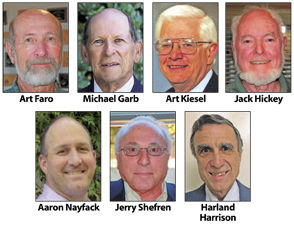
Whether the Sequoia Healthcare District should be dissolved or continue to allocate funds to a variety of organizations providing health care programs is the key issue defining the priorities for the seven candidates vying for three seats on the five-member board.
Largely bounded by parts of Foster City and Menlo Park as well as Woodside to the west, the district will conduct a zone-based election for the first time this November after officials late last year voted unanimously to switch from at-large to zone-based elections in an effort to increase voter participation and expand the pool of candidates pursuing the seats.
Challenging incumbent Arthur Faro in Zone A, which includes Redwood Shores and Foster City, are former Foster City mayor Art Kiesel and retired nonprofit CEO Michael Garb. Board member Jack Hickey is being challenged by physician Aaron Nayfack for the seat in Zone C, which includes San Carlos and Emerald Hills. In Zone E, which extends from Portola Valley to parts of Belmont, incumbent Jerry Shefren is facing challenger Harland Harrison. The terms for board President Kathleen Kane and Kim Griffin, who currently serves as the board’s vice president, will expire in 2020.
Expected to generate some $12.5 million in taxes for distribution toward grants and programs in the 2018-19 fiscal year, the district has supported the operations of Samaritan House’s medical clinic in Redwood City, the Ravenswood Family Health Center in East Palo Alto and a variety of other programs and nonprofits, such as Peninsula Volunteers, which coordinates Meals on Wheels deliveries, and the Boys and Girls Club of the Peninsula to provide youth fitness and wellness programs, according to a staff report.
Having served on the board for some 12 years, Shefren said he’s proud of the role the district has played in investing in critical health care programs and prevention strategies most insurance companies, hospitals and government agencies wouldn’t otherwise provide. By working with school districts, community nonprofits and other local organizations to support their work or on specific health initiatives, Shefren noted the district has been able to target the needs of specific subsets of the population or emerging health care issues.
“We are, for the most part, filling gaps in health care,” he said. “Overall, we’re simply looking to move the needle on health care on a particular age group or a particular health care problem.”
But three candidates are calling the district’s collection of taxes into question, arguing that because the district no longer supports the Sequoia Hospital as was its purpose when it was formed in 1946, it should no longer collect taxes for health care services unless voters approve. Though the district oversaw the Sequoia Hospital for decades, it was eventually handed to the nonprofit now known as Dignity Health and in 2007, the district contributed some $75 million to construct a new facility while releasing its supervisory role by giving up seats on the hospital’s governing board.
Long dissolution battle
Hickey said it’s been his position since he was elected to the board in 2002 that, after the sale of the hospital, the district no longer had a mandate to collect taxes. If the district stopped collecting taxes, Hickey argued, taxpayers would benefit from a reduction in their annual property taxes and should have an opportunity to weigh in on how they are used.
“The status quo is no longer an option,” he said. “[Let’s] stop collecting the taxes [and] get a meeting of the stakeholders to discuss how we can get a ballot measure that would allow the voters to decide the future of these districts.”
Hickey is hoping Harrison and Kiesel will be elected to join him on the board, affording them the majority they would need to take steps toward putting the issue to voters, voting against allocating funds toward health services or merging the district with the Peninsula Health Care District, which funds community health care programs and resources for residents of Burlingame, Foster City, Hillsborough, Millbrae, San Bruno and San Mateo.
With a background in finance, Kiesel said he has served on the City/County Association of Governments’ finance committee as a Foster City councilmember. Focused on making sure taxpayers have a say on where their taxes go, Kiesel advocated for increased accountability on how district funds are being spent to ensure they are not duplicating efforts with other agencies, such as the county, which also dedicates funds to health programs.
Kiesel also took issue with the possibility district funds may not have strictly benefited district residents, noting he felt some of the district’s grant recipients may have served clients outside the district’s boundaries.
“Twelve-million-dollars worth of taxes are being disbursed, not for a hospital because they do not own the hospital anymore, but on other issues,” he said. “The point is it may be good for the citizens, but the voters have not approved that.”
Having served as the CEO of the Sequoia Hospital and as a district board member for some 20 years, Faro felt very strongly the district is playing a vital role in supporting district residents in school, at senior centers and through programs aimed at keeping them out of hospitals. He said he would hate to see the district dissolve, noting it can help residents and health care providers make the transition to fewer hospital stays and care increasingly being offered at community clinics and through preventative programs.
Recommended for you
“Districts throughout the state are changing from running hospitals to community support and I feel that’s a good role,” he said.
Though Harrison, who described himself as a libertarian, said he would be open to merging the two health care districts in the county, he preferred taking steps toward dissolving it altogether.
“It is unjust, it is unreasonable,” he said. “There shouldn’t be any such thing as a Sequoia Healthcare District. It’s an arbitrary line thrown on a map to divert tax money.”
Having run for a seat on the board in 2016, Harrison acknowledged the possibility he may be elected to the seat but not part of a majority vote to dissolve the district, noting in that situation he would focus on ensuring district funds stay in the district.
Support of district’s shift
Both Garb and Nayfack supported keeping the district intact and commended its support of community health care programs to date. Garb is a former board member for the Belmont-Redwood Shores Elementary School District, formerly the CEO of the nonprofit StarVista and a commissioner for First 5 San Mateo. He said he has a good feel for community needs and supported the district’s role in helping residents who might not otherwise receive health care access to critical resources.
“I think there’s a great need for health and wellness in this community,” he said. “Taxpayer money is being well spent on services for those people.”
Having served on the district’s grants committee, Garb said he felt comfortable with the mix of nonprofits and organizations the district has funded, but pegged an interest in studying how mental health resources and programs for child between the ages of 0 to 5 and their families could be bolstered in the county.
Nayfack, who works as a physician for the Palo Alto Medical Foundation clinic in San Carlos, said he’s come to see the district as a critical source of support for the health of the local community, noting the district’s Healthy Schools Initiative and 70 Strong, which aims to boost seniors’ access to tailored resources, as examples of the targeted way in which the district has increased access to care.
As the only practicing physician among the candidates in the race, Nayfack felt he has a good pulse for the needs of families in the district. Though he felt the district has taken steps in addressing some of those needs, he advocated for strengthening partnerships between agencies providing health care in the district and focusing even more attention on mental health resources.
Having earned a master’s in public health, Nayfack said he could see the value in a communitywide approach to health care, and said he felt a communitywide perspective was missing in Hickey’s approach to overseeing the district’s funds. Nayfack said he’s also observed a transition in health care from hospitals being the central place where patients receive care to a more distributed set of centers or clinics addressing patients’ needs and felt the shift in the district’s focus from supporting a hospital to community programs made sense.
“I think it absolutely makes sense and is completely 100 percent appropriate for the health care district to have shifted as well,” he said.
(650) 344-5200 ext. 106



(1) comment
With control of the Board, we would have the power to suspend grants, slash overhead, and reduce or suspend collection of property taxes on an annual basis. This would result in direct savings to property owners. Such an action would bring stakeholders, with an interest in a share of the General 1% property tax, to the table. This would lead to a dialogue addressing the transitional status of the Sequoia and Peninsula Healthcare Districts. It is my intent to have these stakeholders join in a petition to LAFCo seeking an election to resolve the issue created when these hospital districts sold their hospitals, yet continued to collect taxes. The "status quo" is not an option. Voters must decide whether the two districts should be:
1. dissolved; or,
2. consolidated and expanded to include all of San Mateo county
If dissolution is the voter's choice, the dissolved districts taxes and assets would be distributed to the surviving agencies within their Tax Rate Areas. (Art Faro has repeatedly intimated that the state would get a large share of the tax revenue. That’s utter nonsense! The taxes would stay local.)
As a practical matter, funding for a countywide expansion(if called for by voters) must come from a share of the existing 1% general property tax as it currently does for Sequoia and Peninsula. That is, NO NEW TAXES! That requires enabling legislation.
Voters must decide whether Healthcare Districts are so important that they deserve dedicated funding from a share of the 1% General Property Tax.
Welcome to the discussion.
Log In
Keep the discussion civilized. Absolutely NO personal attacks or insults directed toward writers, nor others who make comments.
Keep it clean. Please avoid obscene, vulgar, lewd, racist or sexually-oriented language.
Don't threaten. Threats of harming another person will not be tolerated.
Be truthful. Don't knowingly lie about anyone or anything.
Be proactive. Use the 'Report' link on each comment to let us know of abusive posts.
PLEASE TURN OFF YOUR CAPS LOCK.
Anyone violating these rules will be issued a warning. After the warning, comment privileges can be revoked.