Two wildfires still burning in Los Angeles have torched more urban area than any other fire in the state since at least the mid-1980s, an Associated Press analysis shows.
The Eaton and Palisades fires that erupted last week have collectively burned almost 4 square miles of highly dense parts of Los Angeles, more than double the urban acreage consumed by the region's Woolsey Fire in 2018, according to the AP's analysis of data from the Silvis Lab at the University of Wisconsin in Madison.
Experts say several factors could lead to wildfires reaching cities more often. Urban areas continue to sprawl into wildland. Climate change is raising global temperatures that lead to more severe weather, including droughts, especially in the western United States.
Drone footage from Thursday showed the devastation caused by the Palisades fire to beachfront homes in Malibu. More than 80,000 people are still under evacuation orders, and many do not know what, if anything, is left of their homes and possessions.
"If these conditions get worse or more frequent in the future, it wouldn't be surprising, in my opinion, if there were more events that threaten densely populated places," said Franz Schug, a researcher studying the boundaries between the wildland and urban areas at the University of Wisconsin-Madison.
The Eaton and Palisades fires' rampage through Los Angeles has killed at least 27 people, destroyed more than 12,000 structures and put more than 80,000 under evacuation orders. The fires are likely to be among the most destructive in California history, according to the state agency CalFire.
The Woolsey Fire eventually grew to about twice the current size of the Eaton and Palisades fires but most of the area it burned was uninhabitated.
Silvis, and AP, defined urban areas as those that are "high density," where the land has at least 3 housing units for every acre, calculated with U.S. Census data.
The Great Chicago Fire of 1871 burned about 3.3 square miles of the downtown area of the city, according to the Chicago Architecture Center. San Francisco's Great Fire of 1906 destroyed 4 square miles of the city, according to the Museum of the City of San Francisco.
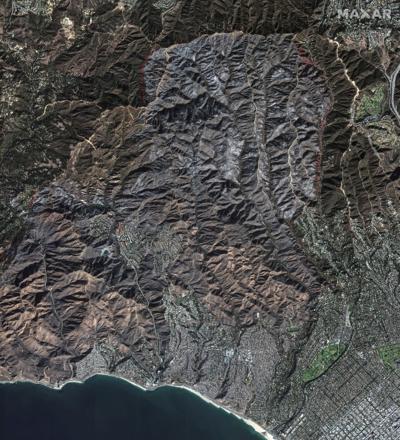
A satellite image shows an overview of the Palisades Fire burn area in Malibu.
MAXAR TECHNOLOGIES
Recommended for you
Besides burning the most urban area, the Eaton and Palisades fires are the largest ever for California in January. Alexandra Syphard, a senior research scientist at the Conservation Biology Institute, said their timing and path through the city "may have no precedent in history."
Authorities haven't determined a cause for the major blazes in California. But experts have noted the extreme weather that created more favorable conditions: heavy rains that drove vegetation growth, then extreme drought that turned much of that vegetation into good fire fuel. Scientists say such extreme weather events are a hallmark of climate change.
Los Angeles Councilwoman Traci Park, left, hugs Mitchell Faith, a board member Los Angeles Department of Public Works during a community meeting held by Palisades Fire representatives and command staff to provide updates on operations in Los Angeles.
Reuters
Then there's the human element.
Across California, about 1.4 million homes were built in areas where residential areas and vegetation intermingle between 1990 and 2020, a 40% increase, the Silvis Lab found.
Fires that begin close to populated areas are often caused by people, and their proximity to people means they are usually extinguished sooner. As David Helmers, a data scientist and geographer at the Silvis Lab, put it, "Humans tend to ignite fires, but they also fight fires."
Heartbroken families, burned-out business owners and beleaguered Los Angeles leaders are beginning to ponder a monumental task: rebuilding what was lost in the Southern California wildfires.
But that wasn't the case with the Eaton and Palisades fires, which were whipped by fierce Santa Ana winds to overwhelm fire crews.
The 2017 Tubbs Fire in northern California's wine country came under similar high winds. That blaze, sparked by a residential electrical system, tore through suburban areas of Santa Rosa, killing 22 people and destroying more than 5,600 homes, businesses and other structures. Overnight, the rubble of the Coffey Park neighborhood became a symbol for how quickly a wildfire can reach a populated area.
Some 53 years prior, another fire — the Hanly Fire — burned through almost the exact same area. Winds helped it spread with furious speed. But with little development at the time, nobody died and only 100 homes were lost.
Keep the discussion civilized. Absolutely NO
personal attacks or insults directed toward writers, nor others who
make comments. Keep it clean. Please avoid obscene, vulgar, lewd,
racist or sexually-oriented language. Don't threaten. Threats of harming another
person will not be tolerated. Be truthful. Don't knowingly lie about anyone
or anything. Be proactive. Use the 'Report' link on
each comment to let us know of abusive posts. PLEASE TURN OFF YOUR CAPS LOCK. Anyone violating these rules will be issued a
warning. After the warning, comment privileges can be
revoked.
Please purchase a Premium Subscription to continue reading.
To continue, please log in, or sign up for a new account.
We offer one free story view per month. If you register for an account, you will get two additional story views. After those three total views, we ask that you support us with a subscription.
A subscription to our digital content is so much more than just access to our valuable content. It means you’re helping to support a local community institution that has, from its very start, supported the betterment of our society. Thank you very much!



(0) comments
Welcome to the discussion.
Log In
Keep the discussion civilized. Absolutely NO personal attacks or insults directed toward writers, nor others who make comments.
Keep it clean. Please avoid obscene, vulgar, lewd, racist or sexually-oriented language.
Don't threaten. Threats of harming another person will not be tolerated.
Be truthful. Don't knowingly lie about anyone or anything.
Be proactive. Use the 'Report' link on each comment to let us know of abusive posts.
PLEASE TURN OFF YOUR CAPS LOCK.
Anyone violating these rules will be issued a warning. After the warning, comment privileges can be revoked.