
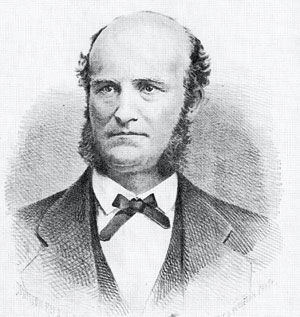
An interesting early lawsuit over land in San Mateo County started in 1863. The original Buri Buri Rancho had been granted to Jose Antonio Sanchez by the Mexican government in 1835.
That land was described in the lawsuit as bounded by: east by the Bay of San Francisco, north by the Visitacion and de Haro Ranchos; west by the San Pedro Rancho; and south by the San Mateo Rancho, containing 14,639.1 acres of land. In today’s geography, this would run roughly from San Francisco to San Mateo, and from the Bay to the mountains bordering Pacifica.
Buri Buri had become a prosperous cattle ranch during Jose Antonio’s time. His wife, Ana Josefa, gave birth to 20 children before she died in 1838. Ten of them survived to adulthood. When Jose Antonio died in 1843, they found no will, so the land, according to the laws at the time, passed undivided to his surviving children. The key word here is "undivided.” That meant that each owned 1/10th of the 14,640 acres, but no one owned specific pieces of it.
The United States happened to acquire California in 1848, and the American government certified the original grant. People were eager to buy prime pieces of land. Some cash-strapped Sanchez heirs agreed to sell their interests in Rancho Buri Buri. Others held on to their shares and passed them to their children upon their deaths.
Darius Ogden Mills and his brother-in-law, Ansel I. Easton were among the earlier purchasers of large parts of the Buri Buri Rancho as well as Henry Lux and many smaller purchasers. Easton laid claim to today’s Burlingame area and Mills settled on what is now Millbrae. Lux was in the South San Francisco area and the others were scattered along the early roads that ran through the property. Surviving Sanchez family members were also still on the property.
But wait! How can one sell an undivided interest in land and have the buyer claim specific pieces of it? This was the crux of that lawsuit. Mills and Easton sued Lux et al to force a legal division of the property. By 1863, those "et al” people numbered 265! Some of the Sanchez heirs had died leaving large families of their own, so we were now dealing with generations of grandchildren and great grandchildren, let alone subsequent sales of the portions that had been sold.
Just to complicate things, the San Francisco to San Jose Railroad had crossed the land and the Spring Valley Water Company had pipelines across it to serve San Francisco.
Recommended for you
The judge in the case, being no fool, delegated the job of investigating the claims and untangling the mess to a panel that he appointed. These referees were Faxon Dean Atherton, Benjamin G. Lathrop and Francis Sievers. All were respected citizens of the Peninsula with no personal claims against the property.
The final outcome of the case divided the land proportionately between the original heirs, translating their percentages into acres and allotting the acreage to subsequent heirs and purchasers when necessary. The subdivision seemed to match closely to the property they were occupying. There were some appeals, but generally it seems that most were satisfied with the result.
The case took years to settle, and an interesting thing is that the bill from the referees for their time and expenses amounted to $19,793.50. No mention is made of what all those lawyers charged.
Rediscovering the Peninsula appears in the Monday edition of the Daily Journal. For more information on this or related topics, visit the San Mateo County History Museum, 2200 Broadway, Redwood City.





(0) comments
Welcome to the discussion.
Log In
Keep the discussion civilized. Absolutely NO personal attacks or insults directed toward writers, nor others who make comments.
Keep it clean. Please avoid obscene, vulgar, lewd, racist or sexually-oriented language.
Don't threaten. Threats of harming another person will not be tolerated.
Be truthful. Don't knowingly lie about anyone or anything.
Be proactive. Use the 'Report' link on each comment to let us know of abusive posts.
PLEASE TURN OFF YOUR CAPS LOCK.
Anyone violating these rules will be issued a warning. After the warning, comment privileges can be revoked.