In 1915, San Bruno appointed Marshal Lugard, with a pay of $75 per month, as a peace officer for the recently incorporated city of 1,400 citizens.
He had to buy his own uniform. He patrolled the streets on horseback, mainly keeping stray cows and goats off of the unpaved streets. His duties also included checking the doors of the downtown businesses at night to see if the owner had left it unlocked. Many of the business owners lived above their business on San Mateo Avenue so, with the check by Marshal Lugard and the vigilant eye of business owners, little crime occurred. Marshal Lugard resigned late in 1915 after a short stay and numerous other individuals served as marshal.
In 1916, the city hired a traffic officer, William Kidd. El Camino Real was the only north-south road up and down the Peninsula and it generated a lot of traffic. Fast traffic. William Kidd, nicknamed Captain Kidd, became the figure to fear by the school children. Edgemont Elementary School was on Elm Avenue, west of El Camino Real, and the intersection that Captain Kidd was to patrol and stop traffic for school children crossing El Camino Real was not always the place kids wanted to go to and cross. Captain Kidd’s booming voice could be heard a half a mile away when he spotted children “jaywalking” to get to school. A lecture followed as the kids quaked in their shoes before they were allowed to cross El Camino Real. The parents loved the job and the reputation of Captain Kidd. He kept the kids safe until his retirement in 1926.
The police facilities were located in the “Old Tin Schoolhouse” that was converted into City Hall. A small jail was built to the rear of the building, in a basement. The cars did not have any radios for many years. Communication to the officers on duty around town was accomplished by those in need of help dialing 101 on the telephone. This activated a red light that was placed on a 50-foot pole at the fire house on San Mateo Avenue and another light at the intersection of Jenevein Avenue and El Camino Real. When 101 was dialed on the phone, the activated light was visible all over town and the officer responded immediately.
San Francisco transplant Arthur Meehan became marshal in 1916 but resigned in 1919, only to be rehired in 1921. Meehan was replaced by a local boy, Carl Lewis, who was replaced by William Maher. In 1927, the title of “marshal” was replaced by police chief. Maher became San Bruno’s first police chief and remained so until his retirement in 1962.
In 1921, the streets were impassable when it rained. Marshal William Weddell became famous when a newspaper article in a San Francisco newspaper reported the number of townspeople were up in arms in San Bruno due to the City Council’s action that authorized Marshal Weddell to arrest all drivers who took to the sidewalks to drive due to muddy streets. This was not to be tolerated. In addition, the billy goat population (more than 700 reported in city limits) was out of control and all owners of unsecured billy goats were to be arrested. Needless to say, this action by the marshal was short-lived when the story broke and San Bruno became the laughing stock of the Peninsula. The council quickly backed down due to irate citizens (and to save face).
Recommended for you
Tanforan Race Track was the main industry in San Bruno for many years and required police supervision. The race track had its own police force in addition but some activities had to be handled by the many deputy marshals. Albert Coturri directed traffic during races and was killed in 1922 while performing this duty. In 1923, a tragic event killed Officer Meehan. He was shot and killed by two young criminals, Joe Tanco and Floyd Hall. They had just robbed a business in South San Francisco and failed to stop at a stop light while traveling through San Bruno. Officer Meehan pursued the individuals and they shot him after he had stopped them on El Camino Real.
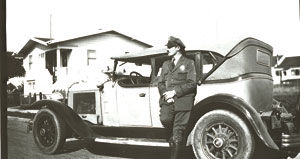
A Willis-Knight touring car was purchased for the police department in 1925. This was the classiest car of any of the law enforcement departments on the Peninsula. The six-cylinder, smoke-belching vehicle proved unsatisfactory and, in 1928, it was replaced by a touring-type Buick.
In 1938, Russ Cunningham joined the police force. The city had one patrol car and one motorcycle to patrol the area. When Cunningham became police chief after Chief Maher’s retirement in 1962, more than 21 officers served the city, with a clerking staff of four. By 1976, the police force numbered 58 people in the department — one chief, one captain, four lieutenants, seven sergeants and 34 police officers. In addition, the support personnel consisted of one secretary, five clerk dispatchers, four clerk typists, one parking control officer and six community service officers. Twenty-one regular motor vehicles were supplemented by three motorcycles and two Cushman motor scooters.
Numerous police chiefs served San Bruno after Chief Cunningham retired in 1978. Frank Hedley served until city manager duties took too much of his time and he stepped down as police chief in 1994. He was followed by Joseph Palla (1995-1998), Lee Violett (1998-2006) and Neil Telford (2006-present).
Rediscovering the Peninsula by Darold Fredricks appears in the Monday edition of the Daily Journal.
Keep the discussion civilized. Absolutely NO
personal attacks or insults directed toward writers, nor others who
make comments. Keep it clean. Please avoid obscene, vulgar, lewd,
racist or sexually-oriented language. Don't threaten. Threats of harming another
person will not be tolerated. Be truthful. Don't knowingly lie about anyone
or anything. Be proactive. Use the 'Report' link on
each comment to let us know of abusive posts. PLEASE TURN OFF YOUR CAPS LOCK. Anyone violating these rules will be issued a
warning. After the warning, comment privileges can be
revoked.
Please purchase a Premium Subscription to continue reading.
To continue, please log in, or sign up for a new account.
We offer one free story view per month. If you register for an account, you will get two additional story views. After those three total views, we ask that you support us with a subscription.
A subscription to our digital content is so much more than just access to our valuable content. It means you’re helping to support a local community institution that has, from its very start, supported the betterment of our society. Thank you very much!






(0) comments
Welcome to the discussion.
Log In
Keep the discussion civilized. Absolutely NO personal attacks or insults directed toward writers, nor others who make comments.
Keep it clean. Please avoid obscene, vulgar, lewd, racist or sexually-oriented language.
Don't threaten. Threats of harming another person will not be tolerated.
Be truthful. Don't knowingly lie about anyone or anything.
Be proactive. Use the 'Report' link on each comment to let us know of abusive posts.
PLEASE TURN OFF YOUR CAPS LOCK.
Anyone violating these rules will be issued a warning. After the warning, comment privileges can be revoked.