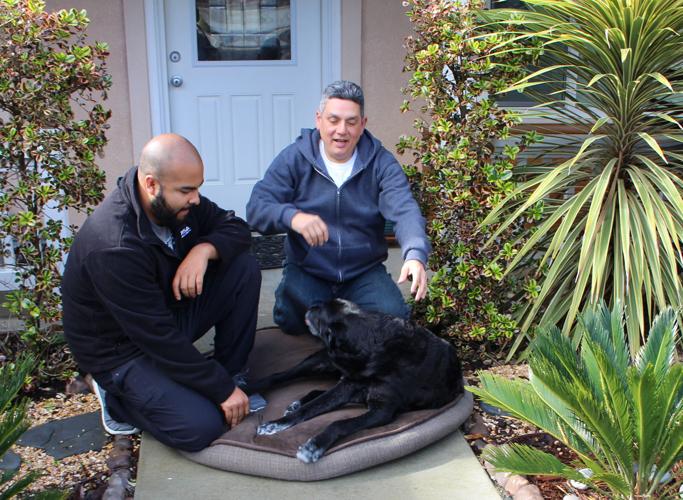
From left, Kevin Zuniga, Taker and Zuniga’s stepfather, Eddie Valadez, outside their South San Francisco home. In more than four years of service with the United States Marine Corps, Zuniga spent some seven months with Taker as his handler on route clearance missions in Afghanistan.
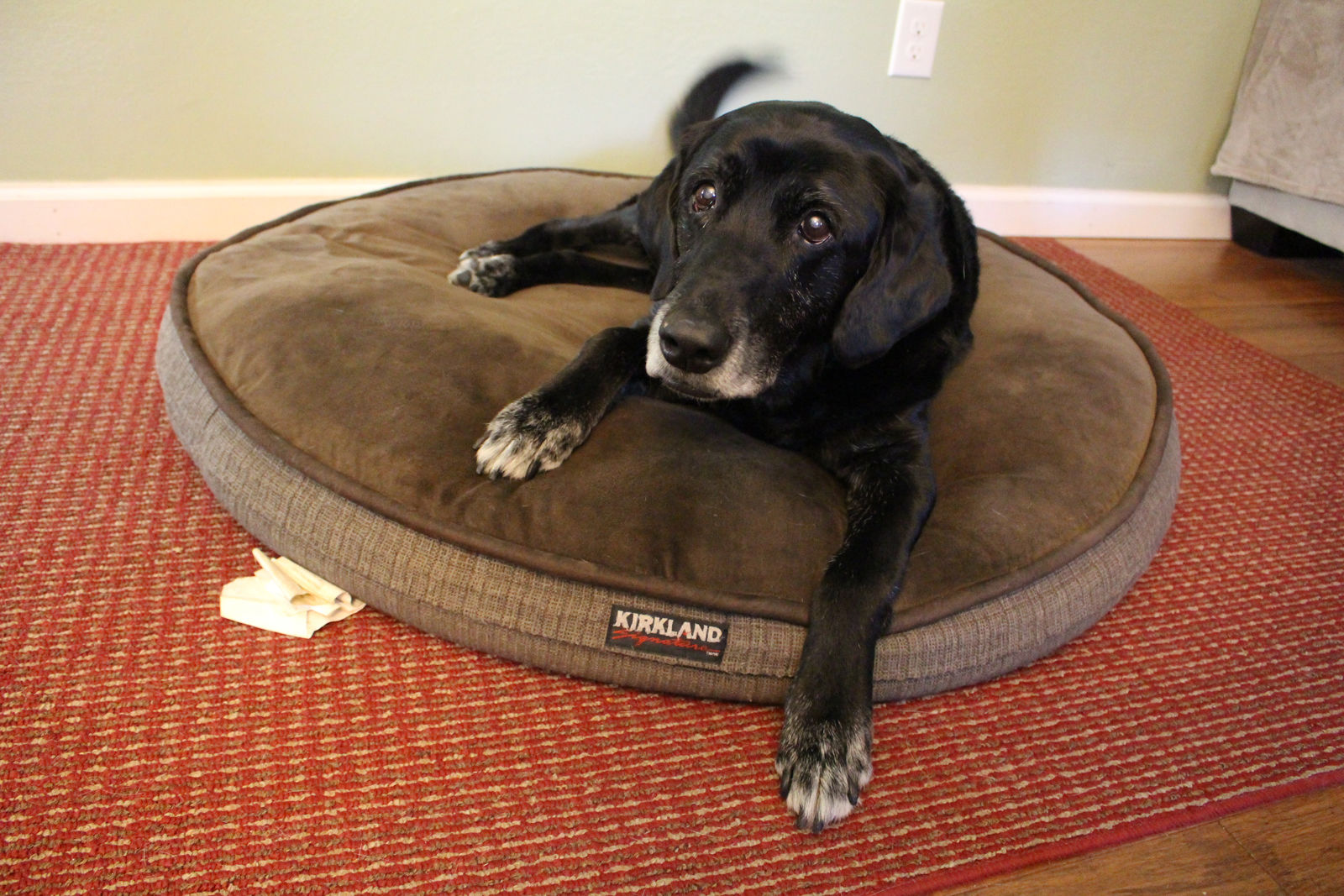
K-9 Sgt. Taker, a 13-year-old black Labrador retriever, is one of the recipients of the American Humane Association’s Lois Pope LIFE K-9 Medal of Courage Awards this year. With training as a bomb-sniffing dog, Taker went on two military tours during his service with the United States Marine Corps.
When South San Francisco residents Kevin Zuniga and Eddie Valadez welcomed a friendly black Labrador retriever to their home in 2012, they knew something of their four-legged companion’s capacity to care of others.
Fresh from more than four years of military service, Zuniga, a sergeant with the U.S. Marine Corps and Valadez’s stepson, was discharged around the same time as K-9 Sgt. Taker, the bomb-sniffing dog with whom he spent some seven months in Afghanistan in 2010.
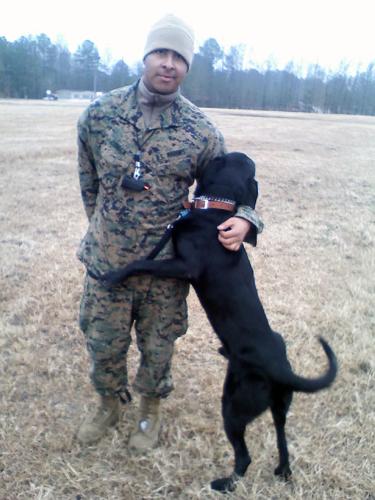
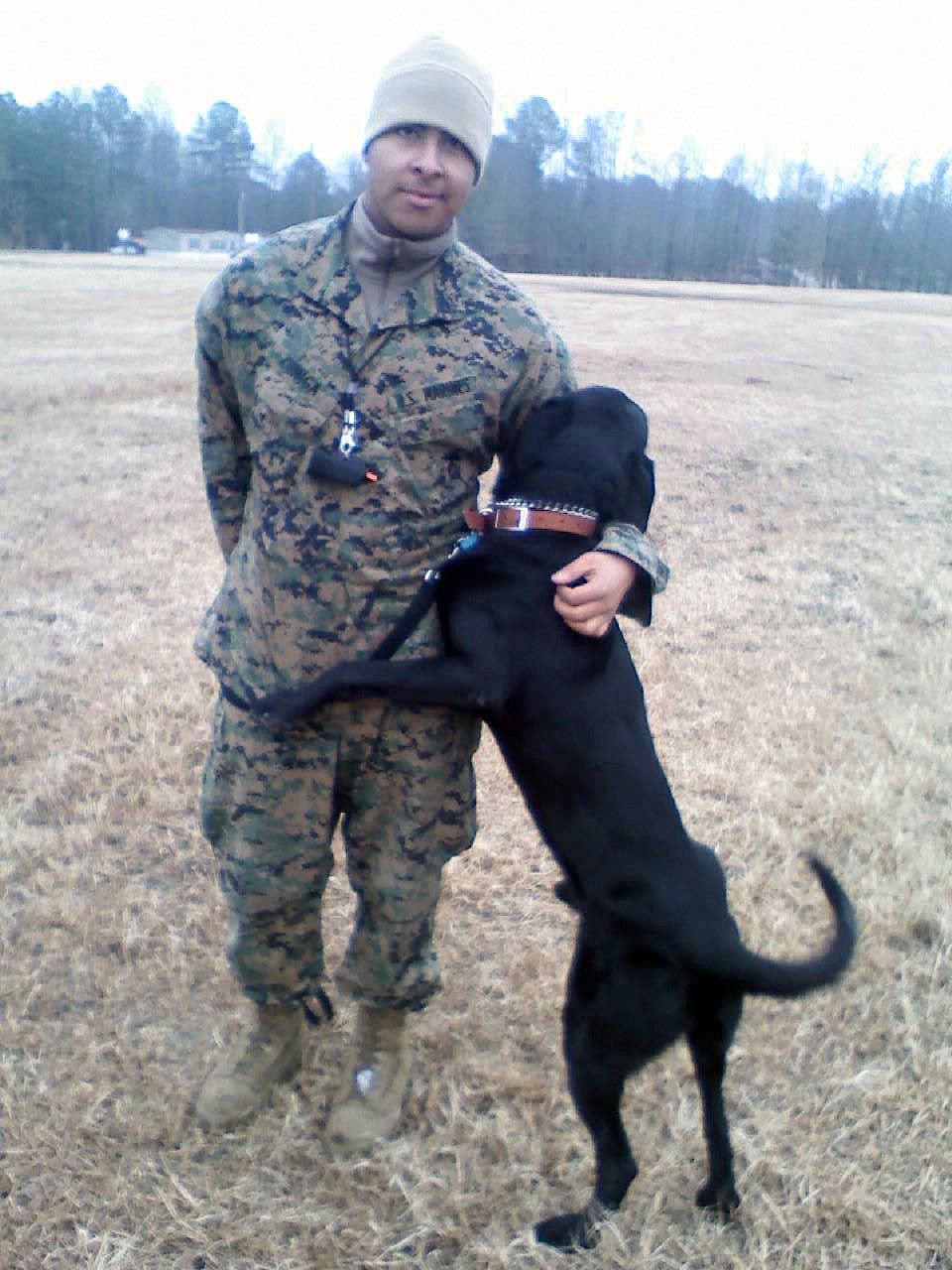
Zuniga and Taker at a training facility in North Carolina before they were deployed to Afghanistan.
With specialized training to identify dozens of scents and military tours to Iraq and Afghanistan behind him, the retriever had several years of practice responding to commands and needed to learn how to adjust to regular home life. But it didn’t take long for Taker to begin sensing his owners’ emotions, helping Valadez and his wife, Amanda Zuniga, de-stress after long work days and while she recovered from a shoulder injury.
“Taker kind of took care of us emotionally,” said Valadez. “He ended up being a therapy dog in a sense without us even realizing that and that’s how we all became emotionally attached, connected with him.”
But in recent years, arthritis and age have taken its toll on the now-13-year-old retriever, spurring the family to seek ways to recognize his service and those who contributed to his health and safety. Having received word earlier this month Taker is one of the recipients of the American Humane Association’s Lois Pope LIFE K-9 Medal of Courage Awards for 2018, it seems as though their efforts are paying off.
“Basically, not enough people get thank yous,” said Valadez. “I just [wanted to say] thank you because Kevin and Taker made it back from Afghanistan, they’re healthy now [and] Taker’s on his twilight years.”
From left, Kevin Zuniga, Taker and Zuniga’s stepfather, Eddie Valadez, outside their South San Francisco home. In more than four years of service with the United States Marine Corps, Zuniga spent some seven months with Taker as his handler on route clearance missions in Afghanistan.
Anna Schuessler/Daily Journal
As Taker’s handler on route clearance missions in Afghanistan, Kevin Zuniga said he went through hours of training before they were deployed. It helped him understand how the dog’s behavior would change when he caught wind of explosives and learn how to give him hand signals to get Taker to return to his side at a moment’s notice. He remembers Taker was the most playful of the dogs he met at the North Carolina training facility in the weeks before their tour, where their job was to determine whether land mines or explosives were planted underground or hidden from sight.
At around 75 pounds, Taker’s body weight was less likely to trigger an explosive designed with heavier human targets in mind, explained Kevin Zuniga. If he sensed Taker’s behavior indicated an explosive nearby, he would let two others in his platoon know, and they would detonate or disarm the weapons.
While his first run with mine detection was nerve-racking, Kevin Zuniga said he became accustomed to it over time. But as confident as he was in Taker’s abilities, he never forgot how much danger his canine companion was in each time they were sent on missions.
Recommended for you
“Every time, we just didn’t know,” he said, of the danger Taker faced in missions.
For others in his platoon, spending time with Taker and the three other Labrador retrievers on their tour not only provided them with stress relief, but also enhanced their sense of trust in the dogs to help them avoid danger. Kevin Zuniga said he and the other handlers spent almost every hour of every day with them, but others would frequently come over to pet the dogs and watch them train to understand what they could do.
“Sometimes they would tell them to hide the odor and they would hide it and they could see that the dog could find it,” he said. “It would give them a confidence boost that they can trust the dog as well.”
Just like their human companions, dogs with experience on tours are often affected by the stress of warfare, said Kevin Zuniga, and Taker was no exception. Though Taker received a warm welcome upon arriving at their home in 2012, he often stayed in Kevin Zuniga’s room for hours, looking for commands from his owners on what to do next. Valadez remembers the dog’s hesitance to walk even a few feet in front of him on daily walks and his difficulties in adjusting to a “normal” dog life after years as a working canine.
“When I would walk him … Taker would … be so stressed out and he would be looking at me every few seconds for a command,” he said.
But Valadez said it didn’t talk long for Taker to get comfortable in his new home, where hugs, belly rubs and snacks were never in short supply. He said Taker now lives a good life with Carl, a 2-year-old white Labrador retriever Kevin Zuniga works with on bomb-sniffing jobs for large Bay Area venues.
And though Taker’s calm and friendly demeanor hasn’t changed with time, the speckling of white fur on his face and body and the arthritic pain his family observes in him are signs of his age, said Kevin Zuniga. Valadez said entering Taker in American Humane’s contest and seeing the overwhelming support from those captivated by his story has taken them one step closer to honoring him for the positive impact he’s had on everyone he’s encountered.
“He’s just at an age now where I can tell I can see some insecurities in him that I never saw before,” he said, adding he simply gives Taker a big hug when he sees him in pain. “He took care of us … now we’re taking care of him.”
Keep the discussion civilized. Absolutely NO
personal attacks or insults directed toward writers, nor others who
make comments. Keep it clean. Please avoid obscene, vulgar, lewd,
racist or sexually-oriented language. Don't threaten. Threats of harming another
person will not be tolerated. Be truthful. Don't knowingly lie about anyone
or anything. Be proactive. Use the 'Report' link on
each comment to let us know of abusive posts. PLEASE TURN OFF YOUR CAPS LOCK. Anyone violating these rules will be issued a
warning. After the warning, comment privileges can be
revoked.
Please purchase a Premium Subscription to continue reading.
To continue, please log in, or sign up for a new account.
We offer one free story view per month. If you register for an account, you will get two additional story views. After those three total views, we ask that you support us with a subscription.
A subscription to our digital content is so much more than just access to our valuable content. It means you’re helping to support a local community institution that has, from its very start, supported the betterment of our society. Thank you very much!






(0) comments
Welcome to the discussion.
Log In
Keep the discussion civilized. Absolutely NO personal attacks or insults directed toward writers, nor others who make comments.
Keep it clean. Please avoid obscene, vulgar, lewd, racist or sexually-oriented language.
Don't threaten. Threats of harming another person will not be tolerated.
Be truthful. Don't knowingly lie about anyone or anything.
Be proactive. Use the 'Report' link on each comment to let us know of abusive posts.
PLEASE TURN OFF YOUR CAPS LOCK.
Anyone violating these rules will be issued a warning. After the warning, comment privileges can be revoked.