
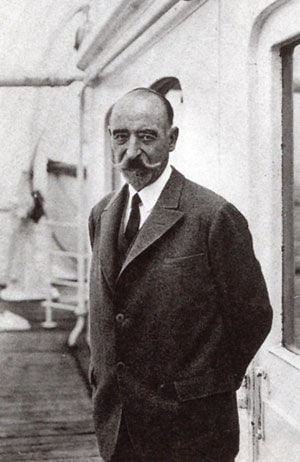
George H. Howard, architect of Burlingame’s train station and Kohl Mansion, typified California’s Gilded Age. At the end of the 1800s, lavish displays of wealth announced not only the social status of the individual, but also the arrival of Californians on the world stage to compete as social equals with New York’s high society. During this time, Howard and others engaged in building projects designed to impress visitors with California’s sophistication and to shed its image as a rough wild West state.
After creating a fortune during the Gold Rush, the Howard family sought to create a genteel country life on the Peninsula in the 1850s. Where others might have seen the area near today’s downtown San Mateo as primitive, the Howards saw possibilities. In 1864, George H. Howard was the first baby baptized within the newly organized St. Matthew’s Episcopal Church in San Mateo. The following year, his parents financed the construction of a Gothic stone church that stood in stark contrast to the handful of wooden frontier structures nearby.
The Howards continued their plans to improve the Peninsula. Before George turned 10, his parents went to Europe in search of a landscaper who could transform the barren, dusty grasslands surrounding their country home into beautiful gardens, similar to those at Versailles. While in Scotland, they found the perfect candidate: John McLaren. During the 15 years he worked for the Howards, he is estimated to have planted more than a million trees on the mid-Peninsula, including the large eucalyptus that still line El Camino Real. Young George’s father was not able to see all the results of his chief gardener’s work; his father died in 1878 when George was only 14.
Within one year of his father’s death, George’s mother Agnes married again; this time to Henry P. Bowie, who was 15 years younger than she. The Bowies soon left for a honeymoon in Europe, with the teenaged George in tow, along with his two younger siblings. One year turned into two and the Bowies remained in Europe. While tagging along on his mother’s honeymoon, George developed a deep appreciation for the neoclassical architecture being taught at the Ecole des Beaux Art in Paris. He also began to share his mother’s love for formal gardens, especially the gardens at Versailles, outside of Paris.
In 1888, at the age of 24, George married Antoinette ("Nettie”) Schmiedell, the only daughter of wealthy San Franciscans, Henry and Fronie Schmiedell. After a European honeymoon that lasted almost two years, the couple made their home on Gough Street. In 1893, Nettie’s father died. Thereafter, due primarily to his wife’s inheritance, the couple lived a privileged life of parties and travel. George also kept busy with architectural commissions, designing as many as 75 country homes for wealthy friends on the mid-Peninsula, including the Kohl Mansion. George and Nettie’s own country home, Howard House, sat at the top of today’s Roehampton Road. Howard House employed classical design elements and was surrounded by spectacular gardens, which George dubbed Versailles. Like the Gothic stone church his parents built several decades earlier, the elegance of Hillsborough’s country homes in the late 1800s often stood in marked contrast to the dusty roads and roaming cattle that surrounded them. California was not New York, or Paris, or London, but it was not for lack of trying.
Recommended for you
Most of George’s architectural projects were either Neoclassical or English Tudor in design, reflecting the Gilded Age preference for all things European. The one major exception was the project for which he is best known, the Burlingame train station. In 1893, the newly formed Burlingame Country Club sought its own train station to welcome guests in style from San Francisco. George and his architect partner Joachim Mathisen chose a quintessentially California design for the station—that of a California mission. The train station, completed in 1894, is now designated as a California Historical Landmark and is listed on the National Register of Historic Places due primarily to its architectural significance as the earliest permanent example of California Mission Revival architecture.
In the late 1920s, George and Nettie moved to Paris. Their firstborn son died in Europe in 1932, at the early age of 41. In the spring of 1933, George accompanied his son’s ashes back to San Mateo. Writing from a train car on a cross-country trip from New York soon after Franklin Delano Roosevelt became president, George told his wife Nettie, "I did not realize what America was really like until I commenced my trip from ocean to ocean. I feel as if I were in a strange country amongst a strange people.” The era of conspicuous consumption was over. Champagne and oysters had been replaced by soup and bread. The Gilded Age had come to a crashing end.
More about George H. Howard, including photos of his home and gardens and copies of his letters to his wife Nettie, can be viewed in a new web exhibit at http://burlingamefoundingfamilies.wordpress.com/ The exhibit is sponsored by the Burlingame Historical Society, which also sponsors a museum at Howard’s Burlingame train station. That museum is open the first Sunday of each month from 1 p.m.-4 p.m.


(0) comments
Welcome to the discussion.
Log In
Keep the discussion civilized. Absolutely NO personal attacks or insults directed toward writers, nor others who make comments.
Keep it clean. Please avoid obscene, vulgar, lewd, racist or sexually-oriented language.
Don't threaten. Threats of harming another person will not be tolerated.
Be truthful. Don't knowingly lie about anyone or anything.
Be proactive. Use the 'Report' link on each comment to let us know of abusive posts.
PLEASE TURN OFF YOUR CAPS LOCK.
Anyone violating these rules will be issued a warning. After the warning, comment privileges can be revoked.