
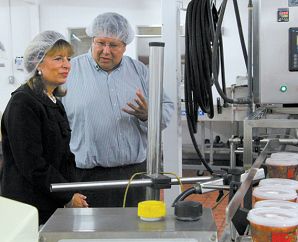
Casa Sanchez may have its roots in San Francisco but the next generation of the family-owned business is ready to take the food manufacturer to new heights from its headquarters in Millbrae.
Started by Mexican immigrants Roberto and Isabel Sanchez, Casa Sanchez got its start as a Mexicatessen in San Francisco’s Mission District almost 50 years ago as the family also established the first mechanized tortilla factory in Northern California.
The second generation of family continued the company’s early success as Robert Sanchez Jr.married one of the company’s factory workers Martha. It was those two who created the recipes for Casa Sanchez’s fresh salsas, which are now sold in grocery stores throughout the region.
With the passing of Martha four months ago, the company is now in the hands of Robert Sanchez, the grandson of the company’s original founder.
Sanchez called his mother "the brains behind the operation.”
It is the success of her recipes that have led the company to develop new products, all made from scratch daily, that have turned the familyowned business into a $10 million a year operation with 85 employees.
The company’s marquee products are its salsas, chips, guacamole and papusas, all made fresh every day in Millbrae.
The company has a 12 percent growth rate, said Chief Financial Officer Bob Nazarenus, and has plans for expansion. It moved from a 5,000-square-foot facility in San Francisco 10 years ago to a larger 20,000-square-foot facility in Millbrae.
Being in Millbrae allows Casa Sanchez to get its products to retailers throughout the Bay Area much quicker than in San Francisco, Sanchez said.
It takes less than a day to make the salsas from fresh produce daily, pack them and ship them to local retailers.
Its products are sold in Safeway, Whole Foods, Lunardi’s, Draeger’s and many other grocery stores locally. The company also just signed a deal with Costco to distribute handmade papusas made from scratch daily, said Leo Avila, a salesman who has been with the company for seven years.
The company’s success has attracted the attention of U.S. Rep. Jackie Speier, D-San Mateo, who visited Casa Sanchez last week.
Congress has a mission to promote products manufactured in America and Speier has made it a point to highlight local companies that manufacture products in her district.
Last week, she spent time with the company’s master salsa maker, Alfonso Meza, with Casa Sanchez for 19 years; Juan Castillo, who leads sales; Rosemarie Ramos, operations manager, and a host of other employees to hear what Congress can do to help make these small manufacturing companies more successful.
The company has an eye for growth, but securing the financing from banks is its biggest obstacle now, said Nazarenus.
Recommended for you
Banks are willing to give loans to small companies for big purchases such as new machinery, Nazarenus said, but not for operations.
Operations capital is needed, he said, because Casa Sanchez suffers highs and lows in sales throughout the year.
Sales pick up during the Super Bowl, March Madness, Fourth of July, Cinco de Mayo and other holidays but decline in during other times of the year, he said.
Getting through the periods of low sales is the company’s biggest obstacle, he said. "
It takes 75 days from the purchase of a tomato to realize a return,” Nazarenus said.
Casa Sanchez also suffers from rising food costs, including high price swings for avocados, and rising fuel costs, which the company absorbs rather than passing the cost off to its customers.
But the quickness in which Casa Sanchez products fly off the shelf ensures Nazarenus that demand is high for the company’s fresh salsas and chips. "People are becoming more conscious of where their food is made,” Speier said. "
People are looking for locallyproduced, organic and sustainable products. I think people are willing to spend a little more knowing jobs are created locally.”
Speier sampled all of the company’s products during her visit.
"I think people will have a greater appreciation for the product if they can see how it is made,” Speier said.
The company previously bought some of its fresh produce from markets outside of California but has since eliminated the practice. Now, every tomato, onion or other produce the company uses in its products are grown in the state.
"The quality is not as good and the shelf life decreases when you buy overseas,” Sanchez said.
A fourth generation of the Sanchez family now works in the Millbrae factory over the summers, Sanchez said.
The company will hire young people, old people or anyone willing to get their hands dirty, Sanchez said.
"This company was built by family and that’s what it is — a family business,” Sanchez said.








(0) comments
Welcome to the discussion.
Log In
Keep the discussion civilized. Absolutely NO personal attacks or insults directed toward writers, nor others who make comments.
Keep it clean. Please avoid obscene, vulgar, lewd, racist or sexually-oriented language.
Don't threaten. Threats of harming another person will not be tolerated.
Be truthful. Don't knowingly lie about anyone or anything.
Be proactive. Use the 'Report' link on each comment to let us know of abusive posts.
PLEASE TURN OFF YOUR CAPS LOCK.
Anyone violating these rules will be issued a warning. After the warning, comment privileges can be revoked.