

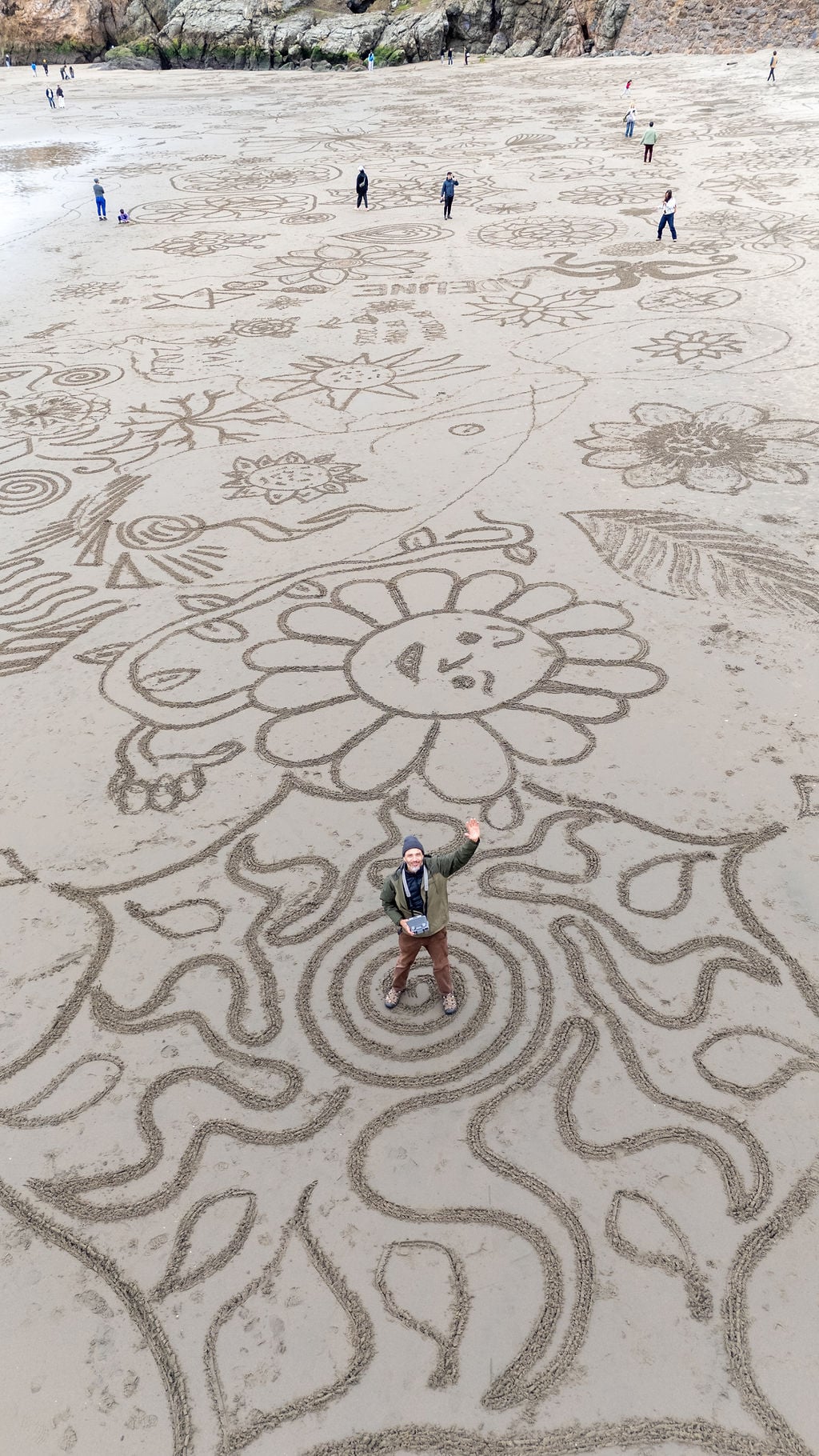

Beach sculptor, land artist or just “earthscape artist,” Andres Amador invites you to experience collaborative monumental art, “letting out your inner child, playing in the sand.”
“There’s an experience creating something so huge that I can’t actually see it in its entirety from the ground,” he said. “Being with nature and creating in a meditative way. Where I work in great open spaces there’s a feeling of expansiveness.”
“Land art” is a modern movement with ties to the Bay Area and the American landscape. From the 1970s monumental structures shaped outdoors with the materials of the land — rocks, sand, trees, geography, light and lightning — arising as counterpoint to the gallery-based art forms. Among those would be two familiar to longtime Bay Area residents: Christo and Andy Goldsworthy.
Amador distinguishes his creations from those who seek to impose their ego on the land. “The natural expressions of something bigger than oneself,” he prefers, different from tech art or massive changes to nature.
While he doesn’t specifically identify with Goldsworthy, Amador sees that “he worked toward a harmony with nature, not bringing in things from outside, not altering it — celebrating what’s there by putting a human spin on it. That is inspirational to me.”
Amador’s artworks are made with emphasis on process and experience. Art that is meant not to be held onto. “There is joy just in the making of it.”
He has a degree in environmental science and did take some art classes, sparking his interest in creative expression. He started making three-dimensional light-string art for festivals. The beach sculpture arose organically through his own explorations.
He sees the medium itself as the main expression. Amador did explore how native cultures created something similar, the Nazca Lines, Māori art, etc. He may use traditional arts as one source, however, preferring to create at large scale, which spawns its own styles and technical challenge.
“The beach is such a huge canvas, easy to work with in such a short time frame.”
Sculpting the landscape is not new, it’s 12,000 or more years old, starting with megalithic creations all over the planet. Most of these are attributed to preindustrial cultures and religious functions.
Recommended for you
Using natural materials for nonreligious, purely esthetic purposes is the modern difference.
Some are permanent, such as Goldsworthy’s “Drawn Stone,” a symbolic earthquake crack at the de Young’s entrance that many miss or misinterpret, or his “Stone River” on Stanford Campus. Others might be deliberately ephemeral, like Tibetan or Navajo sand art. Even Goldsworthy sometimes worked in transient materials: leaves and ice.
Amador’s are deliberately transient. Sculpting a beach with a rake in geometrically intricate designs to be washed away with the next high tide is something akin to crop circles.
Like the Christo and Jeanne-Claude duo, Amador wants the public to have a stake in making these designs. Where Christo’s stake was the political process of local permitting, Amador’s are a literal stake (rakes actually) drawing in the sand.
“My goal is to connect people to their own creativity. People who say they’re not an ‘artist.’ What started as inviting help morphed into guiding people into a creative flow, creating a spontaneous artwork where their contribution is unique. I’m creating a score and they’re filling it in themselves. They work off each other, like improv,” he said.
These collaborative exercises involve the physical act of using your whole body, rather than the fine motor skills of most fine arts that are difficult for people.
“Creating beauty with strangers,” he calls it with reverence.
You Can Create Too: June 20, 9 a.m. at Ocean Beach in San Francisco, Amador invites the public to participate or just observe. Reserve to participate: andresamadorarts.com/events.
Sculpting living trees, bonsai, is yet another natural art form. The Sei Boku Bonsai Kai Society holds their annual show and sale at San Mateo Garden Center, 605 Parkside Way, June 13-14. These are gorgeous creations, awe-inspiring to understand how they’re created.
Bart Charlow, author, artist and consultant blends over 45 years of painting and photography with narrative storytelling. Explore the intersection of observation and expression through his insights on the local art scene, find his books at bartcharlow.com and his art at bartsart.weebly.com.


(0) comments
Welcome to the discussion.
Log In
Keep the discussion civilized. Absolutely NO personal attacks or insults directed toward writers, nor others who make comments.
Keep it clean. Please avoid obscene, vulgar, lewd, racist or sexually-oriented language.
Don't threaten. Threats of harming another person will not be tolerated.
Be truthful. Don't knowingly lie about anyone or anything.
Be proactive. Use the 'Report' link on each comment to let us know of abusive posts.
PLEASE TURN OFF YOUR CAPS LOCK.
Anyone violating these rules will be issued a warning. After the warning, comment privileges can be revoked.