
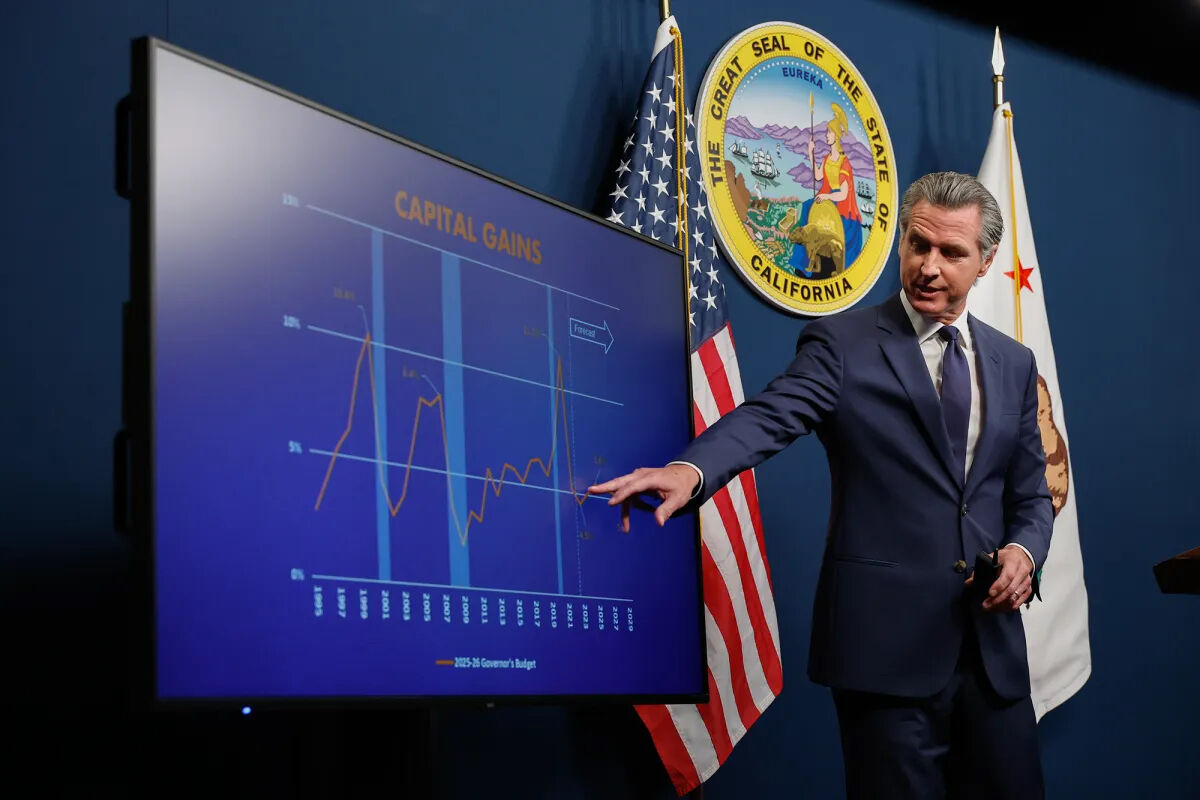
The legislature is challenging Gov. Gavin Newsom’s proposed funding cuts to higher education for next year — while largely leaving intact the relatively more generous TK‑12 spending the governor called for last month.
“In many ways, it’s a tale of two budgets,” said Sen. John Laird, D‑Santa Cruz, chair of the education subcommittee, who characterized Newsom’s higher‑ed cuts as “draconian.”
In 2025‑26, schools and community colleges will receive a record $118.9 billion under Proposition 98 — the state formula that determines the minimum portion of the General Fund that must be spent on schools and community colleges. Laird credits the law for “protecting schools from the hard decisions of what is happening to the other side of the ledger with higher education.”
Legislators would nix Newsom’s proposal to cut next year’s funding to the University of California and California State University by 3% and instead restore that money as part of a joint agreement of the Assembly and Senate.
The Assembly and the Senate published their version of a spending plan for education on Monday. The legislature has until June 15 to present their budget bill to the governor, who then has until June 27 to sign, veto or line‑item veto the bill.
Higher education
The latest version of the 2025‑26 budget may provide some relief to the state’s college students and public universities. In January Newsom said to expect an 8% ongoing cut, a figure he revised down to 3 % in May. Uncertainty regarding federal funding has compounded budget anxieties in California — the Trump administration is proposing reductions to Pell Grants and TRIO programs.
“I think many of you recognize that we’re facing some pretty devastating budget challenges this year,” Sen. Sasha Renee Perez, D‑Pasadena, said at a June 10 budget subcommittee hearing. “It has been incredibly, incredibly tough and we are continuing to face ongoing challenges with potential cuts coming from the federal administration that will impact our higher education systems — and so we are going to be having ongoing conversations about the budget.”
By forgoing the 3% ongoing cut, the Assembly‑Senate recommendations would reinstate $130 million to the 10‑campus UC system and $144 million to CSU’s 23 campuses. However, the legislature would defer those payments until July 2026, giving the universities permission to seek short‑term General Fund loans.
Lawmakers parted ways with the governor’s plan to defer a 5% increase in base funding from 2025‑26 to 2026‑27. The legislative proposal instead splits the deferral — offering a 2% ongoing increase in 2026‑27 and the remaining 3% in 2028‑29.
The proposal drew praise from attendees at the subcommittee hearing. Representatives from the California State University Employees Union, Community College League of California and Cal State Student Association all supported the legislature’s version.
Eric Paredes, legislative director of the California Faculty Association, thanked the legislature for restoring funding. “We know it’s been a difficult budget year and really appreciate the legislature’s ongoing commitment to higher education,” he said.
The legislative proposal also alters a plan to defer nearly $532 million in community college apportionment funding from 2025‑26 to 2026‑27, instead offering a smaller deferral of $378 million. To pare back the deferral, the legislature would reappropriate $135 million from the 2024‑25 part‑time faculty insurance program. A representative of the Faculty Association of California Community Colleges opposed that move, calling the funds “necessary.”
Recommended for you
Lawmakers are also turning down Newsom’s proposal to provide $25 million in one‑time Prop. 98 dollars to the Career Passports initiative, which would help Californians compile digital portfolios summarizing their skills.
The legislature’s plan calls for additional one‑time Prop. 98 funding for community colleges, including $100 million to support enrollment growth in 2024‑25, $44 million for part‑time faculty office hours, and $20 million for emergency financial aid.
For public universities, the budget bill sets in‑state enrollment targets, asking UC and CSU to enroll 1,510 and 7,152 more California undergraduates, respectively, in 2025‑26.
The current draft also would require CSU campuses with “sustained enrollment declines” to submit turnaround plans to the chancellor’s office by end‑2025, outlining strategies to increase enrollment and reduce costs. The chancellor’s office will summarize those plans for the legislature by March 2026.
Finally, the legislature’s proposal restores funding for the Middle Class Scholarship program, which provides grants to more than 300,000 recipients. The program would receive $405 million in one‑time funding in 2025‑26 and $513 million ongoing.
TK‑12 spending
A stipend for aspiring teachers is the single largest difference between the governor and the legislature’s TK‑12 budget for next year. The legislature wants to fully fund student‑teacher stipends at an estimated $600 million. Newsom is proposing $100 million for a new program.
To make room for this, lawmakers would cut the one‑time Student Support and Discretionary Block Grant from $1.7 billion to $500 million. Brianna Bruns of the California County Superintendents voiced concern, saying this is an important source “for core educational services” as federal pandemic funding expires.
Lawmakers also plan two significant changes to reflect concern revenue may fall short. They would put $650 million into the Prop. 98 rainy‑day fund, funds that would otherwise be depleted, expecting they will be needed in the 2026‑27 budget year. And they would substantially cut back on June deferrals. The governor proposed delaying $1.8 billion until July 2026 — the legislature would reduce the deferral to $846 million. As a debt to districts, they would repay most in 2026‑27 and the rest in 2027‑28.
Advocates for paying student teachers at substitute‑teacher rates say the stipends are critical for increasing the teacher pipeline. Candidates spend 600 hours in classrooms during their graduate credential programs and often earn no income while taking on $20,000 to $40,000 in debt, according to analysis of the stipend bill.
“California is facing a persistent teacher shortage that disproportionately affects our most vulnerable students,” Assemblymember Al Muratsuchi, D‑Torrance, the bill’s sponsor, said. The proposed $600 million budget would cover two years of stipends for all credential‑seeking teachers.
Legislators said they support Newsom’s $200 million for reading instruction for K‑2 teachers and $100 million for literacy and math training — even though this is $400 million less than the governor’s preference. They also rejected $42 million to establish a math professional‑learning partnership and statewide math network.
EdSource is an independent nonprofit founded in 1977 dedicated to providing analysis on key education issues facing California and the nation. Visit edsource.org to learn more.






(0) comments
Welcome to the discussion.
Log In
Keep the discussion civilized. Absolutely NO personal attacks or insults directed toward writers, nor others who make comments.
Keep it clean. Please avoid obscene, vulgar, lewd, racist or sexually-oriented language.
Don't threaten. Threats of harming another person will not be tolerated.
Be truthful. Don't knowingly lie about anyone or anything.
Be proactive. Use the 'Report' link on each comment to let us know of abusive posts.
PLEASE TURN OFF YOUR CAPS LOCK.
Anyone violating these rules will be issued a warning. After the warning, comment privileges can be revoked.