
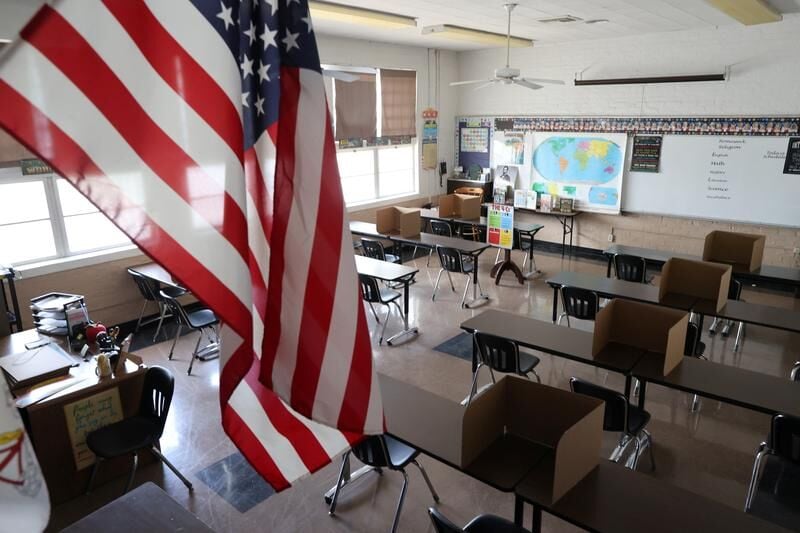
Tough decisions lie ahead for schools across California as the federal government cracks down on diversity, equity and inclusion efforts.
The latest measure came in the form of a letter issued Friday by the U.S. Department of Education, giving K-12 schools across the country two options: eliminate programs focused on diversity, equity and inclusion within two weeks or face unspecified cuts in federal funding.
“I fully anticipate that it will have a chilling effect on school districts but also colleges and universities,” Royel Johnson, who leads the University of Southern California Race and Equity Center’s National Assessment of Collegiate Campus Climates, said.
The Department of Education’s letter is neither law — nor is it legal, Johnson said.
However, many advocates and community members say they are concerned that more districts will gut their DEI initiatives out of fear and deprive students from marginalized backgrounds of the support they need to succeed in the classroom and beyond.
“We often think about California as being protected from this larger right-wing movement,” Johnson said. “But as we saw with changing patterns and demographic votes in the presidential election, I think there are many people in California who are wrestling with this conservative movement and who are afraid of it — and who are proactively or preemptively making decisions.”
The letter
The Department of Education’s letter opens with the words “Dear Colleague,” but the ensuing message takes on a different tone.
“Rather than engaging in that work of acknowledging and affirming educators, what the Trump administration has done thus far is to express hostility and disdain,” said John Rogers, a professor at UCLA’s School of Education and Information Studies and associate dean for research/public scholarship.
The letter specifically claims that white and Asian American students, including those from lower-income backgrounds, have been discriminated against and that “educational institutions have toxically indoctrinated students with the false premise that the United States is built upon ‘systemic and structural racism.’”
Increasing schools’ scores on the Nation’s Report Card has been a justification for some of the administration’s changes, according to Rogers.
But instead of boosting student performance, Rogers maintains that the directive could “throw K-12 schools into further tumult” due to the high fiscal costs of culture wars. Just last year, conflicts surrounding race and LGBTQ+ issues cost schools more than $3 billion nationwide.
“They’re pushing superintendents and those underneath the level of the superintendency to spend time seeking out legal counsel, talking with other educational leaders, trying to figure out, ‘What do we do? What are we doing now that might be considered problematic? Do we need to take action?’” Rogers said.
“All of that time and energy, and to the extent that they’re seeking out costly legal counsel, that has real costs associated with it. It’s pushing people away from the important work of improving student learning and supporting student well-being.”
While Rogers maintained that the letter was hostile in tone, he also described it as vague and confusing — a sentiment shared by many.
“If I was a superintendent, I would want to know: ‘Can my principals bring together a group of Asian American students to talk about whether they’ve experienced anti-Asian hate? Could my district invite African American parents to share their oral histories about growing up in my community as part of African American History Month, or, for that matter, can we even celebrate African American History Month?’”
Superintendents, he said, “don’t have enough information — yet they’re being given two weeks to either take dramatic action or not, of which they have really no sense of what that would mean.”
California districts respond
Recommended for you
With new, unclear circumstances on the horizon, more questions than answers are percolating through school districts across California.
Nikki Henry, spokesperson for Fresno Unified School District, said Tuesday that the district and its attorney are reviewing the letter to understand its impact.
Fresno Unified’s school board in 2020 passed a resolution declaring the district an anti-racist institution and in January reaffirmed the district as a safe place for all students, including immigrant students and families.
That mindset and approach may put Fresno Unified, which received around $238 million in federal funds this school year, in jeopardy of losing such funding under the new administration.
With nearly 93% of its students identifying as members of minority communities, the district has implemented “strong” DEI initiatives, Henry said. Their DEI policy ensures that students have equitable access to the district’s programs and services, that the curriculum reflects and celebrates diversity and that there are sufficient academic, social-emotional and behavioral supports.
Further south, administrators in Los Angeles Unified, the state’s largest district, have also expressed support for students of all backgrounds.
In a statement to EdSource, a Los Angeles Unified spokesperson said the district “adheres to all federal and state law and guidance” — and that if there are discrepancies between the two, they would be resolved through the state.
What’s at stake
Experts and teachers have continually emphasized that DEI programs enrich students’ learning and play a critical role in students feeling like they belong.
“DEI provides mechanisms for addressing issues of safety and security for students who sometimes experience physical harm, psychological harm,” Johnson said. “But, if we start removing the very mechanisms that are designed to address these issues, we’re going to see higher reports and students having concerns around their safety at school.”
Several indicators of student success, from student attendance rates to engagement, rise when DEI programs are implemented, he said.
Pushing back
While the Department of Education’s letter focuses on race, civil rights protections — including through DEI initiatives — support students from various identities based on other factors, including gender, disability and age, according to Amir Whitaker, senior policy counsel of the ACLU of Southern California.
And Johnson said marginalized groups, including those who are LGBTQ+ and first-generation, could also be impacted by potential cuts to DEI.
“I hope that school district leaders and leaders of college and universities will not back down from this moment — and lean into the institutional values that have animated their work for years prior to this erroneous sort of guidance that is designed to threat and intimidate,” Johnson said.
Whitaker added that the very policies that the letter cites — like the Civil Rights Act of 1964 — were victories that “people fought and died for.”
The Trump administration’s action, he said, is “a step backwards in this nation’s journey towards equality and justice.”
“If California backs down,” Johnson said, “I wonder also what message that sends to the rest of the country, that this ultra-progressive place is already making concessions and their sort of commitments to DEI, what that might mean for less progressive places who are figuring out where they fit within this conversation.”












(1) comment
We need more school choice.
Welcome to the discussion.
Log In
Keep the discussion civilized. Absolutely NO personal attacks or insults directed toward writers, nor others who make comments.
Keep it clean. Please avoid obscene, vulgar, lewd, racist or sexually-oriented language.
Don't threaten. Threats of harming another person will not be tolerated.
Be truthful. Don't knowingly lie about anyone or anything.
Be proactive. Use the 'Report' link on each comment to let us know of abusive posts.
PLEASE TURN OFF YOUR CAPS LOCK.
Anyone violating these rules will be issued a warning. After the warning, comment privileges can be revoked.