Adya Tewari and Saanvi Chawla, students at Aragon High School, have led an initiative to improve AI literacy and educate others on how to use the technology ethically.
Two Aragon High School students are working to increase literacy among young kids and senior citizens on how to use artificial intelligence, understand its risks and identify enhanced work to develop confidence as they navigate the emerging technology.
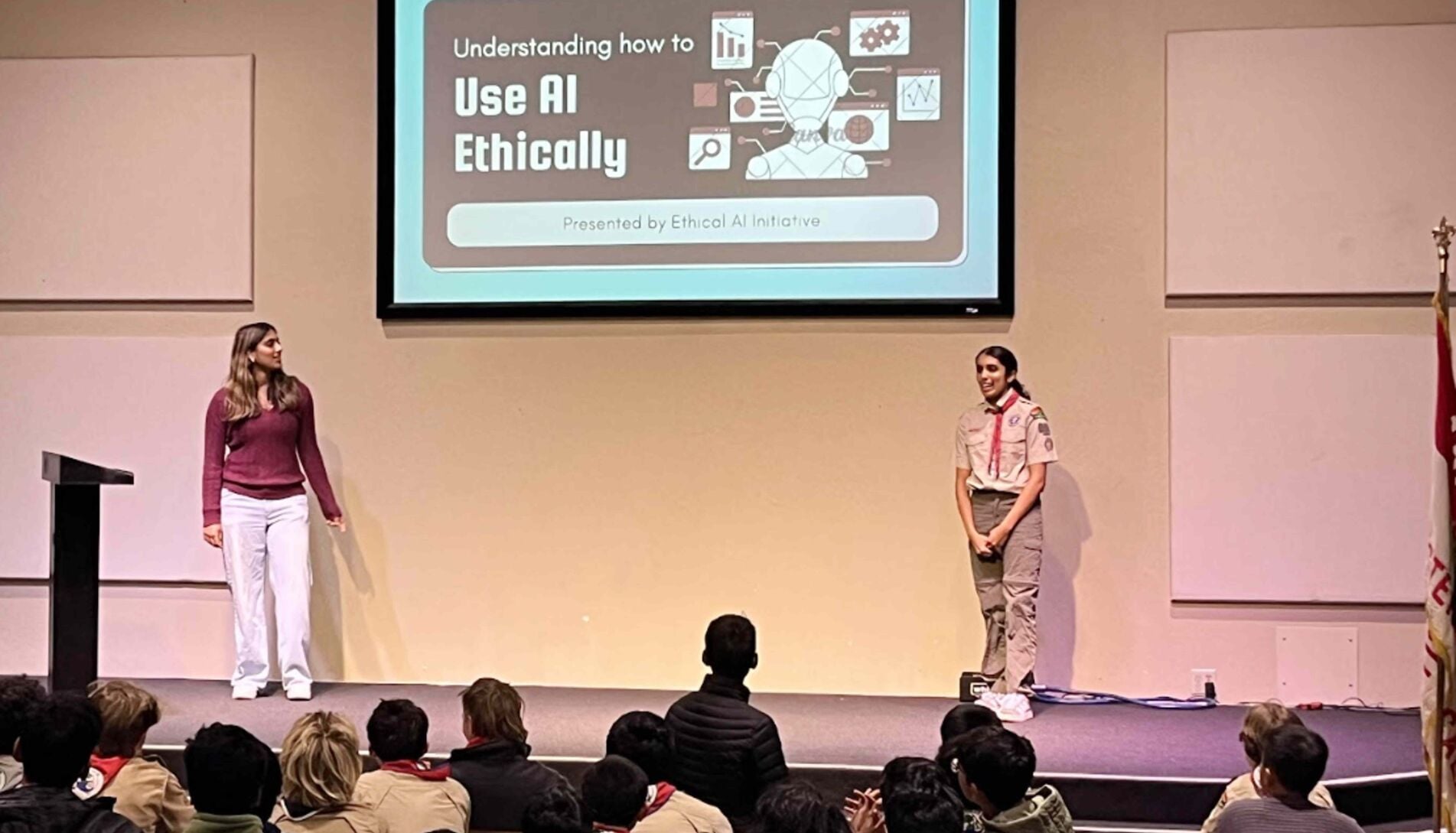
In recent months, Adya Tewari and Saanvi Chawla have visited schools and community organizations to talk about what exactly AI is, how it works, digital safety and how to ethically use the tool.
The in-person lessons are a part of the duo’s AI Literacy Project, an initiative started to empower people of all ages to understand the technological advancement. To start off, they’re focused on equipping young students with the right education.
While many may try to avoid using AI, Tewari said its impact will only become harder to ignore.
If students only are told what not to do or about the scary threat of the technology, they’ll grow up without a comprehensive understanding of all AI can do, she said. The goal for both Tewari and Chawla is to equip young students, and inform adults, so they can proceed confidently in a world where AI is here to stay.
“It’s just going to be integrated in everyday life more and more, it’s not feasible to just ignore it,” Chawla said. “We’re trying to set people up with the mindset needed to use it properly and be able to leverage it for whatever they need.”
Lessons provided to students evenly combine information on good uses of the tool, such as brainstorming ideas, and awareness on digital safety risks including the growing presence of scams, misinformation and deepfakes. They share the need for fact checking and tell students the importance of not cheating, and emphasize that AI generated answers can sometimes get things wrong.
“This would be more helpful to me as a kid, instead of just hearing ‘don’t use it’ but actually understanding why I should or shouldn’t,” Tewari said.
The message has been received well, and has reached more than 1,000 students in more than 16 workshops delivered. The duo has presented at Foster City, Sunnybrae, Lead and College Park elementary schools and Bowditch and Bayside middle schools, among other community organizations.
Recommended for you
The successful lessons are in large part due to who is presenting. When elementary and middle school students hear these lessons from their peers, rather than adults, it’s sometimes easier to digest, Tewari and Chawla said.
Amanda Goll, principal at Bowditch Middle School, said the presentation by Tewari and Chawla resonated with students and teachers.
“What stood out most was how effectively students connected with the message when it came from other students,” said Goll, according to the initiative’s website. “There is a real need for this kind of education, and their approach made the topic accessible, practical and meaningful for our school community.”
Both Chawla and Tewari’s parents work in tech, and they have a strong respect for the field and all it can offer. They also both have younger siblings, who have made it apparent the need for increased literacy at a young age.
“[My younger sister] sees things that are so obviously AI but little kids believe everything they see,” Tewari said. “I just think that’s a big concern. Kids need to be taught that just because you see it in a photo or video doesn’t mean it’s real.
Eventually, Tewari and Chawla hope to expand their lessons to senior residents because they’re a particularly vulnerable population for misleading information on the internet. Right now, the duo is partnered with the Foster City Police Department to develop a schedule of presentations to present at senior centers.
The initiative’s education goal is to ensure everyone has an understanding of what AI can actually do — and understand it’s not always accurate — so they can navigate the world with the necessary literacy.
“The ordinary person is going to use it more and more, and it’s only going to get harder to tell what’s real and what’s not,” Chawla said. “It’s important to make sure to teach people to not be scared of a powerful tool like this.”
Visit www.ailiteracyproject.co for more information about the initiative.
Keep the discussion civilized. Absolutely NO
personal attacks or insults directed toward writers, nor others who
make comments. Keep it clean. Please avoid obscene, vulgar, lewd,
racist or sexually-oriented language. Don't threaten. Threats of harming another
person will not be tolerated. Be truthful. Don't knowingly lie about anyone
or anything. Be proactive. Use the 'Report' link on
each comment to let us know of abusive posts. PLEASE TURN OFF YOUR CAPS LOCK. Anyone violating these rules will be issued a
warning. After the warning, comment privileges can be
revoked.
Please purchase a Premium Subscription to continue reading.
To continue, please log in, or sign up for a new account.
We offer one free story view per month. If you register for an account, you will get two additional story views. After those three total views, we ask that you support us with a subscription.
A subscription to our digital content is so much more than just access to our valuable content. It means you’re helping to support a local community institution that has, from its very start, supported the betterment of our society. Thank you very much!




(0) comments
Welcome to the discussion.
Log In
Keep the discussion civilized. Absolutely NO personal attacks or insults directed toward writers, nor others who make comments.
Keep it clean. Please avoid obscene, vulgar, lewd, racist or sexually-oriented language.
Don't threaten. Threats of harming another person will not be tolerated.
Be truthful. Don't knowingly lie about anyone or anything.
Be proactive. Use the 'Report' link on each comment to let us know of abusive posts.
PLEASE TURN OFF YOUR CAPS LOCK.
Anyone violating these rules will be issued a warning. After the warning, comment privileges can be revoked.