
There is no mystery or surprise that our great state of California is in trouble, both financially and physically, perhaps even morally.
There is no mystery or surprise that it has one of the most divisive, gridlocked and intransigent legislatures — democratic and republican — in modern history. Nor is it surprising that both parties, at this time, look upon the sitting governor as a third party, a third leg on the political stool, as it were, beloved by neither of the major parties and pursuing his own agenda.
This gridlock must be broken and political reconciliation re-established or the state will sink in every respect.
What it needs, above all, is a gifted governor, one who is highly intelligent, rational, deeply schooled in the political mystique and conciliatory who can put "Humpty Dumpty” back together again.
That potential governor is with us right now, and right here, and that is Tom Campbell.
I am sick of hearing Campbell universally given high approvals, with no negatives, followed with, "He’s just too nice to get elected.” That is a terrible commentary. Does a governor need to be short-tempered and testy like Wilson or Schwarzenegger to serve as governor?
Tom is remarkable in every way, personally and academically, with an outstanding and impeccable record of public service. That should not disqualify him for being too smart or too nice to be elected California governor.
Or should he be disqualified for not having nearly enough financial support to do combat in the republican primary against two other candidates who are recognized billionaires. It appears, as if they are attempting, with little and no political experience, to buy the nomination, while he is selling only his knowledge and political experience.
What is that experience and knowledge?
He was born in Chicago in 1952, where his father was a highly respected judge in the federal courts and attended St. Ignatius High, unarguably, not only the best in Chicago, but, perhaps, in the nation.
As well as an outstanding legislator, he has been outstanding as a scholar, a professor at one of top universities and dean at another.
In 1973, he was awarded both a bachelor’s and master’s degree from the University of Chicago.
In 1976, he not only graduated magna cum laude from the School of Law at Harvard University, but also had served as an editor on its law review, one so highly regarded that its articles are often used as citations in the nation’s court decisions.
In 1977, he began serving as a law clerk for U.S. Supreme Court Justice Byron White.
In 1980, apparently still feeling he was an underachiever, he returned to the University of Chicago for a Ph.D. in economics, where his advisor was the world famous, Nobel Prize winning Milton Friedman.
In 1983, he became a professor of law at Stanford University and in 1987, at only age 34, he became the youngest to have achieved full tenure in the history of that great university.
In 2002, he became a professor of business at the University of California, Berkeley, and after being appointed its dean of the Haas School of Business, he was able to raise its stature to becoming recognized by the Wall Street Journal as the number two business school in the nation. During that era of corporate scandals, Campbell stressed the importance of social responsibility and business ethics and a "Center of Social Responsible Business” took root.
OK! So he’s a successful nerd, right? Does that qualify him to become the executive officer of the greatest state in the union?
Hang on!
In 1980, he worked in the White House as a fellow in the Office of the Chief of Staff. The next year, he began serving for two years as director of the Bureau of Competition at the Federal Trade Commission.
In 1989, he began serving the first of his five terms as a U.S. representative, first from the 12th Congressional District of California and, after redistricting, from the 15th Congressional District of California, where the National Taxpayers Union named him the most frugal member of the 102nd Congress, based on net annualized spending reductions in legislation he proposed. Perhaps, as a testimony to the breadth of his political range, that latter district is still overwhelmingly democratic.
For the two years between his congressional services he served as a California state senator, where, again, he won plaudits as "The Best Problem Solver,” "The Most Ethical” and "Overall Best Senator in the State Legislature.”
In 2004 to 2005, Gov. Arnold Schwarzenegger called upon him to serve as the director of the California Department of Finance, where, perhaps through luck, perhaps through skill or perhaps a blending of both, during his tenure, the budget was balanced, there were no tax increases and there was no new borrowing.
Recommended for you
Now, with a resume of such extensive political experience, so many years in public service, impeccable academic record and unquestioned personal integrity, why should the media still be calling Tom Campbell a dark horse in next year’s republican primary?
It is has become absolutely obscene that in the recent years of the accumulation of great wealth, a candidate’s personal net worth should have become such a dominating factor in the political process. Where and how is service in a democracy valued when only wealth and its expenditure in political campaigning, not a record of successful political experience, is capable of leading to victory in elections?
***
It has become sort of a tradition for me to include something about Christmas each year. This is an excerpt from my World War II memoirs:
It was Christmas Eve, 1945, in the Old Church of Heidelberg, an undistinguished Baroque structure standing in the center of the old town.
As previous professional musicians, Sgt. Bud Neeley, a former church musician and I had been drafted from our combat units for General Patch’s Seventh Army band. Bud needed someone to solo the concluding number in the Christmas services in German, so he asked me.
The services were conducted in German by the head chaplain of the Seventh Army, a Catholic, a German-American and a colonel. The sermon was one of the most memorable I’ve ever heard.
First, he reviewed the importance of Jesus as the Prince of Peace. Then in a slowly rising pitch of anger he asked the congregation, if they were here to worship the essence of the religion founded upon that teaching, how they could have participated in, or stood by silently, while that teaching was violated in the worst orgy of hatred in the recorded history of mankind?
When he concluded, there were audible sobs in the congregation. Then, there was dead silence. In the loft, Bud cued me to start. With the choir humming behind me, I stood at the front of the loft and began:
"Stille Nacht! Heilige Nacht! Alles schlaft, einsam wacht. ...”
Suddenly, all I had been through in combat came together. I wasn’t even thinking of the words anymore. I had heard that same carol sung in two languages on opposite sides of the lines on a battlefield exactly one year ago that night.
I was lifting my voice in a way I had never sung before. Bud was no longer conducting. He was looking at me strangely. The chaplain was looking up and the congregation was turning in its pews. Then, across my mind flashed all the horrors and despair that I had witnessed as only a naive, 19-year-old American boy from a land at peace, and by the time I had reached the end of the carol,
"Schlaf in Himmlisher Ruhe. Schlaf. ...”
I was realizing how savagely the message of the Prince of Peace had been violated. My voice broke on the last words and there were tears streaming down my face.
How could all of this have happened?
Mankind’s worst self-administered catastrophe: Dead, 25 million Russians, millions upon millions of Germans, French, English, Polish, Japanese and others. I didn’t even know, yet, about the six million Jews. Many more millions maimed.
To this day, I still don’t have an answer to that question.
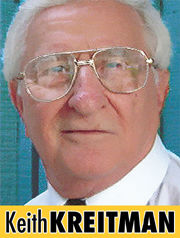
Keith Kreitman has been a Foster City resident for 24 years. He is retired with degrees in political science and journalism and advanced studies in law. He is the host of "Focus on the Arts” on Peninsula TV, Channel 26. His column appears in the weekend edition.






(0) comments
Welcome to the discussion.
Log In
Keep the discussion civilized. Absolutely NO personal attacks or insults directed toward writers, nor others who make comments.
Keep it clean. Please avoid obscene, vulgar, lewd, racist or sexually-oriented language.
Don't threaten. Threats of harming another person will not be tolerated.
Be truthful. Don't knowingly lie about anyone or anything.
Be proactive. Use the 'Report' link on each comment to let us know of abusive posts.
PLEASE TURN OFF YOUR CAPS LOCK.
Anyone violating these rules will be issued a warning. After the warning, comment privileges can be revoked.