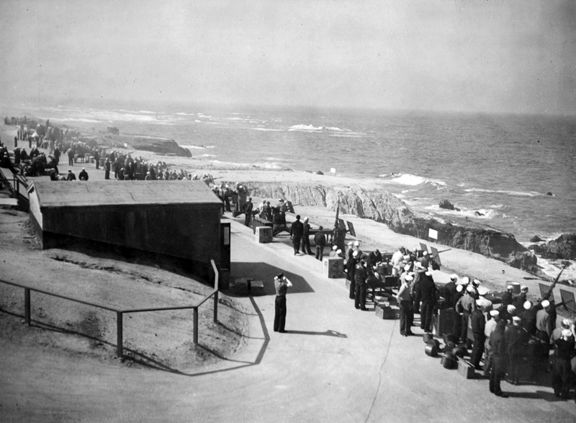
The San Mateo County coast played an important part in World War II, an historical fact that surfaced recently when the county planning commission held hearings on a plan to build 71 affordable housing units in Moss Beach, once home to an anti-aircraft training base that saw more than 320,000 soldiers and sailors pass through its gates.
Little remains of the Twelfth Naval District’s Anti-Aircraft Training Center. Among the remnants of the gunnery school are weapon platforms and ammunitions bunkers located on Montara Water and Sanitary District land. The base was one of many military facilities that sprung up on the coast after the Japanese Navy attacked Pearl Harbor on Dec. 7, 1941, and catapulted the United States into World War II. The Rear View Mirror is not aware of any historical marker that tells the public about the installation, although an information panel at the Devil’s Slide Tunnel trail notes that women pilots flew planes that towed the targets.
“In a matter of months, new installations were either built or in progress, augmenting an already formidable network of logistical, surveillance and weaponry systems,” historian Mitch Postel wrote in a 2016 issue of La Peninsula, the magazine of the San Mateo County Historical Association, that was dedicated to the county’s World War II legacy. Some of the installations were planned in the late 1930s, indicating that military authorities were preparing for war, which would come soon enough. Between Pearl Harbor and Dec. 23, at least three merchant vessels were attacked by enemy submarines off the California coast. The ships included the H.M. Story, which fought off a submarine near Point Arguello. The Story survived that battle but was sunk by a submarine in 1943.
In Postel’s opinion, the most enduring wartime installation on the coast was Half Moon Bay Airport, which was a high priority because it was closer to Hawaii and the Pacific Theater of War than any other airfield in the continental United States. A fire control station designed to direct artillery fire by big guns on the coast was built at Pillar Point, adjacent to the airport. About all that’s left of the control station are some concrete and steel pedestals, a concrete bunker and a cable vault. A more visible reminder of the war are the ruins of a fire control station at Devil’s Slide, a landmark for drivers on Highway 1. Actually, three fire control stations and a power plant were built in the area.
“One can easily understand why the Army selected this site for observation purposes, with its sweeping views of the Pacific Ocean,” Postel wrote in the article that detailed the history of the Devil’s Slide facility, which was part of a weapons system that involved Fort Funston near Lake Merced in San Francisco. The San Francisco fort held two 16-inch guns, the largest type ever in the Army’s arsenal. Some concrete bunkers for the guns remain at the Fort Funston recreation area along the ocean. In the 1960s plans to turn the Devil’s Slide bunker into a restaurant fell through, unfortunately. What a spectacular dining vista that would have provided!
Some concrete gun emplacements are also visible near Sharp Park Road at Milagra Ridge, where the Army installed its southern most coastal defense fortifications for protecting San Francisco Bay, a battery that consisted of two six-inch guns encased in steel shields that made them look like warship turrets. The guns, about the size of those found on Navy destroyers, were emplaced on either side of underground works that included ammunition magazines, a power plant, plotting room and living quarters. Postel points out that the guns weren’t put in place until 1948, long after the war ended. Still, the site has historical significance: The guns were removed in 1950, making it the last artillery position around San Francisco Bay to be disarmed.
CORRECTION: The Feb. 2 Rear View Mirror column about the Russian cannon said the Battle of Santa Clara was the only battle of the War with Mexico that was fought in Northern California. It has been pointed out that there was an engagement in Monterey County called the Battle of Natividad.
The Rear View Mirror by history columnist Jim Clifford appears in the Daily Journal every other Monday. Objects in The Mirror are closer than they appear.
Keep the discussion civilized. Absolutely NO
personal attacks or insults directed toward writers, nor others who
make comments. Keep it clean. Please avoid obscene, vulgar, lewd,
racist or sexually-oriented language. Don't threaten. Threats of harming another
person will not be tolerated. Be truthful. Don't knowingly lie about anyone
or anything. Be proactive. Use the 'Report' link on
each comment to let us know of abusive posts. PLEASE TURN OFF YOUR CAPS LOCK. Anyone violating these rules will be issued a
warning. After the warning, comment privileges can be
revoked.
Please purchase a Premium Subscription to continue reading.
To continue, please log in, or sign up for a new account.
We offer one free story view per month. If you register for an account, you will get two additional story views. After those three total views, we ask that you support us with a subscription.
A subscription to our digital content is so much more than just access to our valuable content. It means you’re helping to support a local community institution that has, from its very start, supported the betterment of our society. Thank you very much!







(0) comments
Welcome to the discussion.
Log In
Keep the discussion civilized. Absolutely NO personal attacks or insults directed toward writers, nor others who make comments.
Keep it clean. Please avoid obscene, vulgar, lewd, racist or sexually-oriented language.
Don't threaten. Threats of harming another person will not be tolerated.
Be truthful. Don't knowingly lie about anyone or anything.
Be proactive. Use the 'Report' link on each comment to let us know of abusive posts.
PLEASE TURN OFF YOUR CAPS LOCK.
Anyone violating these rules will be issued a warning. After the warning, comment privileges can be revoked.