The artist whose Depression-era mural at a San Francisco high school ignited recent controversy also painted a mural in San Mateo County, but, so far at least, it has drawn no fire.
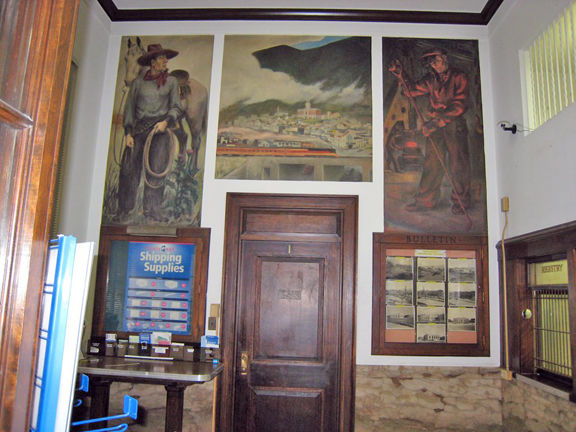
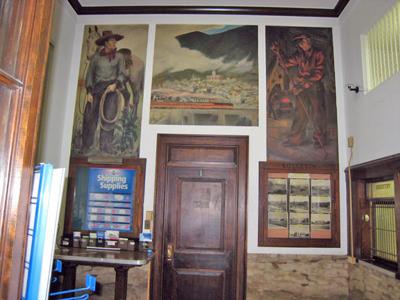
It’s doubtful that anyone would be offended by Victor Arnautoff’s work at the post office on Linden Avenue in South San Francisco. It should be noted, however, that the mural at Washington High School in San Francisco also drew little concern until some people complained that it depicted the prone body of a Native American slain as pioneers march westward as well as showing slaves on George Washington’s plantation. Arnautoff’s 1941 work at the post office is called “Past and Present,” a mural that shows a cowboy, a factory worker and a train.
Arnautoff, who died in 1979, is best known for his “City Life” mural at Coit Tower, a work that was controversial from the start when it was unveiled in 1934. Among other aspects of city life, it shows a newsstand that sells far left publications. The mural debuted as San Francisco went through a longshoremen’s strike that resulted in “Bloody Thursday” when two men were killed. The controversy was so intense that Coit Tower was closed for months, according to the Labor Archives and Research Center at San Francisco State University. His other murals included those at the Old Cathedral of the Holy Virgin in San Francisco, the chapel at the Presidio in San Francisco and the Palo Alto Medical Clinic. He also created a post office mural in Pacific Grove as well as two in Texas.
Murals that date back to President Franklin Roosevelt’s New Deal can be found in many post offices. Most are colorful renderings of working Americans going about their everyday lives. The works of art were commonly believed to be projects of the WPA, the Works Progress Administration, sometimes called the Works Projects Administration, which lasted from 1939 to 1943 and brought work to thousands of unemployed Americans. Actually the post office murals were painted by artists working for the Section of Fine Arts that was established in 1934 and operated by the Treasury Department.
There are other Depression-era art works on the Peninsula. The post office on Jefferson Street in Redwood City has a mural called “Flower Farming and Vegetable Raising” that was painted by Jose Moya del Pino in 1937, a time when Redwood City was known as “the chrysanthemum capital of the world.” Del Pino, who painted murals in many Bay Area post offices, is best known for his “San Francisco Bay, North” mural in the lobby of Coit Tower. The downtown San Mateo post office houses a three panel mural by Tom Laman entitled “Early Life in California” which recalls the days of Spanish pioneers. One segment has a bear and bull getting ready to fight for the amusement of onlookers.
Three WPA murals by Frederick Pawla that adorn the foyer at Burlingame High School drew controversy in 1973 when there was a move to take them down. According to the school’s alumni website, alumni and students united to fight the effort by those who wanted to replace Pawla’s work with “more modern graphics.” Not all WPA works of art were murals. James Hansen’s stone sculpture entitled “The Letter” adorns a former post office in Burlingame. A good place to find out about WPA art is a website called The Living New Deal, reported Brigid O’Farrell of Moss Beach who recently spoke in Half Moon Bay about “The Coastside, The New Deal and the Roosevelts.”
“On a panel last year at a Berkeley conference about women and the New Deal I learned about the Living New Deal Project and the map where they are identifying projects all over the country. I highly recommend this web page,” said O’Farrell, author of “She Was One of Us: Eleanor Roosevelt and the American Worker. The WPA projects, she said, included the Cunha Intermediate School in Half Moon Bay that was a high school when it opened in 1939. Among other things, she learned that WPA artist Galen Wolf produced more than 130 paintings of the coast.
The Rear View Mirror by history columnist Jim Clifford appears in the Daily Journal every other Monday. Objects in The Mirror are closer than they appear.
Keep the discussion civilized. Absolutely NO
personal attacks or insults directed toward writers, nor others who
make comments. Keep it clean. Please avoid obscene, vulgar, lewd,
racist or sexually-oriented language. Don't threaten. Threats of harming another
person will not be tolerated. Be truthful. Don't knowingly lie about anyone
or anything. Be proactive. Use the 'Report' link on
each comment to let us know of abusive posts. PLEASE TURN OFF YOUR CAPS LOCK. Anyone violating these rules will be issued a
warning. After the warning, comment privileges can be
revoked.
Please purchase a Premium Subscription to continue reading.
To continue, please log in, or sign up for a new account.
We offer one free story view per month. If you register for an account, you will get two additional story views. After those three total views, we ask that you support us with a subscription.
A subscription to our digital content is so much more than just access to our valuable content. It means you’re helping to support a local community institution that has, from its very start, supported the betterment of our society. Thank you very much!




(0) comments
Welcome to the discussion.
Log In
Keep the discussion civilized. Absolutely NO personal attacks or insults directed toward writers, nor others who make comments.
Keep it clean. Please avoid obscene, vulgar, lewd, racist or sexually-oriented language.
Don't threaten. Threats of harming another person will not be tolerated.
Be truthful. Don't knowingly lie about anyone or anything.
Be proactive. Use the 'Report' link on each comment to let us know of abusive posts.
PLEASE TURN OFF YOUR CAPS LOCK.
Anyone violating these rules will be issued a warning. After the warning, comment privileges can be revoked.