
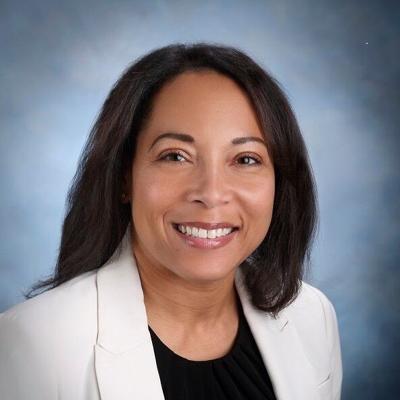

There’s a new county health officer in town and her vision for treating the residents of San Mateo County is broad from addressing disaster preparedness and homelessness to the opioid crisis and other more traditional health concerns.

Kismet Baldwin-Santana
Dr. Kismet Baldwin-Santana was selected in May to replace former health officer Dr. Scott Morrow, who retired this summer after about 30 years in the role and, most notably, lead the county through the COVID-19 pandemic.
Now as the top official leading health policy in the county, Baldwin-Santana is charged with familiarizing herself with local issues most affecting the public and overseeing teams of people developing solutions for those issues. Rather than rebuilding initiatives from scratch, she said her goal is to fine-tune what measures are already in place.
“I was excited about this position. It seemed like everyone in general really cared about the health and well-being of the people who live here. I got the sense that it really was a shared goal of pretty much everybody in the county, including the elected officials and that means a lot,” said Baldwin-Santana who described replacing Morrow, “an institution in himself,” as “daunting.”
Just months into the role, Baldwin-Santana said she’s still learning about the most pressing health risks in the county by meeting with different officials and participating in community meetings.
What has routinely come up are concerns for accessing housing, a key factor in determining health outcomes, Baldwin-Santana said, along with other stressors like child care resources and disaster preparedness.
The issues may appear outside the realm of what’s traditionally addressed by health officials — communicable diseases, family planning and mental health and substance abuse issues — but Baldwin-Santana said health officers have the privilege of expanding their work as broadly as may be necessary to treat a whole community.
“Public health is involved with everything. They’re working with law enforcement, they’re working with social services, they’re working with communities based orgs. Sometimes they work with elected officials. They’re in everything trying to make these changes and that’s something I thought I want to do,” Baldwin-Santana said about her decision to pursue public health. “It’s just so wide open, it makes it a very enjoyable job.”
Where it started
Baldwin-Santana has long been a lover of science. Her favorite subject in school was biology and she still finds herself pulled toward science fiction novels to this day. Becoming a doctor was also long in her plans after her mother set up a meeting between Baldwin-Santana and a primary care provider while she was in middle school.
Despite having her mind set, Baldwin-Santana’s academic and professional journey to her current position was filled with shifts and pivots. The Ohio native studied microbiology at Ohio State University where she realized her fascination with small organisms. After a brief stint in a research lab, Baldwin-Santana said she realized her passion was in the clinical space, pushing her to make her first pivot with a return to Ohio State to earn her doctorate.
While on rotations, her passions were further focused on pediatric medicine, specifically the neonatal intensive care unit where Baldwin-Santana said she was inspired by both the uplifting dispositions of NICU staff and the recoveries babies made.
“A lot of the choices I have made have to do with the people I’ve interacted with in these different settings. If they were mean, terrible people I probably wouldn’t want to go that route but I had great, great attendings and nurses and respiratory therapists and pharmacists in the NICU and it’s really rewarding taking care of these babies,” Baldwin-Santana said.
She went on to complete her pediatric residency at Sinai Hospital in Baltimore, Maryland, from 2007 to 2010 before accepting a neonatology fellowship position at the University of California, Los Angeles. That period led Baldwin-Santana to conduct research into stem cell gene therapy for sickle cell disease, studying how editing genes from placentas could potentially prevent cells from mutating into the red blood cell disorder.
Baldwin-Santana said the experience was likely the best she’s had in the medical field. It gave her the chance to interact with a diverse group of people and attend conferences where passionate people made strides in addressing the disease.
But Baldwin-Santana also recognized the hours of time her mentor Dr. Donald Cohen spent reviewing grant applications to get the funding the lab needed to continue his work, turning her attention back to person-to-person health care. She went on to accept a job as a neonatologist with Elliot Hospital in Manchester, New Hampshire, in 2014 where she was a member of the NICU emergency preparedness team and chairman of the Neonatal Abstinence and Medication Safety committees.
Recommended for you
Another shift
Her work in neonatology was rewarding, Baldwin-Santana said, but she questioned whether she’d be able to do the job into her 70s. Public health had never crossed her mind even as her peers pursued studies in the area but when working with sick babies, she often found herself thinking of the life circumstances that could have improved their health such as treatments for a mother struggling with addiction or access to healthy foods for moms with uncontrolled diabetes.
“I went home every day thinking, hoping I really made a difference in a family or baby’s life,” Baldwin-Santana said. “But I thought I’d like to be more involved in what was going on out in the community and that’s the focus of public health, not just an individual baby or an individual patient but the population level.”
After nearly two years with Elliot Hospital, Baldwin-Santana accepted a position as public health officer for the San Joaquin County Public Health Services. The experience, Baldwin-Santana said, was eye opening.
Unlike in a one-on-one clinical setting, health interventions among a larger population took longer to show results, Baldwin-Santana said, noting nothing major occurred during her time overseeing health in San Joaquin County. She dealt with the occasional health outbreaks, poor air quality and spills, which gave her the time she needed to learn the role.
She spent roughly two years in that position before beginning work for the Centers for Disease Control and Prevention as a quarantine medical officer at the San Francisco International Airport. In that role, Baldwin-Santana provided guidance to physicians and travelers, participated in daily conversations with CDC officials on screening guidelines and medical situations and collaborated with health partners in the Bay Area all to help prevent the spread of COVID-19.
Back to local health
Though she believed she was working with good people doing great work and working for the CDC was Baldwin-Santana’s end-goal dream, she said she found the role to be too far removed from daily health issues to which she was drawn.
“It was exciting,” Baldwin-Santana said. “It was good but I also learned at the CDC level — it’s important, we need them but it’s not as in touch with the community as I wanted to be.”
By July of 2020, Baldwin-Santana accepted the deputy public health officer position in Sonoma County and by April of 2023 she was acting as interim health officer of the county, a position she said has been the most rewarding in her career and taught her the “bread and butter of public health.”
Like health officials across the country, much of Baldwin-Santana’s work for the past three years revolved around the COVID-19 pandemic, a period that also threw the traditionally unnoticed work of health officials into the spotlight. It also exposed the need for more funding to be directed toward public health before an issue grows to the level of a global pandemic.
The county’s COVID-19 recovery remains a top priority for officials but Baldwin-Santana noted health concerns that existed before the pandemic still need to be addressed including the opioid crisis, an increasingly concerning issue as fentanyl saturates the street drug market.
Lessons from the pandemic will carry through into her future work, especially when it comes to crafting messaging and working closely with trusted organizations to get information out into vulnerable populations, she said.
“I think we will and should continue to use a lot of those things. It’s nice that we’re not at the same emergency and urgent level but I think it’s good that we got that feedback,” Baldwin-Santana said. “We need to keep fine-tuning these things so when the next thing happens, which, hopefully, that won’t be any time soon, we’ve got most of these things in place already and we’re not building the palace as we’re flying.”
(650) 344-5200 ext. 106











(1) comment
Impressive qualifications but the bottom line is whether Dr. Baldwin-Santana will follow the science on COVID “vaccines” that don’t vaccinate and masks not working to prevent COVID infections or whether she’ll cave to folks following emotion and the appearance of doing “something” but not really doing anything. I’ll be interested to see her stances and policies.
Welcome to the discussion.
Log In
Keep the discussion civilized. Absolutely NO personal attacks or insults directed toward writers, nor others who make comments.
Keep it clean. Please avoid obscene, vulgar, lewd, racist or sexually-oriented language.
Don't threaten. Threats of harming another person will not be tolerated.
Be truthful. Don't knowingly lie about anyone or anything.
Be proactive. Use the 'Report' link on each comment to let us know of abusive posts.
PLEASE TURN OFF YOUR CAPS LOCK.
Anyone violating these rules will be issued a warning. After the warning, comment privileges can be revoked.