A good argument can be made that San Bruno was the birthplace of naval aviation, especially if that history means landing on and taking off from a carrier, which many consider flying’s ultimate challenge.
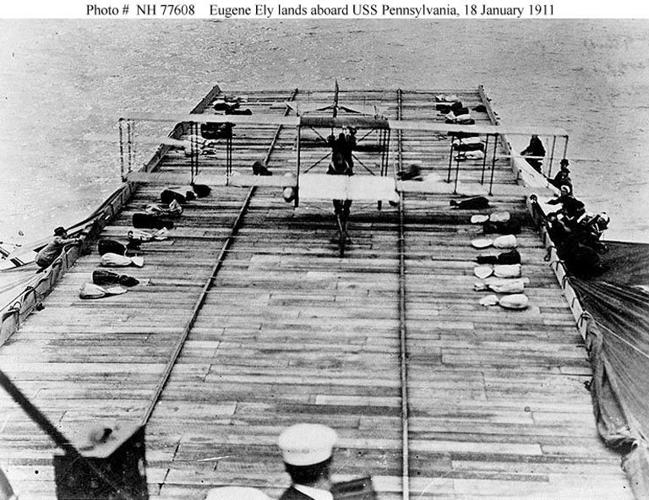
It’s true that historians often cite Hampton Roads, Virginia, as the debut of flight from a ship, an event that occurred on Nov. 14, 1910, when pioneering pilot Eugene Ely took off from the deck of the cruiser USS Birmingham in a one-way flight to a beach about three miles away. However, the flight was round-trip on Jan. 18, 1911, when Ely landed his Curtiss pusher biplane on a ship and took off from the same vessel, the cruiser Pennsylvania anchored in San Francisco Bay. His starting point for the historic flight was an airfield at Tanforan race track in San Bruno.
Ely’s success came on the third day of a 10-day aviation meet held at the Selfridge Aviation Field at Tanforan. An hour or so after he landed, the daring aviator, who wore a padded helmet and inflated bicycle tubes as a life preserver, took off from the special deck constructed on the Pennsylvania and returned to San Bruno.
The San Francisco Examiner hailed the 13-mile flight, proclaiming in a headline that it “revises world’s naval tactics.” The skipper of the Pennsylvania, Capt. C.F. Pond, said the flight was “the most important landing of a bird since the dove flew back to the ark.”
According to the U.S. Naval Institute, the San Bruno aviation meet set several firsts, including dropping live bombs and receiving wireless message while aloft. Ely clearly stole the show. Thousands lined the San Francisco waterfront and cheered long and hard when the aviator landed on the ship. According to the account in the Redwood City Democrat, the officers of the Pennsylvania reported that Ely “landed without mishap and with very little circling. The Curtiss biplane was in perfect shape on landing.”
Recommended for you
All was in readiness aboard the cruiser. A wooden platform 130 feet long and 32 feet wide had been built on the quarterdeck. At intervals of about a yard, lengths of sturdy ropes were stretched across the deck, anchored at the sides with sandbags. Hooks were attached to the plane’s undercarriage. Plans called for the hooks to grab the ropes one after the other until the weight of the dragging sandbags would halt the aircraft. Just in case, a broad strip of canvas across the end of the platform was designed to stop the flimsy airplane in case the sandbags didn’t. Basically, the method is similar to that used today.
There were no mishaps, but one account said “the ropes creaked, the gunny sacks spit sand far out over the water. People held their breath as the plane shuddered to a halt, several yards short of the canvas.”
Ely’s glory days were short. He was killed in October at an aviation exhibition in Macon, Georgia. In a gruesome aftermath, spectators rushed to the site of the crash and picked it clean of souvenirs, even the pilot’s gloves and cap. Ely was 24. He was posthumously inducted in to the National Aviation Hall of Fame with a citation that proclaimed he provided “the final convincing proof of the adaptability of airplane to sea based operations. Ely’s legacy lives on every time that aircraft take off and land on ships.”
The Rear View Mirror by history columnist Jim Clifford appears in the Daily Journal every other Monday. Objects in The Mirror are closer than they appear.
Keep the discussion civilized. Absolutely NO
personal attacks or insults directed toward writers, nor others who
make comments. Keep it clean. Please avoid obscene, vulgar, lewd,
racist or sexually-oriented language. Don't threaten. Threats of harming another
person will not be tolerated. Be truthful. Don't knowingly lie about anyone
or anything. Be proactive. Use the 'Report' link on
each comment to let us know of abusive posts. PLEASE TURN OFF YOUR CAPS LOCK. Anyone violating these rules will be issued a
warning. After the warning, comment privileges can be
revoked.
Please purchase a Premium Subscription to continue reading.
To continue, please log in, or sign up for a new account.
We offer one free story view per month. If you register for an account, you will get two additional story views. After those three total views, we ask that you support us with a subscription.
A subscription to our digital content is so much more than just access to our valuable content. It means you’re helping to support a local community institution that has, from its very start, supported the betterment of our society. Thank you very much!





(0) comments
Welcome to the discussion.
Log In
Keep the discussion civilized. Absolutely NO personal attacks or insults directed toward writers, nor others who make comments.
Keep it clean. Please avoid obscene, vulgar, lewd, racist or sexually-oriented language.
Don't threaten. Threats of harming another person will not be tolerated.
Be truthful. Don't knowingly lie about anyone or anything.
Be proactive. Use the 'Report' link on each comment to let us know of abusive posts.
PLEASE TURN OFF YOUR CAPS LOCK.
Anyone violating these rules will be issued a warning. After the warning, comment privileges can be revoked.