SACRAMENTO — The projected cost of California’s bullet train between San Francisco and Los Angeles has jumped to $77 billion and the completion date has been pushed back four years to 2033, according to a business plan released Friday.
The plan by the California High-Speed Rail Authority presents the latest setbacks for a project that’s been beleaguered by delays and cost overruns since voters first gave it the greenlight in 2008.
It focuses almost entirely on first opening track between San Francisco and the inland Central Valley, a goal the state is still billions of dollars short of financing.
“You cannot build a mega-project of this magnitude on a pay-as-you-go basis,” Brian Kelly, the project’s new chief executive, told reporters Friday.
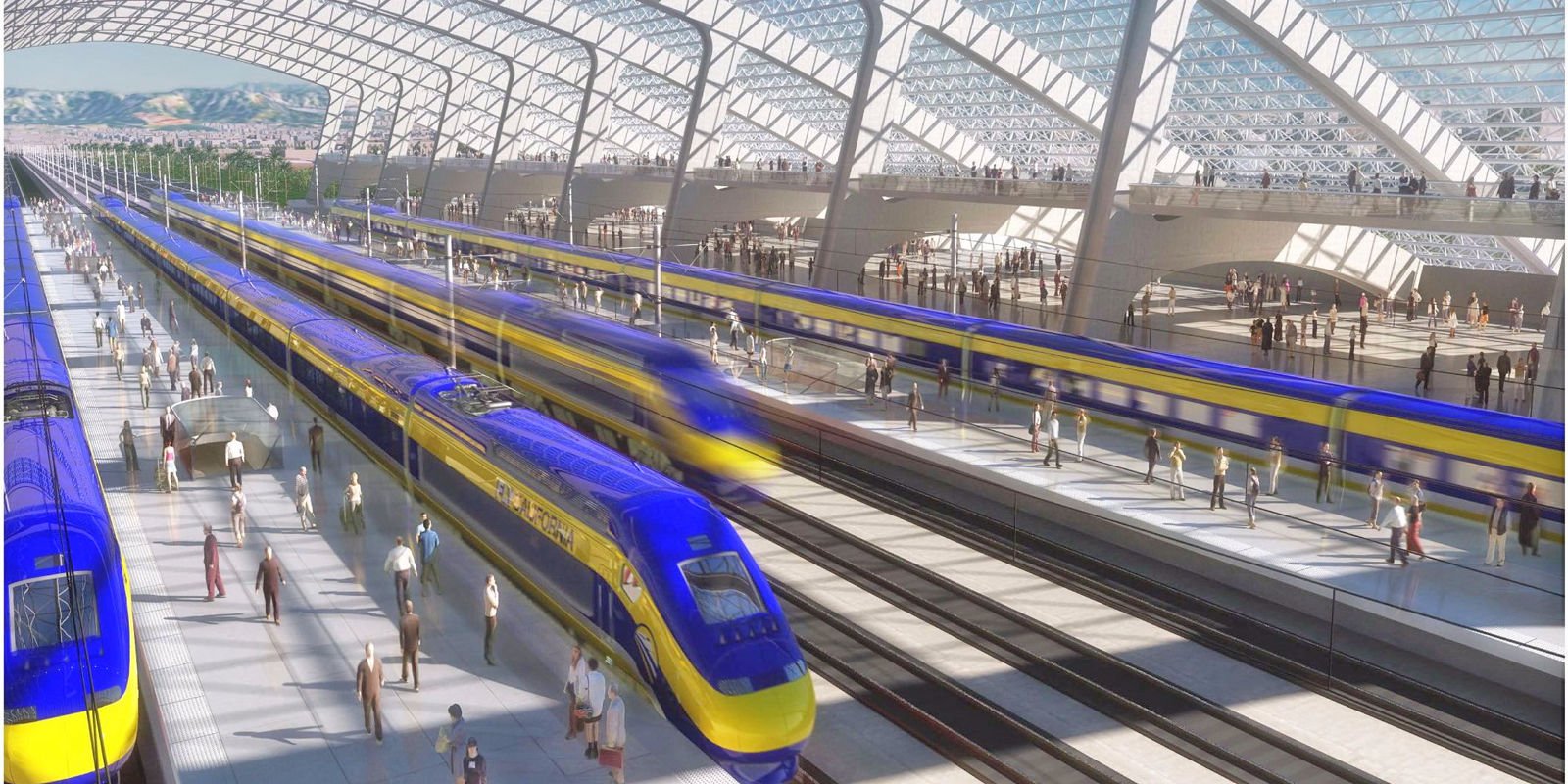
Artist’s rendering of California’s High-Speed Rail.
The plan calls for a fresh infusion of cash from the Legislature and private money to cover the costs of weaving tunnels through mountain passes between the Silicon and Central Valleys.
At present, the project doesn’t have enough money for the tunnels. But rail executives want them completed by 2029.
If completed, it would be the nation’s fastest train, carrying people between Northern and Southern California in less than three hours.
Officials hope connecting the San Francisco Bay Area, where rental and living costs are skyrocketing, to the more economically challenged and sparsely populated Central Valley, will provide an economic boost that will help shore up public and private support before the project continues south to Los Angeles and Anaheim.
While $77 billion is the baseline cost estimate, the plan estimates total costs could be as low as $63.2 billion or as high as $98.1 billion. The last plan, presented in 2016, estimated the project would cost $64 billion and be open by 2029.
Despite Kelly’s optimism that the project is doable, the plan drew fresh fire from critics who doubt it will ever be built.
“Let’s cut our losses and use the billions not yet wasted on (high-speed rail) to instead improve freeways, highways and roads and perhaps improve existing rail systems throughout California,” Republican state Sen. Andy Vidak said.
Critics outside Sacramento weighed in, too.
Recommended for you
“Heavy sigh,” Elon Musk, the billionaire entrepreneur and proponent of a “hyperloop” transportation system, wrote on Twitter in response to the cost jump.
Musk, chief executive of California-based SpaceX and Tesla, has long criticized U.S. infrastructure projects for getting bogged down in bureaucracy and high consultant costs.
Beyond the business plan, a state audit under way could expose more management and cost issues when released later this year.
Kelly, who took over as head of the project in February, has promised more transparency about the project’s challenges and was frank in his assessment of where it stands.
In the business plan, he assigned costs to a variety of risks, such as trouble acquiring land or security environmental clearance, two issues that have slowed the project in the past.
“At the very least, this business plan is different than the ones I’ve seen before because it really does admit that they’re broke and they can’t get to the finish line,” said Republican Assemblyman Jim Patterson of Fresno, where construction is underway.
The plan relies in part on fresh investment from the increasingly skeptical Legislature. Rail executives will make the case throughout a series of public hearings during the 60-day comment period before the business plan is finalized.
A major source of rail funding is the cap-and-trade program, under which the state auctions permits to release greenhouse gases. Rail planners are currently using the money as it comes in but say they’d need the ability to take on debt that would be paid off with future cap-and-trade dollars.
That would require the Legislature to extend the program until 2050. That’s a difficult task for a Legislature that struggled just last year to muster the two-thirds votes needed to extend the program from 2020 to 2030.
The state has spent $2.5 billion in federal stimulus money and has an additional $930 million in federal money on the table. That’s on top of a $10 billion bond from voters.
——
This story has been corrected to show the 119 miles of track in the Central Valley is the first construction segment, not the first operational segment.
And there's some Americans who think we don't pay enough tax.. like I wrote on the first article before it was deleted, this is classic Homer Simpson planning/Econ I . 10 yrs into a project that never began with every question answered. What a shame, there's some problems. That money could've been spent on freeways, overpasses and roads to help with unbearable traffic jams. But no, the traffic exists because we need more overpriced fancy dwellings to be built, then no one will have to get on a freeway on account of the Bay Areas top notch public transportation system everyone will be using. Doh!
Keep the discussion civilized. Absolutely NO
personal attacks or insults directed toward writers, nor others who
make comments. Keep it clean. Please avoid obscene, vulgar, lewd,
racist or sexually-oriented language. Don't threaten. Threats of harming another
person will not be tolerated. Be truthful. Don't knowingly lie about anyone
or anything. Be proactive. Use the 'Report' link on
each comment to let us know of abusive posts. PLEASE TURN OFF YOUR CAPS LOCK. Anyone violating these rules will be issued a
warning. After the warning, comment privileges can be
revoked.
Please purchase a Premium Subscription to continue reading.
To continue, please log in, or sign up for a new account.
We offer one free story view per month. If you register for an account, you will get two additional story views. After those three total views, we ask that you support us with a subscription.
A subscription to our digital content is so much more than just access to our valuable content. It means you’re helping to support a local community institution that has, from its very start, supported the betterment of our society. Thank you very much!










(1) comment
And there's some Americans who think we don't pay enough tax..
like I wrote on the first article before it was deleted, this is classic Homer Simpson planning/Econ I . 10 yrs into a project that never began with every question answered. What a shame, there's some problems. That money could've been spent on freeways, overpasses and roads to help with unbearable traffic jams. But no, the traffic exists because we need more overpriced fancy dwellings to be built, then no one will have to get on a freeway on account of the Bay Areas top notch public transportation system everyone will be using. Doh!
Welcome to the discussion.
Log In
Keep the discussion civilized. Absolutely NO personal attacks or insults directed toward writers, nor others who make comments.
Keep it clean. Please avoid obscene, vulgar, lewd, racist or sexually-oriented language.
Don't threaten. Threats of harming another person will not be tolerated.
Be truthful. Don't knowingly lie about anyone or anything.
Be proactive. Use the 'Report' link on each comment to let us know of abusive posts.
PLEASE TURN OFF YOUR CAPS LOCK.
Anyone violating these rules will be issued a warning. After the warning, comment privileges can be revoked.