In the 15 years between 1922 and 1937, only two ocean-going dry cargo freighters were produced in American shipyards. The United States had built 2,500 ships in World War I and now the Navy was in shambles.
There were but 10 shipyards in the United States capable of building ocean-going vessels 400 feet or longer. The U.S. Maritime Commission was established in 1936 to oversee and access the needs of the United States. It, however, did not increase our naval supply of ships adequately although there was a war brewing in Europe. We had an order to build 60 ships for England and they were the antiquated , slow, obsolete, coal-burning ships. Immediately after the war began, we dropped their contract and converted those vessels to oil burners that were much faster. Our merchant fleet consisted of 1,150 vessels.
In 1822, William Richardson landed in the port of Yerba Buena and, when his ship, a British whaler Orion, left, it sailed without him. It was believed he deserted his ship because he fell in love with the Presidio commandant’s daughter, Maria Antonia Martinez. Pablo Vicente de Sola, the Mexican governor, granted Richardson permission to stay on condition he give lessons in carpentry and navigation to the youth of California.
He was baptized at the mission and the couple got married in 1823. They lived at the Presidio with her father. Their first child was born April 9, 1826. The year before he received citizenship, the family moved to southern California —1829. In 1831 and 1833, two sons were born.
In 1835, Richardson returned to San Francisco and built the first structure on the property then called Yerba Buena. Francisco de Haro was now alcalde (mayor and judge) of Yerba Buena and he marked the first street, La Calla de la Foundation (literally the Street of the Founding) that ran from the beach (now Montgomery Street) to the west, turned north and continued to the Presidio. The section at the right turn is now Grant Street. Richardson constructed a home at what is now the corner of Washington Street and Grant Avenue.
Because of his many talents, Richardson was appointed port captain by Gov. Jose Figueroa in 1835 and he played a significant role in the development of the area. He frequently served as a pilot on vessels entering and leaving the harbor. During this time, he developed a lucrative smuggling business after he was grantee of the 18,000-acre Rancho Sausalito in Marin County (parts of Sausalito and Mill Valley). Richardson Bay was named for him.
Recommended for you
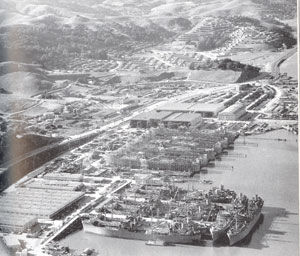
U.S. shipbuilder W.A. Bechtel Co. decided to use the Rancho area for a new shipyard where an old railroad repair yard of former Southern Pacific Railroad was located at the base of Spring Street. The area became too small when additional contracts for emergency needs raised due to excessive sinking of ships. After March 28, 1942, about 42 houses were removed. Pine Point was dynamited and more than 800 cubic yards of dirt was used to fill in the mudflats where six ways were to be constructed as well as outfitting docks, subassembly shops and mold lofts where forms were made for the ships.
Ferry and bus service transported the workers to the site. It cost 10 cents to ride on the ferry from the San Francisco Ferry Building and Hyde Street terminal. More than 1,800 passengers rode the ferry each day and classes were held on the ferry for the workers. More than 3,800 workers rode the bus to the Marinship site. Five lunch sites were set up for food for the workers. The price of a box lunch was 35 cents, a pint of milk cost 11 cents and a cup of coffee was had for a nickel. A hot meal was available at the north end of the site. Across Highway 101 at the north end, facilities were built for single men to sleep and, to its south, was built a number of barracks for married couples. Schools were built as well as a church for the 6,000 that lived there. It was named Marin City and it still exists.
Marinship’s first Liberty Ship was launched on Sept. 26, 1942. It was named for the captain and later land owner who founded the Port of Sausalito and name of the Bay on which it sits. After the first six ships were launched, the organization built its first T-2 tanker and the ways were modified to build oil tankers.
It was a massive undertaking that had to be built in such a short time. The war was raging and we were losing ships almost as fast as they were being constructed. Approximately 15,000 people worked there day and night. The night shift earned an extra 15 cents an hour. Records were broken for constructing ships. No longer did it take a year to complete a new ship. A record of 33 days was set in the delivery of a T-2 tanker, Huntington Hills. At the end of Marinship’s existence, it was contracted to build a number of barges called “Dagwoods,” breakwater components.
In all, Marinship built 93 ships with the last ship being named Mission San Francisco.
Rediscovering the Peninsula by Darold Fredricks appears in the Monday edition of the Daily Journal.
Keep the discussion civilized. Absolutely NO
personal attacks or insults directed toward writers, nor others who
make comments. Keep it clean. Please avoid obscene, vulgar, lewd,
racist or sexually-oriented language. Don't threaten. Threats of harming another
person will not be tolerated. Be truthful. Don't knowingly lie about anyone
or anything. Be proactive. Use the 'Report' link on
each comment to let us know of abusive posts. PLEASE TURN OFF YOUR CAPS LOCK. Anyone violating these rules will be issued a
warning. After the warning, comment privileges can be
revoked.
Please purchase a Premium Subscription to continue reading.
To continue, please log in, or sign up for a new account.
We offer one free story view per month. If you register for an account, you will get two additional story views. After those three total views, we ask that you support us with a subscription.
A subscription to our digital content is so much more than just access to our valuable content. It means you’re helping to support a local community institution that has, from its very start, supported the betterment of our society. Thank you very much!



(0) comments
Welcome to the discussion.
Log In
Keep the discussion civilized. Absolutely NO personal attacks or insults directed toward writers, nor others who make comments.
Keep it clean. Please avoid obscene, vulgar, lewd, racist or sexually-oriented language.
Don't threaten. Threats of harming another person will not be tolerated.
Be truthful. Don't knowingly lie about anyone or anything.
Be proactive. Use the 'Report' link on each comment to let us know of abusive posts.
PLEASE TURN OFF YOUR CAPS LOCK.
Anyone violating these rules will be issued a warning. After the warning, comment privileges can be revoked.