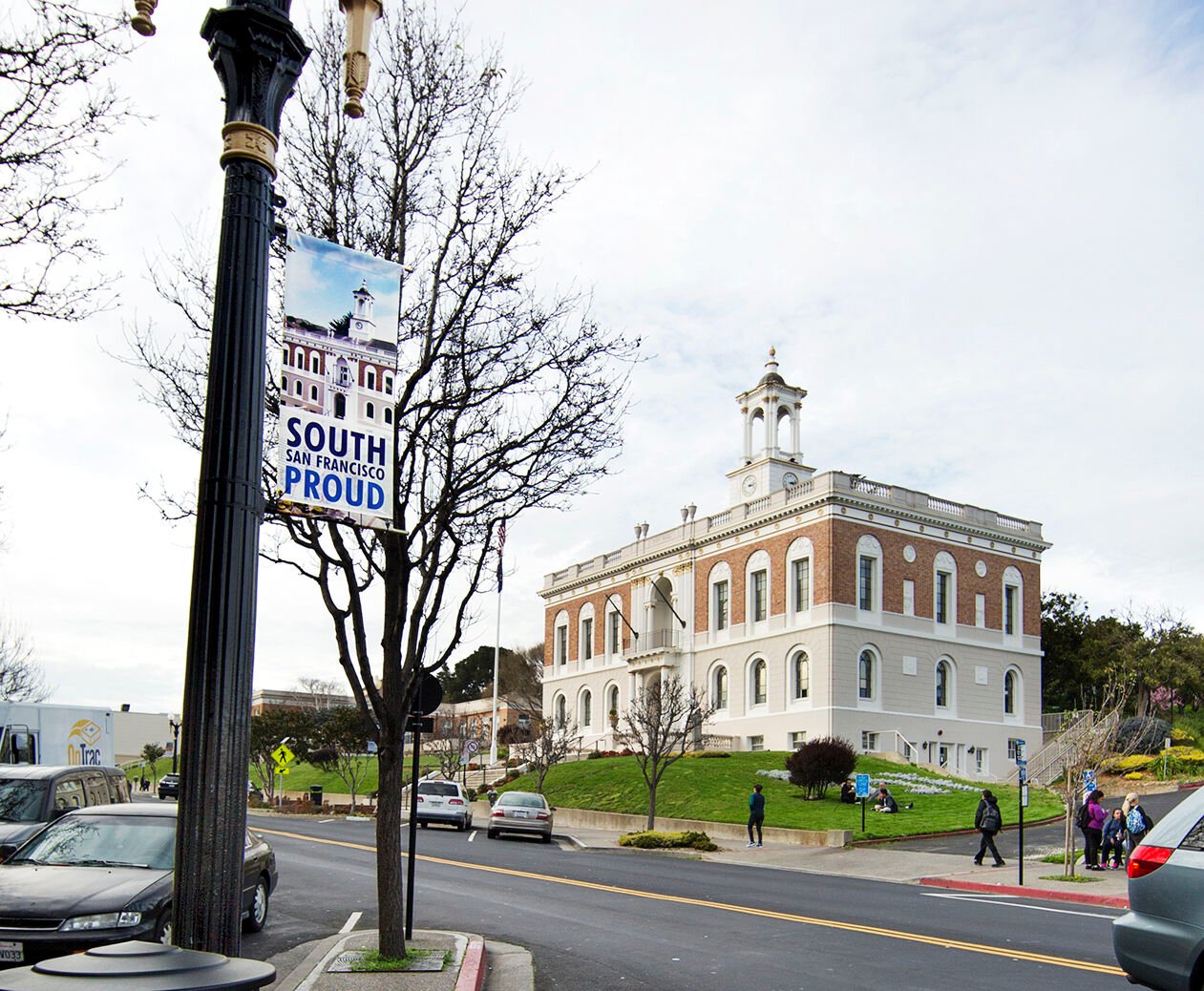
South San Francisco has completed nearly 20% of its state-mandated housing targets for the current 2023-31 planning cycle, issuing roughly 770 building permits for housing units thus far.
The housing element is a state-mandated document outlining how each California jurisdiction will plan for its housing needs. While South San Francisco must plan for 3,956 units by 2031, according to its Regional Housing Needs Allocation, the state requires that a certain number of those units are for very low-income, low-income and moderate-income households.
Market-rate units comprise about 27% of the issued permits, with very low-income units at 8%, low-income units at 22% and moderate-income units at 12%.
In 2025 alone, the city issued at least 593 new residential building permits, the bulk of which came from the massive South Linden Avenue housing development. About 97 units received certificates of occupancy during the year, including those at Baden Station and McLellan Drive developments.
“We do also have a couple of larger multifamily projects that are under review by planning, so hopefully that is a sign that there will be additional units constructed,” Senior Planner Stephanie Skangos said during a Planning Commission meeting March 19.
Housing element progress varies greatly from city to city and is also dependent on zoning policies and general macroeconomic forces, especially related to private market lending conditions. Development over the last couple years has slowed, even when projects had received entitlements, and cities were issuing increasingly more extensions to developers to allow them to keep their approvals past the typical one- to three-year timeframe.
Recently, Foster City reported that it had only approved 2% of its total target, while San Mateo has made significant strides compared to the last housing element cycle, with 97% of its RHNA target in its development pipeline — though much of that is still in the early stages.
“The biggest issue is the financing side. If banks aren’t financing projects, the city only has so much it can help with,” Principal Planner Billy Gross said. “Are we getting lots of applications for larger projects? No, because it doesn’t make sense for a developer to get a project entitled if they can’t get financing to construct it.”
Keep the discussion civilized. Absolutely NO
personal attacks or insults directed toward writers, nor others who
make comments. Keep it clean. Please avoid obscene, vulgar, lewd,
racist or sexually-oriented language. Don't threaten. Threats of harming another
person will not be tolerated. Be truthful. Don't knowingly lie about anyone
or anything. Be proactive. Use the 'Report' link on
each comment to let us know of abusive posts. PLEASE TURN OFF YOUR CAPS LOCK. Anyone violating these rules will be issued a
warning. After the warning, comment privileges can be
revoked.
Please purchase a Premium Subscription to continue reading.
To continue, please log in, or sign up for a new account.
We offer one free story view per month. If you register for an account, you will get two additional story views. After those three total views, we ask that you support us with a subscription.
A subscription to our digital content is so much more than just access to our valuable content. It means you’re helping to support a local community institution that has, from its very start, supported the betterment of our society. Thank you very much!




(0) comments
Welcome to the discussion.
Log In
Keep the discussion civilized. Absolutely NO personal attacks or insults directed toward writers, nor others who make comments.
Keep it clean. Please avoid obscene, vulgar, lewd, racist or sexually-oriented language.
Don't threaten. Threats of harming another person will not be tolerated.
Be truthful. Don't knowingly lie about anyone or anything.
Be proactive. Use the 'Report' link on each comment to let us know of abusive posts.
PLEASE TURN OFF YOUR CAPS LOCK.
Anyone violating these rules will be issued a warning. After the warning, comment privileges can be revoked.