
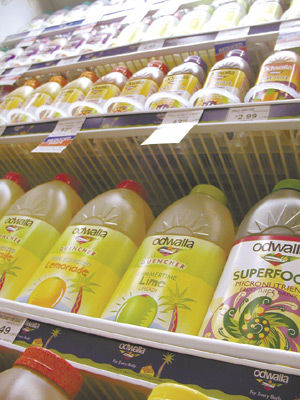
Hippie-inspired colorful bottles donning the Odwalla logo are popping up at stores, restaurants and airports nationwide.
Despite boasting a $189-million year last year, the Half Moon Bay company still strives keep the home-town, small-company approach to its product. After over 25 years, Odwalla now offers more than the original juices with juice blends, smoothies, enhanced water and a line of nutritious energy bars. More nutritional food and drink items are sure to follow, but for now the California company is looking at building its brand throughout the country.
Doing so became easier in 2001 when Coca-Cola purchased Odwalla for $181 million. This partnership hasn’t changed the homegrown values and personality of the company, said Chief Operating Officer Steve McCormick.
"It’s a very important separate company. We’re separate. It’s still Odwalla Inc. All the employees are Odwalla employees. It’s important for the brand,” said McCormick. "But it’s a great marriage. We have access and support for resources, capital and processes; all the things that can help us grow.”
Odwalla began in Santa Cruz in 1980 with three friends, a used $200 hand juicer and a few boxes of oranges. Greg Steltenpohl, Gerry Percy and Bonnie Bassett squeezed the juice in a shed behind their home then delivered it to local restaurants. One box of oranges was used the first day. Profits from that day bought two boxes of oranges the next day marking the beginning of Odwalla.
Music inspired the original name. "Illistrum,” a piece composed by Malachi Favors and performed by The Art Ensemble of Chicago sparked the name. In the poem, Odwalla is the hero who guided "the people of the sun” out of the "gray haze.”
From the beginning keeping thing natural was important. The juice gained popularity and began being sold outside of California in 1994. Its decision not to pasteurize — a heating process to kill bacteria but is thought to alter the product’s color and nutrients — changed in 1996 after E. coli was found in apple juice, which sickened many children and killed one person. Now the products are flash-pasteurized. This method exposes the liquids to heat for a shorter period of time. It is supposed to maintain the quality of the ingredients while killing bacteria.
The incident was a set back for the company financially for a short while. Things were heading back up not long after the changes were put in place. Coca-Cola bought Odwalla in 2001 giving the company help to expand.
Today, Odwalla products are in grocery stores, Starbucks, airports nationwide, in food service and colleges.
Bottling the fresh, nutritious products is important for Odwalla. The company creates new products and bottles the juice in Dinuba, Calif. - an area close to the farmers that grow the fruit and vegetables in the products.
Recommended for you
"We’ve been fortunate to not only have built out the availability [of our products], there is such a huge demand for the product. People are looking for healthy alternatives that are convenient. There’s a significant consumer demand and we’re really trying to meet that,” said McCormick. "We want to be available where people go to work; where they go to school; where the eat; where they shop. Each time we’ve made the product available sales demand grows as well.”
Creating new products isn’t a simple process. In recent years the company expanded into include food bars. This week a new chewy food bar line was released.
"We have a dedicated research and development team constantly working,” he said. "It’s incredibly important [that the product be] great for you but they’re great tasting, in order to launch, highest quality ingredients and principals.”
Take Superfood for example. The green drink isn’t the most visually appealing but it’s full of nutrients and tastes like apples. And, it’s the best selling drink offered by Odwalla.
McCormick explained the drink offers the nutrients of a wheat grass shot with other vitamins. Places serve such shots with a slice of lemon or orange to take the bite off the bitter grass taste. Odwalla just adds those sweet flavors into the drink.
McCormick wasn’t the most health conscious guy before joining the Odwalla team in 2003. Today he begins each day with a Soy Smart Chai drink, which provides Omega-3 — a nutrient helping the brain and retina.
And when asked about the product, he passionately explained the nutrients missing from most American diets.
Keeping a product, on the other hand, is completely driven by the consumer. If it’s successful — like a product in any business — it will continue to be on the shelf.
Although tightlipped about the details, McCormick did add there was room for Odwalla to expand its nutrition-based product line in the future.
Heather Murtagh can be reached by e-mail: heather@smdailyjournal.com or by phone: (650) 344-5200 ext. 105.






(0) comments
Welcome to the discussion.
Log In
Keep the discussion civilized. Absolutely NO personal attacks or insults directed toward writers, nor others who make comments.
Keep it clean. Please avoid obscene, vulgar, lewd, racist or sexually-oriented language.
Don't threaten. Threats of harming another person will not be tolerated.
Be truthful. Don't knowingly lie about anyone or anything.
Be proactive. Use the 'Report' link on each comment to let us know of abusive posts.
PLEASE TURN OFF YOUR CAPS LOCK.
Anyone violating these rules will be issued a warning. After the warning, comment privileges can be revoked.