If you’ve driven up or down the scenic, coastal Highway 1, you might have stopped in for a slice of pie at the Pie Ranch farm stand.
If that snack turned into a leisurely walk around the grounds, you might also pick up on the nonprofit farm’s far-ranging, holistic programming — including a native plant garden created in tandem with the Amah Mutsun Tribal Band and Land Trust to facilitate Indigenous land stewardship and cozy, wooden buildings across the property that host barn dances, artist retreats and school field trips, among a bevy of other uses.
Still, visitors to the ranch often remain surprised at just how deftly Pie Ranch turns traditional expectations of a working farm on its head.
“They tend to, ‘go, wow, I didn’t realize there’s all these other elements woven into the farm,’” Pie Ranch co-founder Jered Lawson said. “It’s definitely a joy for us to see how you can take a working farm and make it so much more, and leverage it to accomplish these other goals that you have — for us to build a more healthy and just food system.”
Founding mission
Pie Ranch — which gets its name from the pie-slice shape of the land on which the ranch is located — was founded by Lawson, his partner Nancy Vail and another co-founder, Karen Heisler, in 2003.
The first educational programs began two years later, inviting high-school-aged students to work on the farm and engage in conversations around how food is grown and the interconnected systems that create it.
“We all have a connection to food, of course, because we all eat, we all have ancestors that once upon a time, were deeply connected to the earth and to community,” Vail said. “Food is a powerful tool for thinking about — whether it’s social, political, spiritual, economic or environmental issues in our world. And it’s a wonderful way to bring people together.”
The ranch has expanded in size and programming scope since then. It brings more than 1,000 students and 6,000 individuals total to the property each year, first to learn about the partnership between the farm and the Amah Mutsun Tribal Band and then to help harvest the farm’s bounty of crops — like squash, beans, berries and wheat, among many others.
Students will then often get the opportunity to prepare a meal together, completing a hands-on education that allows them to understand how food comes from the dirt to table. For some, it’s a new experience.
“Sometimes we’ll have folks show up and they’ll be like,’ I don’t want to get my shoes dirty. That is a scary bug.’ Or they don’t want to get their clothes dirty, or their hands dirty, or they’ll be really aware of how the animals smell,” Vail said. “There’ll be a resistance to it, but in that resistance, or the scariness, or is also a lot of excitement, because it’s new.”
While this education is one integral component of Pie Ranch, both Lawson and Vail clearly espoused that the goal of their work is centered in the converging movements of food justice, anti-racism, the dismantling of white supremacy and using their privilege to offer marginalized communities opportunities to farm, ranch and steward land to which they historically have not had access.
“From the beginning with Pie Ranch, it wasn’t just about education for young people,” Vail said. “That was definitely a part of it, but it was also about farmer pathways. We wanted to really hold that vision of a multiracial corridor of land stewards that are feeding the diverse communities of the Bay Area.”
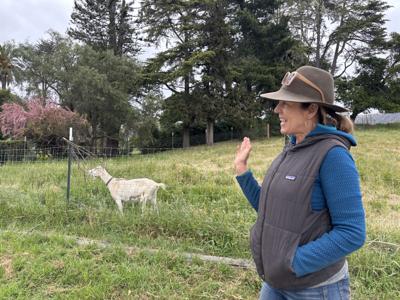
Co-founder Nancy Vail with the Pie Ranch goats.
Holly Rusch/Daily Journal
Indigenous land stewardship
A critical component of this work is in partnership with the Amah Mutsun Tribal Band and Land Trust, which first began in 2014.
The Indigenous people who once lived on the land that is now Pie Ranch, the Quiroste Tribe, have no living descendants. In their honor, the Amah Mutsun Tribal Band and Land Trust — which represents Indigenous people of the south-San Francisco and north-Monterey Bay Area — have helped Pie Ranch honor and tend to the land.
“At first we didn’t know who they were, and we were resisting, because the trust issue is always big with our tribe,” Chairman Valentin Lopez said.
Over time, the Amah Mutsun Tribal Band began to feel that the intentions of the Pie Ranch founders were genuine, Lopez said, and partnered with them on projects, including the development of a native plant garden. The tribe has also hosted gatherings on healing, food sovereignty and ceremonies on the ranch.
The relationship has been fruitful because Pie Ranch has respected the boundaries and expertise of the tribe and a mutualistic understanding of the environment that honors the relationship between people, animals and plants, Lopez said.
Recommended for you
“They try to at the same time understand we’re going at our pace, not theirs,” he said. “That’s always important, the learning of our traditional ways. A big part of that learning is that all plants have the responsibility to take care of a full community, and that full community means taking care of the fungi, insects, the birds, the four-legged and people.”
Every tour of the ranch begins in the native plant garden, which is fittingly split into four pie slices, each representing different plant groups. Attendees discuss what the land might have looked like before it was farmed and learn about traditional ecological practices.
“How can we bring back some of these ways of being in relationship with plants, and have that sense of reciprocity and relationship where you don’t see a plant as an it, but as a being?” Vail said.
“The shining silver lining in all of this is that we have been able to rebuild,” Vail said.
The rebuilding effort allowed Pie Ranch to be more intentional with its replanting efforts, centering native plants and removing invasive species with the help of the Amah Mutsun Tribal Band and Land Trust.
That included planting of 3,000 native plants in a hedgerow, clearing out invasive species from the nearby creek, removal of invasive eucalyptus trees and planting of native trees.
“We brought in native trees that are used for native purposes, I think primarily foods, and those are important for education for Pie Ranch,” Lopez said. “Pie Ranch can talk about Indigenous foods … at the same time those plants are available to us for harvesting for our foods.”
The Silicon Valley Community Foundation — a nonprofit that connects donors to local charitable causes — has provided Pie Ranch with grants since 2010, but stepped up in the wake of the fires to offer rebuilding support that went to debris removal, roadwork and supporting native stewardship, among other initiatives.
“SVCF stood up an emergency relief fund where we quickly dispersed funding to nonprofits,” SVCF executive vice president of community impact initiatives Moses Zapien said. “Our emergency support following the fires provided relief and helped catalyze a deeper collaboration between Pie Ranch and the Amah Mutsun Tribal Band.”
There are other native stewardship practices that Pie Ranch is interested in implementing in the future, Lawson said, including controlled burns that Indigenous peoples would use to mitigate fire hazards.
“We didn’t deploy the kinds of resources or fire that the Indigenous communities did when they were residing in this area for thousands of years,” he said. “This is what happens when you plant volatile, explosive, nonnative trees that take over an area — it becomes more catastrophic.”
Future efforts and ongoing events
There are other programs into which Pie Ranch is expanding. One, the Cascade Regenerator program, aims to support historically underserved communities in becoming farmers, ranchers and land stewards.
The first regenerator farm, Brisa Ranch, was hosted in 2019, and the Amah Mutsun Tribal Band is also using the 418 acres of property at nearby Cascade Ranch to grow seeds of native plant species that will then be repopulated across the Santa Cruz Mountains.
“It was initially conceived of as a way to provide more accessible, affordable land for next-generation farmers, and particularly farmers who haven’t had as easy a time accessing land as European settlers in this area,” Lawson said.
Fostering community is also a key tenant of Pie Ranch’s goal, with a work day and barn dance hosted every third Saturday, an active roadside farm stand that also sells the produce and wares of neighboring farms, and plans for a future artist’s retreat and fellowship program.
The ranch is also interested in facilitating culture and arts events that translate the messages of food justice and interconnectedness that their work promotes, Lawson said.
“Cultural shifts tend to happen when there’s other aspects of our culture that uplift the benefits of that shift of vision,” he said. “Usually, arts and culture are what help drive those social change efforts in the community.”
Keep the discussion civilized. Absolutely NO
personal attacks or insults directed toward writers, nor others who
make comments. Keep it clean. Please avoid obscene, vulgar, lewd,
racist or sexually-oriented language. Don't threaten. Threats of harming another
person will not be tolerated. Be truthful. Don't knowingly lie about anyone
or anything. Be proactive. Use the 'Report' link on
each comment to let us know of abusive posts. PLEASE TURN OFF YOUR CAPS LOCK. Anyone violating these rules will be issued a
warning. After the warning, comment privileges can be
revoked.
Please purchase a Premium Subscription to continue reading.
To continue, please log in, or sign up for a new account.
We offer one free story view per month. If you register for an account, you will get two additional story views. After those three total views, we ask that you support us with a subscription.
A subscription to our digital content is so much more than just access to our valuable content. It means you’re helping to support a local community institution that has, from its very start, supported the betterment of our society. Thank you very much!






(0) comments
Welcome to the discussion.
Log In
Keep the discussion civilized. Absolutely NO personal attacks or insults directed toward writers, nor others who make comments.
Keep it clean. Please avoid obscene, vulgar, lewd, racist or sexually-oriented language.
Don't threaten. Threats of harming another person will not be tolerated.
Be truthful. Don't knowingly lie about anyone or anything.
Be proactive. Use the 'Report' link on each comment to let us know of abusive posts.
PLEASE TURN OFF YOUR CAPS LOCK.
Anyone violating these rules will be issued a warning. After the warning, comment privileges can be revoked.