
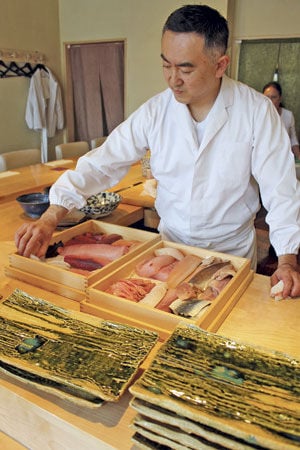
Months after opening Sushi Yoshizumi, owner and chef Akira Yoshizumi said his underappreciated journey to achieve mastery of traditional Edo style sushi was validated when his restaurant received a Michelin star.
Located on Fourth Avenue in downtown San Mateo, the inconspicuous and modest storefront has no signs. Besides a framed information sheet with business hours and a bio of Chef Yoshizumi hanging on the glass door, there is no announcement of his induction into the coveted roster of restaurants.
The Michelin star only serves as a sign that he is on the right path, said Yoshizumi. It gives him the confidence to be bolder with his traditional, authentic, Edo style sushi menu.
“Now I know that people accept it and are willing to pay for it,” he said.
Originating in early 1800s, Edo — the historic name for Tokyo, or Edomae sushi is more than a delicate sliver of fish, pressed lightly on top of a nugget of warm rice. The unique flavors of Edo sushi requires a traditional method of preparing rice, and curing the fish a certain way.
Unlike other Japanese restaurants, patrons who wait the average two months for a seat at Sushi Yoshizumi won’t find a picture menu, a chalkboard with daily specials or a list of sake options.
The meal is served, Omakase, which means chef’s choice. For a set fee of $125 per person, diners embark on a culinary adventure led by the hands and knife of the sushi master. Proving there is a palate demand for a tasteful trip to old Tokyo, Yoshizumi introduced a premium selection for $185, shortly after receiving a Michelin star. A sake pairing can be requested at an additional fee.
Hairy crab and rosy sea bass from Japan are among the ingredients that Yoshizumi personally selects at a fish purveyor’s warehouse in South San Francisco.
“Only me and a few sushi chefs are there in the morning, the rest usually just have their fish delivered to them,” said Yoshizumi.
Being able to talk to the vendors and ask questions about the fish and where they came from gives Yoshizumi an advantage. Sometimes they offer special items that very few restaurants can get, he said.
After Yoshizumi makes his selection, the fish is cleaned, marinated and aged at the restaurant. Using a historical approach in modern times, each strip of fish is placed side by side inside a wooden cedar box that looks like a 50 count cigar humidor, then placed in an under-counter fridge. Depending on the fish, the aging process can take two days to three weeks.
“I know when it is the best time for the fish to be the most tasty, I know when it’s ready,” said Yoshizumi.
Inside the restaurant, both space and design complement the chef’s personality and food.
“Sushi is supposed to be simplicity,” Yoshizumi said.
Recommended for you
The plain walls and cedar wood sushi bar — noticeably missing the usual glass refrigeration case filled with raw fish — feels refined, serious and Zenful.
There are 15 seats and chef Yoshizumi hosts two dining services per night, excluding Monday and Tuesday, maintaining an intimate dining experience void of distractions that would take away from the main attraction — sushi that is undoubtedly Japanese.
A few centuries ago in Japan, Edo style sushi originated as a form of fast food sold in street stalls for workers and business owners who had very little time to dine. With no refrigeration, chefs cured the fish and used vinegar to prepare rice that would avoid advanced spoilage.
According to Yoshizumi, rice is treated with, akazu, an aged red vinegar, and seasoned with sea salt, which naturally sweetens the rice.
“Rice is the most important part of sushi, about 95 percent of the sushi depends on how good the rice is,” he said.
Early on in his career, Yoshizumi worked for a highly regarded Edo chef in New York City, making rice for two years. According to Yoshizumi, the traditional career path to becoming a sushi chef required years of working through different stations.
The belief is, “if you can’t make good rice,” Yoshizumi said, “how can you make good sushi?”
The concept of redundancy to achieve mastery was encouraged again when Yoshizumi returned to Japan. He worked under the guidance of Sugiyama Toshiaki, a master Edo chef in Japan most famously known for training Masayoshi Takayama of Masa in New York City.
When Yoshizumi informed Toshiaki about the Michelin honor, he told Yoshizumi it means he should work even harder.
Yoshizumi said he still gets nervous that people will not like this kind of sushi. The Michelin star has calmed some nerves but also invited what he calls, “non-serious sushi people.”
The lure to eat at a Michelin rated restaurant sometimes conflicts with Yoshizumi's serious commitment to deliver dynamic flavors.
According to Yoshizumi, eating the sushi immediately after it is served is key because the temperature and texture offers the best taste. Some people get distracted and let it sit too long, causing the sushi to dry out, said Yoshizumi.
While he appreciates every customer, Yoshizumi mostly feels bad if a true sushi lover missed out on a seat.






(0) comments
Welcome to the discussion.
Log In
Keep the discussion civilized. Absolutely NO personal attacks or insults directed toward writers, nor others who make comments.
Keep it clean. Please avoid obscene, vulgar, lewd, racist or sexually-oriented language.
Don't threaten. Threats of harming another person will not be tolerated.
Be truthful. Don't knowingly lie about anyone or anything.
Be proactive. Use the 'Report' link on each comment to let us know of abusive posts.
PLEASE TURN OFF YOUR CAPS LOCK.
Anyone violating these rules will be issued a warning. After the warning, comment privileges can be revoked.