
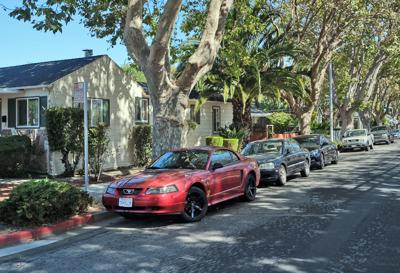
Allowing each licensed driver in a household to apply for a street parking permit and establishing new ways by which parking restrictions in different parts of the city are approved and changed are among the rules the San Mateo City Council unanimously approved Monday.
With the goal of maximizing the availability of street parking for residents in parts of the city near commercial zones or other areas affected by overflow or long-term parking, San Mateo has established parking restrictions for residential neighborhoods near the city’s three Caltrain stations as well as some 15 other areas in the city, said Sue-Ellen Atkinson, the city’s principal transportation planner at the council’s Sept. 16 meeting.
The city’s current residential parking permit program, or RPPP, established two-hour parking time limits on specific stretches of residential streets and allowed an unlimited number of permits to be issued to households within the RPPP zones, explained Atkinson, who noted the City Council voiced support for exploring some limits to the number of permits issued when they reviewed the program in March.
By proposing free street parking permits be issued to each licensed driver with a vehicle registered to an address within an RPPP area and offering one visitor parking pass for each household, staff hoped the new rules would allow each licensed driver to have one permitted vehicle while cutting down on the use of on-street parking as vehicle storage, said Atkinson. Allowing appeals of the city’s RPPP program to be reviewed by the Sustainability and Infrastructure Commission, requiring proposed changes to existing RPPPs to be vetted with the affected community and defining a list of parking generators, or land uses causing parking to overflow onto residential streets, were among the other program changes the council approved Monday.
Deputy Mayor Maureen Freschet described the changes as a good starting point in addressing some of the concerns residents have had about the ability to park on their street in recent years, but she also acknowledged the challenges the rules could present for those who may have more cars than licensed drivers in their households.
“You’re going to get more parking on your street,” she said, according to a video of the meeting. “But you may have to park that extra car in your driveway … It’s not going to make everybody happy but I think there … has been a real attempt to try create some balance so that there’s fairness to everybody.”
For resident Clive Isip, parking on his street has been much easier to find after an RPPP was implemented in his neighborhood.
“It made a difference in my life because I was able to come home at 8 p.m. in the evening and actually park in front of my house,” he said. “That’s a great blessing for us.”
But Isip voiced some concern about limiting the number of permits issued to a household to the number of licensed drivers, noting there may be some residents who have an extra vehicle they don’t use as often but that they need occasionally. Atkinson noted homes with more vehicles than licensed drivers could use off-street parking for extra vehicles.
As a 20-year resident of the 500 block of South Fremont Street, Al Mir said he’s seen the parking availability on his street worsen over time as RPPPs were implemented on nearby residential streets surrounding downtown San Mateo. Mir felt the two apartment buildings on his block contributed to the lack of street parking near his home where he lives with his mother, who has disabilities. He noted he has seen some cars parked on his street for weeks at a time, and felt that if finding enforcement staff is a challenge for the program, putting up signs indicating the restrictions would make a big difference.
Recommended for you
“One thing I know for sure is just putting up a sign adds … a huge deterrent,” he said.
Atkinson said staff reviewed the possibility of including multi-family housing in the list of parking generators, which do not have access to RPPPs and include schools and commercial uses. But they found multi-family housing is a very broad term and residences that include parking in the home price or rent must be treated in the same manner.
She said staff proposed a change to the city’s RPPP restricting residents in new developments with unbundled parking packages from obtaining residential parking permits. If parking is purchased or rented separately from a housing unit, there could be a financial incentive for a resident to park on the street for free rather than pay to park at their residence, explained Atkinson.
In response to questions about whether caregivers of an older adult or younger children could be issued a permit, Atkinson said residents can apply to obtain a permit for their caregiver. Public Works Director Brad Underwood added there is no moratorium on parking permits for residents with disabilities.
In response to Councilman Eric Rodriguez’s questions about how city staff will evaluate the program’s effectiveness, Underwood said the Public Works Department, which is in charge of administering the program, will collect feedback on the program and report back on the program in a year. Rodriguez also asked staff to let residents in RPPPs know residents should not be cited if they use visitor passes from time to time.
City Manager Drew Corbett said the $100,000 to $150,000 required to administer the proposed revisions does not include the cost of enforcement, which he said is carried out by the San Mateo Police Department and whose enforcement costs are typically offset by the revenue generated by fines. He added the council in the spring approved dedicating additional resources toward parking enforcement, which include bringing on contract enforcement staff and hiring two vehicle abatement staff members.
Having reviewed the city’s RPPP over the years as a member of the City Council and the city’s Public Works Commission, Councilman Joe Goethals noted the changes up for review Monday were a place to start and the program would likely come back to officials for review in the future.
“I do think what we’re trying to do here tonight is relatively limited, we heard a lot of good ideas that may help us going forward,” he said. “I look forward to continuing to work on this.”
(650) 344-5200 ext. 106




(0) comments
Welcome to the discussion.
Log In
Keep the discussion civilized. Absolutely NO personal attacks or insults directed toward writers, nor others who make comments.
Keep it clean. Please avoid obscene, vulgar, lewd, racist or sexually-oriented language.
Don't threaten. Threats of harming another person will not be tolerated.
Be truthful. Don't knowingly lie about anyone or anything.
Be proactive. Use the 'Report' link on each comment to let us know of abusive posts.
PLEASE TURN OFF YOUR CAPS LOCK.
Anyone violating these rules will be issued a warning. After the warning, comment privileges can be revoked.