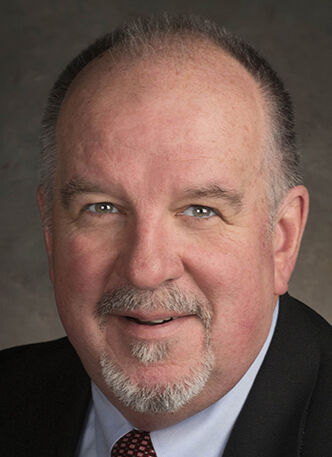
State efforts to reduce wildfire risk through increased cooperation and mitigation efforts in San Mateo County are increasing, with the California Fire Safe Council appointing former San Mateo Fire Chief Brian Kelly as Fire Safe county coordinator to help organize efforts.
Kelly is the former chief of the San Mateo Fire Department and retired in 2007 after a long career. As coordinator, he is responsible for centralizing, overseeing, coordinating and implementing wildfire mitigation efforts within the county for the Fire Safe Council. His position was created as part of a county-level wildfire prevention program in 24 counties. The California Fire Safe Council works with stakeholders like community leaders, governmental agencies, and corporations to educate residents on wildfire dangers. It is a project of the California Department of Forestry and Fire Protection, known as Cal Fire.
Key stakeholder agencies include San Mateo County Parks, San Francisco Public Utilities Commission, Pacific Gas and Electric, Cal Fire and Caltrans. While there is already coordination, Kelly will work to increase cooperation over the 18-month grant program after starting in March. For example, if PG&E is fixing infrastructure near the Crystal Springs Watershed, which SFPUC is in charge of, Kelly would work to ensure SFPUC is aware and coordinating with PG&E.
“The objective is to work with all the disparate groups that are providing some level of fire mitigation and fire prevention activities in the county to see that we coordinate our activities to get the best bang for the buck,” Kelly said.
The Fire Safe Council takes grants from federal agencies and distributes them to local Fire Safe Councils. The San Mateo County Fire Safe Council has applied for a $2.6 million grant for fuel reduction on either side of Highway 35 for 25 miles. It hopes to hear in the next couple of months. The reduction would remove the most dangerous debris from the route if residents were forced to flee during a fire.
Another county project is installing wildlife cameras throughout vulnerable areas. The cameras would identify smoke and send an alert to monitors, who could then determine the fire’s location as early as possible. While some are now up, the county must still set up a significant number throughout the county. Local organizations are also working to help create and educate people about defensible spaces. Kelly will also work on agency coordination of fuel reduction, like removing eucalyptus trees, which are nonnative species and expensive to remove. While removing all fire fuels is impossible, removing some can significantly reduce risk.
Recommended for you
California is investing in wildfire mitigation through more mutual aid resources, grants to local agencies, vegetation management projects and supporting evacuation planning. Last year, County Parks made plans to reduce wildfire fuel loads across more than 1,800 acres of land of critical concern. Cities like San Bruno are preparing high-risk areas like Crestmoor Canyon, a 76-acre area home mostly to eucalyptus trees, for fire through tree and vegetation removal.
Most targeted areas are roughly west of Interstate 280, which has become gradually drier over the years, resulting in increased fire danger for communities. The increased risk of wildfires has changed how fires burn, ignite and spread, creating more difficulties protecting people and property. San Mateo County is approximately 476,000 acres, with 110,000 considered a high severity zone for wildfires, mainly on the west side of Interstate 280, Kelly said. Most small communities throughout the mountains are working with Cal Fire and San Mateo County Parks on mitigation projects to reduce fuel lands around vegetation. The main goal is to reduce the fire threat from growing to an unmanageable level, like the CZU Lightning Complex fires in August 2020.
“The increased fire activity level is easily explained due to how we have modified the environment and how the environment has been modified by climate change,” Kelly said.
While there tends to be a focus on small towns east of Interstate 280, he said San Mateo, Belmont, San Carlos, Redwood City and Atherton all face increased wildfire danger.
“They all have significant wildlands fuel issues,” Kelly said. “They are different from one to the other, but they have a significant threat there.”
Keep the discussion civilized. Absolutely NO
personal attacks or insults directed toward writers, nor others who
make comments. Keep it clean. Please avoid obscene, vulgar, lewd,
racist or sexually-oriented language. Don't threaten. Threats of harming another
person will not be tolerated. Be truthful. Don't knowingly lie about anyone
or anything. Be proactive. Use the 'Report' link on
each comment to let us know of abusive posts. PLEASE TURN OFF YOUR CAPS LOCK. Anyone violating these rules will be issued a
warning. After the warning, comment privileges can be
revoked.
Please purchase a Premium Subscription to continue reading.
To continue, please log in, or sign up for a new account.
We offer one free story view per month. If you register for an account, you will get two additional story views. After those three total views, we ask that you support us with a subscription.
A subscription to our digital content is so much more than just access to our valuable content. It means you’re helping to support a local community institution that has, from its very start, supported the betterment of our society. Thank you very much!







(0) comments
Welcome to the discussion.
Log In
Keep the discussion civilized. Absolutely NO personal attacks or insults directed toward writers, nor others who make comments.
Keep it clean. Please avoid obscene, vulgar, lewd, racist or sexually-oriented language.
Don't threaten. Threats of harming another person will not be tolerated.
Be truthful. Don't knowingly lie about anyone or anything.
Be proactive. Use the 'Report' link on each comment to let us know of abusive posts.
PLEASE TURN OFF YOUR CAPS LOCK.
Anyone violating these rules will be issued a warning. After the warning, comment privileges can be revoked.