
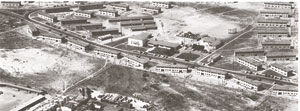
South San Francisco, "The Industrial City,” was well-prepared to take on the challenge of supplying ships and food for World War II. It had constructed ships during World War I and would now continue to do it. The meat-packing plants would supply a great deal of meat products for the soldiers overseas. Numerous other businesses contributed greatly to the war effort.
However, an enormous number of men and women would be needed to fire the furnaces and pack the meat in these plants. The response to the needs of World War II on the Peninsula created an excessive demand on housing and shipyards in South San Francisco. The city would eventually demand over 10,000 workers. EiMac electronics in San Bruno, where tubes were made for radar, almost matched those numbers of needed personnel. The Tanforan Naval Base had to have housing for their dependents and there were many other smaller war production sites that employed thousands of workers. In 1940, there were 6,445 people living in South San Francisco. In 1942, the population had increased to 7,814 — 1,300 new residents. San Bruno had a population of approximately 4,000 in 1940 and, by 1945, it was up to 15,000.
South San Francisco had a large open field south of the Colma Canal that could be used for housing so the South San Francisco housing Authority authorized 720 units of housing for 4,200 people to be built in this vacant area (Spruce Avenue did not connect from Railroad Avenue to El Camino Real at this time). This housing development was to be called Lindenville as it was reached by Linden Avenue. These buildings were wooden two-story army-type barracks that would house four families (units) each. The buildings needed to be built quickly so minimal foundations were poured. The barracks were built inexpensively with only quickly put-up 2-by-4s with tar paper and stucco construction to keep out the weather. This type of construction made the units cold in the winter and hot in the summer. As was attested to me by Ray Zuniga and Danny Collier, two youth that lived in Lindenville, the units were totally utilitarian with absolutely no frills. There was a recreation/auditorium building for the kids, a preschool and nine barracks that served as an elementary school. A large central area surrounded by the 50 to 60 barracks was developed as a baseball field. Clothes lines were furnished to hand out the washing that could be done at a Laundromat next to the recreation building. Groceries could be bought by peddlers or a trip to Grand Avenue. The nature of the community developed a special esprit de corps in the families of Lindenville that had been thrown together by the war. Lindenville initially housed 1,700 people but it eventually grew to over 4,000. Due to the great influx of people from around United States to help with the war effort, the housing units had to shelter a great number of diverse individuals. Many black people had answered the call and the Housing Authority made available shelter for over 200 in five barracks. In 1943, the Peninsula’s chapter of the NAACP sued the housing authority for racial segregation because they were housed in five buildings at one corner of the project and they felt this to be unfair.
On the southern border of South San Francisco and San Bruno, the Lombardi Farm site on San Mateo Avenue (the northern most San Bruno border along Interstate 380), Cape Esperance Naval Housing for 1,200 people was built in 1954.
Another naval housing area was built on the site where the Bay Hill Shopping Center in San Bruno is today. The large number of metal Quonset Huts was built that eventually expanded across what is now developed as San Bruno Avenue. This was called Homaja Naval Housing. Cherry Avenue did not extend to this property. So, a road was built from the officer billets along El Camino to this western section.
Along Seventh Avenue in Belle Air, San Bruno, was built 150 defense homes by the Green Brothers of San Bruno. The cost of these homes about $4,000, and they were to be sold to defense workers. In addition to the housing, there were a number of apartment/room units built for the air personnel from San Francisco Airport. The U.S. Army Air Force had taken over San Francisco and they practiced air maneuvers here throughout the war.
Recommended for you
In addition, in South San Francisco, there was built housing called Industrial Village for low-income housing. This housing consisted of 152 units.
To the north of Tanforan Race Track, Homaja Naval Housing was constructed. These units took up the space between approximately Noor Avenue to Spruce Avenue.
Lindenville was turned over to the city of South San Francisco in 1955 and it was demolished in 1958. Victory Avenue is approximately the northern limit of the housing with Maple Avenue the eastern boundary. To the west, the boundary was the railroad tracks. Many of the barracks were razed or sold for industrial use in the area and a few are still being used for businesses.
Rediscovering the Peninsula by Darold Fredricks appears in the Monday edition of the Daily Journal.







(0) comments
Welcome to the discussion.
Log In
Keep the discussion civilized. Absolutely NO personal attacks or insults directed toward writers, nor others who make comments.
Keep it clean. Please avoid obscene, vulgar, lewd, racist or sexually-oriented language.
Don't threaten. Threats of harming another person will not be tolerated.
Be truthful. Don't knowingly lie about anyone or anything.
Be proactive. Use the 'Report' link on each comment to let us know of abusive posts.
PLEASE TURN OFF YOUR CAPS LOCK.
Anyone violating these rules will be issued a warning. After the warning, comment privileges can be revoked.