
Anthony Harbor has a job interview today.
He is a little nervous about his interview, though, considering he spent 18 months in state prison until his release a month ago.
The 36-year-old is currently living in clean-and-sober transitional housing at a place called the Centre’ in Redwood City and is learning to be patient.
"Not having a job can be frustrating,” Harbor told about 20 people at a support group meeting yesterday through Service Connect, San Mateo County’s response to prison realignment.
The state moved last year to transfer responsibility for supervising low-level felons to counties and about 140 of them have been served locally by the county’s probation department and Human Services Agency.
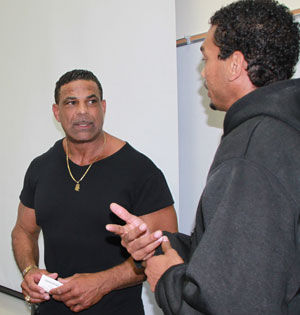
Yesterday, the support group had a special speaker, Eason Ramson, meant to motivate and inspire the former prison inmates to not give up on life by sharing his own story.
Ramson was a two-strike felon facing a 35-to-life sentence for petty theft when he reached out to an old friend for help.
Having an intense cocaine addiction, Ramson had isolated himself from friends and family and even tried to kill himself by overdosing on drugs.
His friend, William "Bubba” Paris, pleaded with Ramson’s judge in 1999 to give him a lighter sentence considering all the good he had done in his life.
Paris and Ramson were old teammates on the San Francisco 49ers in the early 1980s, when winning Super Bowls was the norm.
Paris told the judge of Ramson’s incredible generosity by helping the homeless and disadvantaged.
Ramson had become so sick with addiction, however, he wasn’t even sure Paris was actually speaking about him.
"He described a compassionate man to the judge — a man I didn’t know anymore,” Ramson told the former inmates yesterday.
Paris told his old friend to "get on your knees and pray for a miracle.”
That was 20 years after Ramson was first drafted into the NFL by the St. Louis Cardinals.
He had never tried cocaine before the day he was actually told he made that squad.
"That night, some of my teammates offered me cocaine, calling it the ‘rich man’s drug,’” he told the support group.
The team would party hard after a win, he said.
The tight end was traded to the 49ers the next year and he went on to win San Francisco’s first Super Bowl in 1981, wearing No. 80.
The Niners won 16 games that year and Ramson did a lot of partying.
He was traded away from the Niners just before the team won its second Super Bowl. By the time his NFL career ended, his cocaine habit was $1,000 a day.
Recommended for you
It was not long after retirement, however, that Ramson’s money dried up and he turned to crime to support his addiction. He would rob people at ATM machines to support his addiction, he told the group.
"I would do whatever to get the drug. All I cared about was my drug,” he said.
He spent a total of 10 years incarcerated before writing a letter to Walden House from his jail cell. Walden House is a San Francisco nonprofit that helps rehabilitate drug addicts.
Later this month, Ramson will celebrate 13 years of sobriety as he approaches his 56th birthday.
"My mother used to tell me, ‘the people you hang around with are the people you become like,’” he said.
He learned in Walden House to, he said, "keep it simple. Life is not deep as long as you love yourself.”
His story brought tears to some of the former inmates, many who had also grappled with addiction. He spent about two hours with the group, signing autographs and posing for pictures when he was done.
After he left the group, some of the other inmates shared their stories and concerns about transitioning back to normal life. Many had been in the state’s parole system before realignment.
Rodrigo Ponce, 32, was released from state prison in December.
While on parole previously, Ponce said he was "almost on his own” with little contact or oversight from his parole officer.
Through the county’s Service Connect, he is now employed and volunteers his time to help newly-released inmates.
"They have helped me find the right direction,” he said about the people who work for Service Connect. "They made me feel like I was a good person.”
Clarence Jacks used to stare at his prison cell wall for 22 hours a day.
Jacks, 46, spent the better part of 30 years incarcerated until his release April 12.
He was in and out of prison for more than 10 years and had little success under the state’s parole system as he was repeatedly arrested.
"This is the first time I’ve been helped,” he said about Service Connect. "I was not expecting this level of support.”
Debra Lee Torres is the director of Service Connect and relies heavily on volunteers such as Pastor Andre Harris, a former inmate himself, to assist the group.
"We need each other. It is lonely out there but you are not alone,” Harris told the group at the conclusion of the meeting.
The HSA program provides the formerly incarcerated with services to help them reenter the community, such as finding work, housing and support for mental health and health services. The county expects to have a few hundred more low-level offenders released from state prisons back into local care this year and got $4.2 million from the state to fund the program.
The aim of Service Connect is to provide the former inmates with the tools they need to survive in society and keep them from ending up back in prison.
Bill Silverfarb can be reached by email: silverfarb@smdailyjournal.com or by phone: (650) 344-5200 ext. 106.










(0) comments
Welcome to the discussion.
Log In
Keep the discussion civilized. Absolutely NO personal attacks or insults directed toward writers, nor others who make comments.
Keep it clean. Please avoid obscene, vulgar, lewd, racist or sexually-oriented language.
Don't threaten. Threats of harming another person will not be tolerated.
Be truthful. Don't knowingly lie about anyone or anything.
Be proactive. Use the 'Report' link on each comment to let us know of abusive posts.
PLEASE TURN OFF YOUR CAPS LOCK.
Anyone violating these rules will be issued a warning. After the warning, comment privileges can be revoked.